TL;DR:
- Fewer than 2% of African SMEs have basic online assets like websites.
- Building an online presence includes a website, Google profile, social media, and reviews.
- Overcoming misconceptions and starting with free tools can significantly boost visibility.
Fewer than 2% of African businesses have the basics covered online. That means only 1.8% of African SMEs operate owned digital assets like professional websites, which is a staggering gap when you consider how many customers now search for local businesses before they ever pick up the phone. For South African SME owners, this gap is both a warning and an opportunity. If your competitors are not online, you have a genuine chance to lead your local market. This guide will walk you through what online presence really means, why it matters more than ever in 2026, what barriers to watch for, and exactly how to start building yours today.
Table of Contents
- What does online presence mean for South African SMEs?
- Why online presence is a business game changer in 2026
- Common barriers to building a strong online presence
- Practical steps to improve your online presence in South Africa
- Why most SMEs overlook the power of online presence
- Enhance your online visibility with proven SEO solutions
- Frequently asked questions
Key Takeaways
| Point | Details |
|---|---|
| Online presence matters | Maintaining a visible digital profile helps South African SMEs build trust and attract local customers. |
| Asset gap slows growth | Most SMEs lack basic digital assets like websites, which hampers their effectiveness in digital marketing. |
| Actionable steps available | Simple tactics and affordable tools empower SMEs to enhance their visibility even with limited budgets. |
| Overcoming barriers | Identifying and addressing common misconceptions and constraints can kickstart greater digital adoption. |
What does online presence mean for South African SMEs?
The phrase “online presence” gets used loosely, but it has a very specific meaning for your business. In simple terms, your online presence is the collection of digital touchpoints where potential customers can find, learn about, and engage with your business on the internet. It is not just one thing. It is a layered system of assets that work together to make you visible, credible, and accessible.
The most important components of a solid online presence include:
- A professional website: This is your owned digital property. Unlike social media platforms, you control it completely. It holds your services, your contact details, your story, and your credibility.
- A Google Business Profile (formerly Google My Business): This listing places your business on Google Maps and in local search results. When someone searches for a plumber in Cape Town or a bakery in Sandton, this is what gets them to you.
- Social media profiles: Platforms like Facebook, Instagram, and LinkedIn give you reach, social proof, and a way to stay top of mind for existing and potential customers.
- Local business listings: Directories like Yellow Pages South Africa, Brabys, and industry-specific platforms add more places where customers can discover you.
- Online reviews and ratings: Your reputation on Google, Hellopeter, or Facebook reviews shapes how new customers perceive you before they even make contact.
Each of these components plays a different role. A website builds credibility. A Google listing drives foot traffic and calls. Social media keeps you human and relatable. Reviews close the trust gap. None of them work as well alone as they do together.
What is striking about the South African SME landscape is how many businesses skip the foundational step. Research shows that many SMEs lack foundational digital assets like professional websites, which means they are essentially invisible to anyone searching online. This is a critical problem when you consider that the majority of consumers now turn to Google before making any purchase or booking decision.
Understanding the SEO challenges for SMEs in South Africa helps explain why this gap persists. Many business owners are focused on the day-to-day, and digital investment feels like a luxury. But this is exactly the mindset that keeps small businesses stuck in the slow lane.
| Component | What it does | Cost to start |
|---|---|---|
| Professional website | Builds credibility, holds all key information | Low to medium |
| Google Business Profile | Drives local search and map visibility | Free |
| Social media profiles | Builds community and engagement | Free |
| Local listings | Expands discoverability on directories | Free to low |
| Online reviews | Builds trust and conversion | Free |
The point is not that you need to do everything at once. The point is that each layer you add makes your business easier to find, more trustworthy, and more competitive. Even digital marketing for SMEs at a basic level starts with getting these foundational pieces in place.
Pro Tip: Start with your Google Business Profile if you have nothing else. It is free, it takes less than an hour to set up, and it immediately puts your business on the map for local searches. You can build from there.
A business without any of these components is like a shop with no signage in a city full of search engines. People walk right past it, not because they do not need what you offer, but because they simply cannot see you.
Why online presence is a business game changer in 2026
Now that you understand the basics, let us explore why online presence matters so much for growth, especially right now.
South Africa’s digital economy has grown significantly over the past few years. Mobile internet access has expanded, more consumers are comfortable making purchasing decisions online, and local search behaviour has matured. People are not just Googling things for fun. They are searching with intent. They want to find a business, call them, visit them, or buy from them. If you are not showing up in that search, you are losing that customer to someone who is.
“Online presence is not equally resourced, and many SMEs lack the foundational digital assets they need to compete.” Research continues to highlight this visibility gap among African SMEs, making the case that those who act now have the clearest path to standing out.
Consider what happens when a potential customer cannot find your business online. They move on to the next result. They might find a competitor with a polished website, dozens of positive reviews, and a well-optimised Google listing. Even if your service is better, your invisible competitor just won that customer. This is the real cost of a weak online presence.
Here is what a strong online presence actually does for your business:
- Builds instant credibility: A professional website signals that you are a legitimate, established business. Without one, many customers assume you are either too small to be reliable or not serious about your service.
- Attracts local customers actively searching for you: Local SEO makes your business appear in “near me” searches. These are high-intent queries from people who are ready to spend money right now.
- Reduces your cost per acquisition: Organic search traffic costs nothing per click once your presence is established. Compared to paid advertising, this provides long-term value at a fraction of the ongoing cost.
- Supports word-of-mouth with digital proof: When someone recommends your business, the first thing the recipient does is Google you. If they find a strong profile, reviews, and a website, your word-of-mouth referral is confirmed and the sale is more likely to close.
- Allows you to compete with larger brands: A well-optimised local presence allows a small business in Pretoria to outrank a large national chain for searches that matter in that specific area.
The local SEO challenges that many SMEs face are real, but they are not insurmountable. Understanding local search algorithms, knowing how Google evaluates relevance and proximity, and keeping your listings accurate are all practical steps you can take without a massive budget.
Why 2026 is a pivotal year for South African SMEs
The pace of digital adoption in South Africa has accelerated. Consumers across age groups and income levels are relying more heavily on their smartphones to find local services. Load-shedding recovery, improved infrastructure, and affordable data have combined to make the internet more accessible to more South Africans than ever before. This means the pool of potential online customers is growing every month.
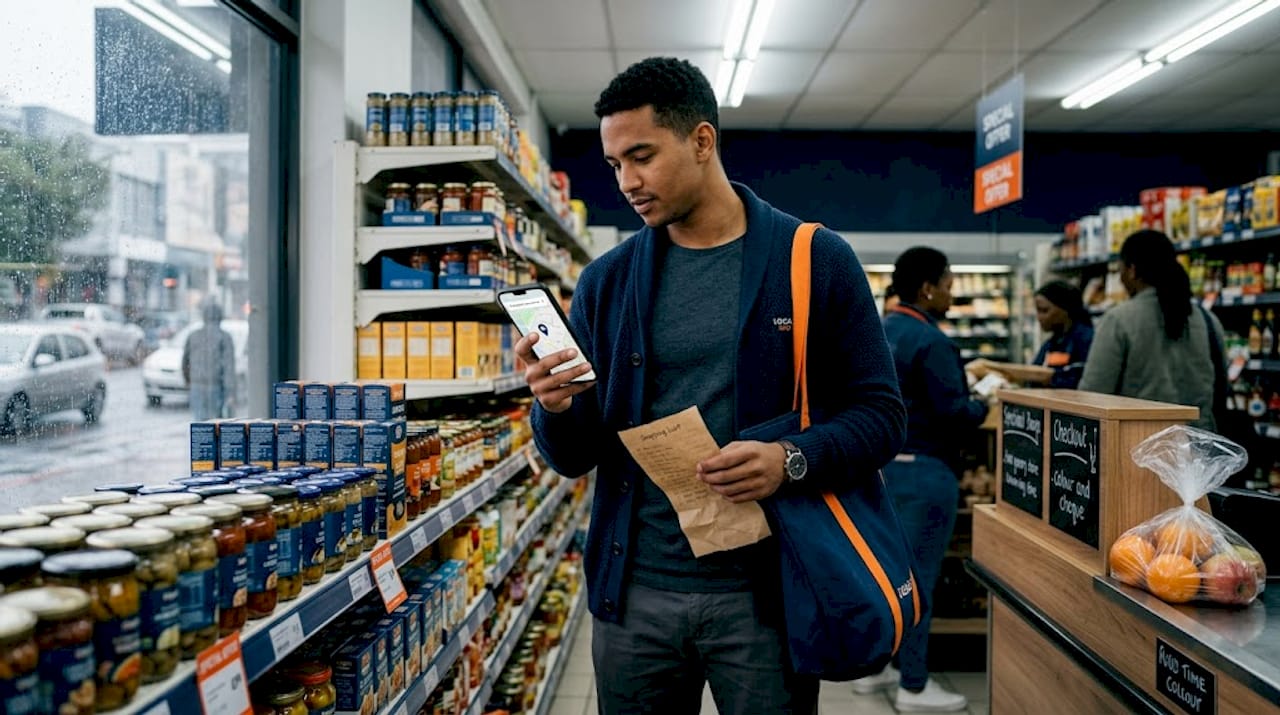
Working with an experienced SEO specialist can help you move faster, but even starting with the basics puts you ahead of the significant portion of businesses that have not started at all. The window of competitive advantage for early movers in local search is still very much open. The question is whether you are going to step through it.
Understanding local business SEO for SMEs gives you the strategic knowledge to make informed decisions about where to invest your limited time and money. The businesses seeing the best results are not necessarily those with the biggest budgets. They are the ones that show up consistently, update their information regularly, and build trust over time.
Common barriers to building a strong online presence
Having seen the benefits, let us look at what holds many businesses back from achieving online visibility. Because the barriers are real, and pretending they do not exist does not help anyone.
The research is clear. Only 1.8% of African SMEs operate basic owned digital assets such as professional websites. That number tells a story about systemic challenges, not just individual choices.
The most common barriers facing SA SMEs include:
- Perceived cost: Many business owners believe that a professional website costs tens of thousands of rands. The reality is that affordable options exist, from simple website builders to cost-effective local agencies that specialise in SME packages.
- Lack of technical knowledge: Setting up a website or optimising a Google listing feels overwhelming if you have never done it. This is understandable, but it is also a surmountable challenge with the right guidance.
- Time constraints: Running a small business is all-consuming. Digital marketing tasks often get pushed to the back of the queue because they feel less urgent than serving existing customers.
- Misconception that social media is enough: Many SMEs assume that having a Facebook page covers all the bases. It does not. Social media is a tool for engagement, not a substitute for a website or Google presence.
- Distrust of digital marketing: Some business owners have tried digital marketing and seen little return. Usually, this is because common SEO mistakes were made early on, not because digital marketing itself does not work.
| Barrier | SA reality | Global comparison |
|---|---|---|
| Budget constraints | Very high among micro-businesses | Moderate, with more support structures |
| Technical skills gap | Significant, especially in smaller towns | Narrowing due to online education |
| Social media reliance | Very high, often misused as a website replacement | High, but better supplemented with websites |
| Agency trust issues | Common due to past bad experiences | Present globally, but stronger oversight |
| Time availability | Severe for owner-operators | Similar, but more access to help |
The myth that social media alone is enough is one of the most damaging misconceptions we see. Facebook and Instagram are platforms you rent, not own. If the algorithm changes, your visibility disappears. If the platform loses popularity, so does your reach. Your website is the one digital asset you own outright, and that ownership matters for long-term stability.
How do you prioritise when resources are limited? The answer lies in sequencing.
- Claim and complete your Google Business Profile first. It is free and high-impact.
- Build a simple, mobile-friendly website. Even a single-page site beats nothing.
- Choose one or two social platforms relevant to your audience and use them consistently.
- Start gathering reviews from satisfied customers. Ask directly and make it easy.
- List your business on free South African directories to expand your digital footprint.
Pro Tip: Before paying for any paid advertising, make sure your owned digital assets are in place. Running ads to a business with no website or outdated information is like pouring water into a cracked bucket. Fix the foundation first, then amplify with local SEO optimization and paid campaigns.
Barriers are real. But they are not permanent. Every one of them has a practical workaround, and the businesses that find those workarounds are the ones growing their customer base while their competitors are still debating whether to get a website.
Practical steps to improve your online presence in South Africa
It is time to turn insight into action. Here is how you can strengthen your online visibility starting today, even if you are working with a tight budget and limited time.
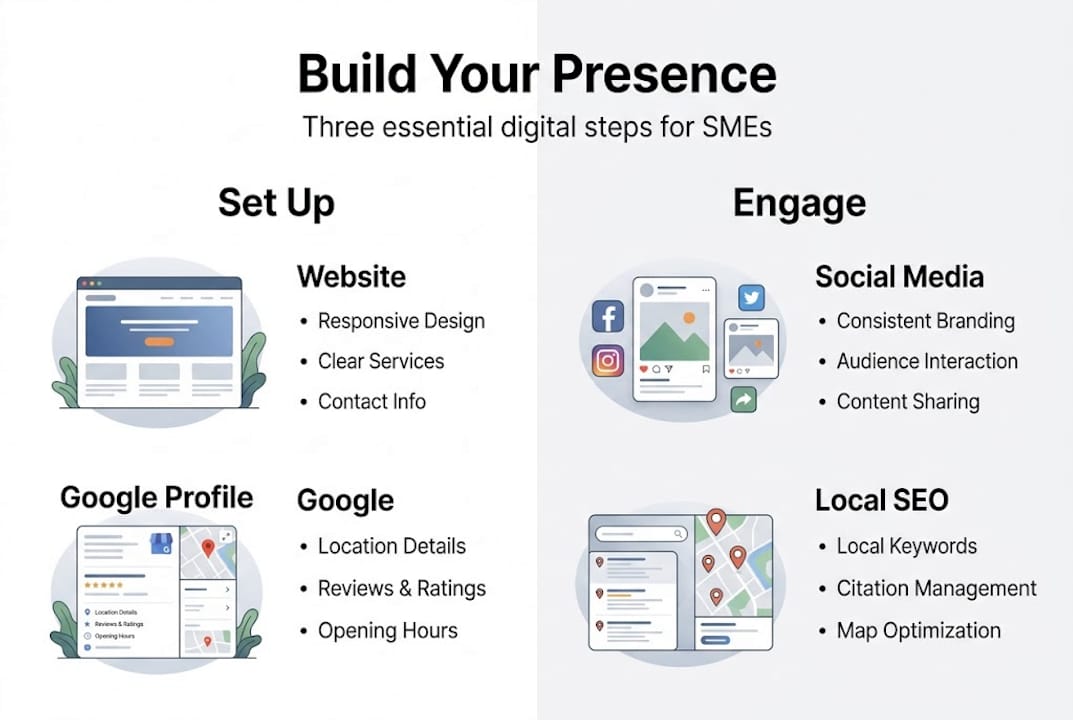
Visibility campaigns are hindered when SMEs lack foundational digital assets, which means the single most impactful thing you can do right now is put those assets in place. Here is a practical sequence to follow:
Step 1: Claim your Google Business Profile
Go to Google and search for your business name. If a profile exists, claim it. If not, create one. Fill in every field: address, phone number, website, business hours, category, and a compelling description. Add photos of your premises, products, or team. This single step can result in your business appearing in local map searches within days.
Step 2: Build a mobile-friendly website
South Africa has very high mobile internet usage. Your website must work perfectly on a smartphone. Use platforms like WordPress, Wix, or Squarespace to start. Focus on these essentials:
- Clear description of what you offer and where you operate
- Contact details prominently displayed
- A call to action on every page (call us, book now, get a quote)
- Fast loading speed (aim for under 3 seconds)
- Basic SEO setup including relevant local keywords in your page titles and descriptions
Step 3: Set up your social media presence
Pick one or two platforms. Facebook is still the dominant platform for SMEs in South Africa, particularly for B2C (business to consumer) businesses. LinkedIn works well for B2B. Post consistently rather than abundantly. Three posts per week done consistently beats ten posts per week done sporadically.
Step 4: Implement a local SEO strategy
Local SEO (Search Engine Optimisation) is the practice of making your business visible in location-based searches. A strong local SEO strategy includes:
- Using location-specific keywords naturally in your website content (for example, “accounting services in Johannesburg”)
- Building local citations by listing your business consistently across directories
- Earning backlinks from local South African websites, newspapers, or business associations
- Encouraging and responding to Google reviews regularly
Step 5: Use free and affordable tools to track progress
You cannot improve what you do not measure. These local SEO tools give you visibility into how your online presence is performing:
- Google Search Console: Shows you what search terms people use to find you and how you rank
- Google Analytics: Tracks how many people visit your website, where they come from, and what they do
- Google Business Profile Insights: Shows how many people found your listing, called you, or asked for directions
Pro Tip: Set aside 30 minutes every week to review your Google Business Profile performance. Respond to new reviews, update your photos, and check whether your contact details are still accurate. Consistency here is more valuable than occasional big efforts.
Practical budget breakdown for getting started:
- Google Business Profile: Free
- Basic website (using a website builder): R150 to R500 per month depending on the platform
- Domain name registration: R100 to R200 per year
- Directory listings: Mostly free for basic listings
- Social media management: Free if you do it yourself
You do not need a large budget to start. You need a plan, consistency, and a commitment to showing up online the same way you show up for your customers in person.
Why most SMEs overlook the power of online presence
Here is something that most digital marketing articles will not tell you. The biggest barrier to online visibility for South African SMEs is not budget, and it is not technical skill. It is mindset.
Most SME owners we work with understand, in theory, that they should be online. They know a website matters. They have heard about Google listings. But understanding and acting are two very different things. What keeps businesses stuck is a deeply ingrained belief that digital is complicated, expensive, or not really relevant to their specific customers.
This belief is almost always wrong, but it persists because it has never been seriously challenged. Conventional wisdom says digital marketing is for big brands with marketing teams. The reality we see on the ground in South Africa is that local SEO’s impact is often felt most dramatically by small businesses, precisely because the competition at the local level is so weak. A small accounting firm in Bloemfontein that optimises its Google listing properly can dominate search results in that city within months, not years.
The SMEs that thrive digitally are not the ones with the flashiest websites. They are the ones that commit to showing up online consistently, treating their digital presence with the same seriousness as their physical premises. They update their hours during holidays. They respond to every review, positive and negative. They add new photos regularly. These small actions compound over time into genuine market authority.
The mindset shift required is simple but profound: stop thinking of your website as a brochure and start thinking of it as your hardest-working employee. It is open 24 hours a day, answers questions before you have to, and convinces strangers to trust you before they ever speak to you. That is a powerful asset, and it deserves real investment.
Enhance your online visibility with proven SEO solutions
Building a strong online presence can feel like a lot to take on when you are running a business on your own or with a small team. The good news is that you do not have to figure it all out by yourself.
At Local SEO Agency, we specialise in helping South African SMEs close the digital visibility gap with practical, results-driven strategies tailored to your local market. Whether you need help building local SEO strategies that get you found in Google searches, or you want expert support with local listings optimization to make sure your business shows up accurately across all the places your customers look, we have the tools and the experience to move the needle for your business. Our local SEO services are designed to deliver real, measurable growth for businesses just like yours. Reach out today for a free consultation and let us build your visibility together.
Frequently asked questions
Why is online presence important for South African SMEs?
Online presence helps SMEs attract local customers, build trust, and compete more effectively in their area. With only 1.8% of African SMEs operating basic digital assets, the opportunity for those who act is enormous.
What digital assets are essential for small businesses?
A professional website, Google Business Profile, and active social media profiles form the foundation of a strong online presence. Research confirms that many SMEs lack these foundational digital assets, which puts them at a significant competitive disadvantage.
How can SMEs improve their online presence on a tight budget?
Start with Google My Business (free), add a simple mobile-friendly website, and use consistent local keywords. As the research highlights, visibility campaigns are hindered most by the absence of these basic assets, so getting the foundations right costs very little and delivers outsized returns.
What is the main barrier to online visibility for African SMEs?
The primary barrier is the absence of foundational digital assets, particularly professional websites. Without these, even well-run local visibility campaigns cannot reach their full potential, leaving businesses invisible to customers who are actively searching for them online.