

TL;DR:
- Google’s ranking depends on hundreds of interconnected signals, not just keywords.
- Local SEO factors like Google Business Profile and reviews are vital for South African SMBs.
- Prioritize content relevance, technical SEO, and local signals for effective search visibility.
If your first instinct when thinking about SEO is to stuff your pages with keywords, you are not alone. Most South African business owners start there. But Google’s ranking system is far more layered than that. Your website’s position in search results depends on hundreds of signals working together, from how fast your pages load to whether your business details are consistent across the web. For small to medium-sized businesses (SMBs) in South Africa, understanding these factors is not just useful, it is essential. The businesses that rank well are not the ones who guessed right on keywords. They are the ones who built a strategy around how Google actually works.
Table of Contents
- The core factors that impact website ranking
- Content quality and search intent: why relevance matters most
- Technical SEO: building a foundation for ranking
- Local signals: what matters for South African SEO
- What most guides miss: SEO in South Africa demands a local-first mindset
- Take your next step with proven SEO solutions
- Frequently asked questions
Key Takeaways
| Point | Details |
|---|---|
| SEO rankings are multi-factor | Website ranking depends on content, technical, and local factors working together. |
| Match search intent | Creating relevant, trustworthy content is the #1 way to win in Google. |
| Local signals matter | Google Business Profile, NAP, and reviews are critical for South African businesses. |
| Technical basics are vital | Mobile-first, HTTPS, and Core Web Vitals ensure your site doesn’t get penalized. |
| Track results monthly | Always measure traffic, rankings, and conversions—not just your position in search. |
The core factors that impact website ranking
There is a common misconception that SEO is a single lever you can pull. In reality, SEO ranking factors span hundreds of signals, and Google does not rely on any one of them in isolation. It uses interconnected systems to evaluate your site as a whole. That shift in thinking, from “what keyword do I target” to “how does my entire website serve users,” is what separates businesses that rank from those that stay invisible.
One of the most important frameworks Google uses is called E-E-A-T. It stands for Experience, Expertise, Authoritativeness, and Trustworthiness. Core ranking factors include content quality and relevance to search intent, demonstrated through E-E-A-T. This means Google is looking at whether your content proves real-world knowledge, whether other credible sites reference you, and whether users can trust what you publish. For an SMB in Johannesburg or Cape Town, this matters as much as it does for a global brand.
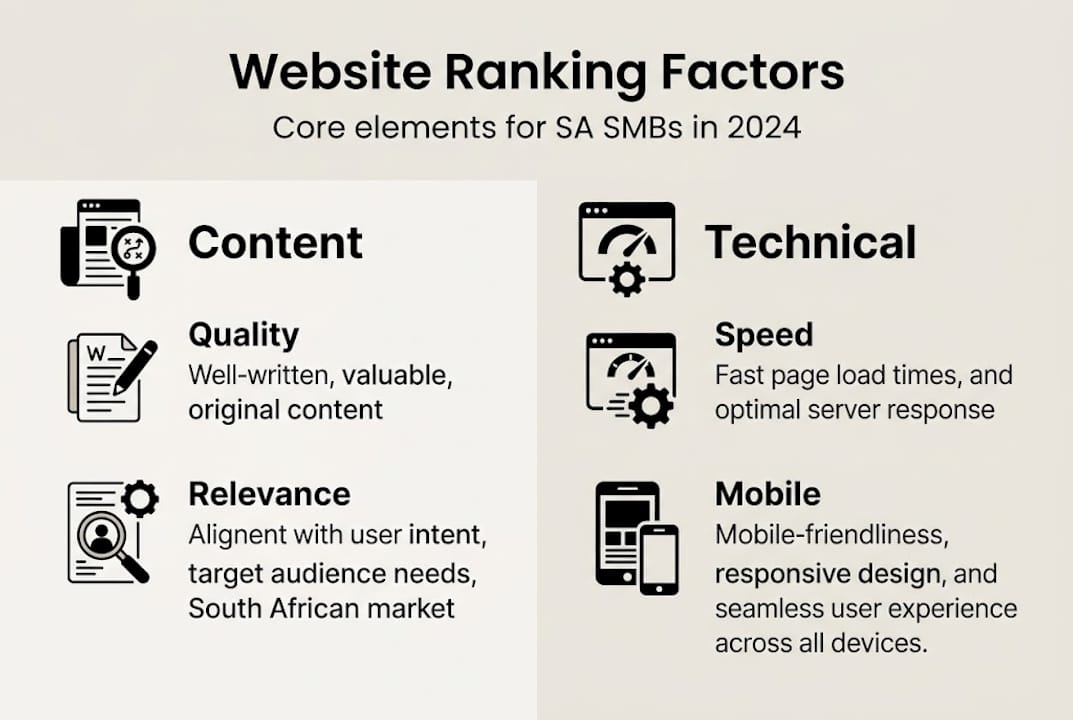
Google confirms over 200 signals but emphasises systems over isolated factors. That means you should not obsess over any single metric. Instead, focus on building a well-rounded digital presence. Here are the main categories of ranking factors every South African business owner should know:
- Content factors: relevance, depth, originality, and alignment to what users are actually searching for
- Technical factors: site speed, mobile-friendliness, HTTPS security, and crawlability
- Local factors: Google Business Profile, consistent contact details, and local reviews
- Link-related factors: the quality and relevance of websites that link to yours
To put this in perspective, here is how these three core categories compare at a glance:
| Factor category | What it affects | Priority for SA SMBs |
|---|---|---|
| Content quality | Relevance, trust, click-through rates | High |
| Technical SEO | Crawling, speed, user experience | High |
| Local signals | Map pack rankings, local visibility | Critical |
Working with experienced South African SEO companies means getting a strategy that covers all three categories, not just one. The most effective SEO plans treat these factors as a system, not a checklist.
Content quality and search intent: why relevance matters most
With core factors mapped, let’s go deeper into why content, when aligned to search intent and quality, drives real results. You could write the most beautifully crafted article in the world, but if it does not answer what your potential customer is actually searching for, Google will not rank it. Search intent is the “why” behind a query. Someone searching “best plumber in Pretoria” wants a local service provider, not a blog about plumbing history.
This distinction matters enormously for South African SMBs. Local queries often carry high commercial intent. A person typing “accounting firm Cape Town” is likely ready to make contact. Your content needs to match that intent directly by featuring your services, your location, and proof that you can deliver.
Content quality and relevance to search intent, demonstrated through E-E-A-T, is one of Google’s primary ranking drivers. So how does a small business demonstrate expertise without a massive content team? Start with what you know. Write service pages that explain your process. Add a FAQ section based on real client questions. Publish case studies showing real outcomes. These are all signals of genuine experience.
“Google rewards content that proves real expertise and builds real trust. For South African businesses, that means showing your local knowledge, your credentials, and your results, not just filling pages with words.”
For boosting online visibility in a competitive local market, the types of content that consistently perform well include:
- Service pages with clear descriptions, locations served, and calls to action
- Local guides answering questions specific to your city or industry in South Africa
- Case studies showing before-and-after results for real clients
- Customer reviews embedded on your site to build social proof
- Blog posts addressing common questions your target customers are asking right now
Pro Tip: Set a reminder to review your top-performing pages every three months. Update statistics, refresh examples, and add new information. Google notices when content is actively maintained, and it rewards that effort with improved rankings over time.
For those thinking about maximizing SEO impact across their site, understanding E-E-A-T is the first step. Once you understand what Google is looking for, building content that satisfies it becomes a clearer process. The goal is to be the most useful, credible result for the people you serve.
Technical SEO: building a foundation for ranking
Content is crucial, but technical elements can make or break your rankings, especially in South Africa’s mobile-first landscape. Think of technical SEO as the foundation beneath your content. Even the most relevant, well-written page will struggle to rank if Google cannot crawl it efficiently, or if it takes six seconds to load on a mobile device.

Technical factors like HTTPS, mobile-friendliness, and Core Web Vitals are confirmed direct ranking signals. Let’s break these down simply. HTTPS means your site uses a security certificate. It protects user data and signals trustworthiness to both Google and your visitors. If your URL still starts with “http://” rather than “https://”, fixing that is your first priority.
Core Web Vitals are a set of three speed and usability measurements Google uses to evaluate user experience:
- LCP (Largest Contentful Paint): How long it takes for the main content on a page to fully load. Aim for under 2.5 seconds.
- INP (Interaction to Next Paint): How quickly your site responds when a user taps or clicks something. Under 200 milliseconds is the target.
- CLS (Cumulative Layout Shift): Whether your page elements move around unexpectedly while loading. A score below 0.1 is ideal.
Here is a simple action plan to improve your technical foundations:
- Switch to HTTPS if you have not already, using an SSL certificate from your hosting provider.
- Test your site on a mobile device and fix any layout or navigation issues.
- Compress large images before uploading them to reduce page load time.
- Use Google PageSpeed Insights to identify your specific bottlenecks.
- Ask your developer to enable browser caching and use a content delivery network if your audience is spread across South Africa.
Pro Tip: Google Search Console and PageSpeed Insights are both free. Run your most important pages through them monthly. They will flag technical issues before they silently cost you rankings.
The South African SEO industry context adds an important layer here. Mobile-first is essential in SA due to high mobile usage. Many South Africans access the internet primarily through smartphones, often on data-limited connections. A slow, desktop-heavy site will not just frustrate users. It will actively hurt your ranking.
| Metric | South Africa (estimated) | Global average |
|---|---|---|
| Mobile share of web traffic | ~70% | ~58% |
| Average mobile page load time | 5-7 seconds | 3-5 seconds |
| Users who abandon slow pages | ~53% | ~53% |
If your local SEO insights are pointing to high bounce rates, slow load times are often the culprit. Fixing technical issues first creates the platform everything else is built on.
Local signals: what matters for South African SEO
Once your technical basics are covered, it is time to focus on local signals, the element that gives South African businesses a genuine edge in their own market. Local SEO is not a separate discipline from general SEO. It is a layer on top of it, and for SMBs serving specific cities or regions, it is often the most valuable layer of all.
Local SEO factors like Google Business Profile optimisation, consistent NAP citations, reviews volume and quality, and local links are critical for South African SMBs. Let’s unpack each one.
Google Business Profile (GBP) is your free listing that appears in Google Maps and the local search results pack. If you have not claimed and fully completed your GBP, you are leaving enormous visibility on the table. Fill in every field: your business name, address, phone number, hours, categories, photos, and a description using natural language about what you do and where you operate.
NAP citations refer to the consistent use of your Name, Address, and Phone number across every online directory and website. If your phone number on your website differs from what appears on a directory like Yellow Pages South Africa, Google gets confused and may rank you lower. Consistency builds trust in Google’s eyes.
Here are the essential actions every South African SMB should take to build local authority:
- Claim and fully optimise your Google Business Profile
- Submit consistent NAP details to local directories like Brabys, Yellow Pages SA, and Hotfrog
- Earn backlinks from South African publications, blogs, and industry associations
- Encourage satisfied customers to leave Google reviews
- Add location-specific content to your website, mentioning the areas you serve
Pro Tip: Ask happy clients for a Google review right after a positive interaction. A simple message like “We’d love your feedback on Google” with a direct link to your review page dramatically increases the response rate.
Reviews do double duty. They signal trust to Google and they influence whether potential customers choose you over a competitor. A business with 47 reviews averaging 4.8 stars will almost always outperform one with no reviews, even if the second business has a slightly better website.
For SEO for SMEs in SA that delivers real enquiries, local signals are non-negotiable. They are also one of the fastest areas to improve if you have been neglecting them. A well-thought-out South African SEO strategy will always include a dedicated local component that reflects how your customers actually search.
What most guides miss: SEO in South Africa demands a local-first mindset
Most SEO guides are written for a global audience. They talk about domain authority, link velocity, and schema markup without ever acknowledging that a plumber in Durban has a very different competitive landscape than a software company in San Francisco. That gap in guidance is where many South African SMBs get lost.
Here is the uncomfortable truth: ranking on page one of Google means very little if the traffic coming to your site is not converting into enquiries or sales. We have seen businesses obsess over their keyword rankings while their actual lead pipeline stays flat. The reason is almost always that they are optimising for visibility in the wrong context, chasing national or international terms when their real customers are searching locally.
South Africa’s high mobile usage rate makes this even more acute. Mobile-first tracking of organic traffic, rankings, and conversions monthly against baselines is the only honest way to measure whether your SEO is working.
“A ranking is a vanity metric. A customer enquiry is a business result. Focus on what actually moves money.”
The businesses that win with SEO in South Africa are those that tie their strategy to local context, measure real outcomes, and stay consistent. They also understand that SEO is not a once-off project. If you need help applying all of this in a structured way, the team at SEO services South Africa brings a local-first perspective that generic guides simply cannot offer.
Take your next step with proven SEO solutions
Understanding ranking factors is the first step. Applying them consistently to your specific market is where the real work begins. If you are running a business in South Africa and want to see genuine growth in search visibility, enquiries, and revenue, working with specialists who understand the local landscape makes all the difference.
Our team offers best SEO optimization service packages designed specifically for South African SMBs, covering everything from technical audits to content creation and local signal building. If budget is a concern, explore our affordable SEO options that deliver measurable results without enterprise-level costs. For businesses focused on dominating their local market, our local SEO services are built around exactly the strategies covered in this guide. Request a free consultation and find out where your site stands today.
Frequently asked questions
How does Google decide which websites rank higher?
Google uses over 200 signals including content relevance, technical performance, local factors, and system-based algorithms, evaluating your site holistically rather than on any single metric.
What is the most important SEO ranking factor for South African businesses?
For South African SMBs, local SEO factors like Google Business Profile optimisation, consistent NAP citations, reviews, and local links are the most critical for appearing in relevant local searches.
Does website speed affect my ranking in South Africa?
Yes. Core Web Vitals like LCP, INP, and CLS are confirmed ranking signals, and with South Africa’s mobile-heavy user base, a slow site will cost you both rankings and customers.
How do I track if my SEO is improving?
Track organic traffic, rankings, and conversions monthly and compare against a baseline. Rankings alone are not enough; conversions and enquiries are the real indicators of SEO success.
Recommended
- Understanding search rankings: boost your South African SMB SEO
- How to improve Google rankings: proven SEO steps for SA SMEs
- Website Security and SEO – Why It Matters for SA Business
- Website speed optimization: boost South African business performance
- How SEO drives branding and growth for UK SMEs | Radka Advertising