

TL;DR:
- White label SEO enables South African SMEs to deliver professional SEO services without hiring an in-house team by partnering with external providers. This model offers scalable solutions covering technical audits, content, local SEO, link building, and transparent reporting, tailored to market needs. To succeed, businesses must choose trustworthy providers, understand clear deliverables, and future-proof with AI-ready strategies in a competitive landscape.
Most small and medium South African businesses assume that serious SEO either costs a fortune or demands a full in-house team. Neither is true. White label SEO has quietly changed the rules, making it possible for agencies and even individual consultants to deliver professional, measurable search engine optimisation to clients without hiring a single specialist. This article breaks down exactly how the model works, what services you can expect, how pricing tiers stack up, which red flags to avoid, and how to stay ahead as AI reshapes the search landscape in 2026.
Table of Contents
- What is white label SEO and how does it work?
- Core services you can expect from South African white label SEO providers
- Pricing demystified: what affordable white label SEO really costs
- Risks, red flags, and smart ways to protect your reputation
- What’s next: future-proof SEO with AI-readiness and advanced optimisation
- A fresh perspective: why most SA SMEs underestimate the value and the risks of white label SEO
- Ready to grow? Affordable SEO solutions for your SA business
- Frequently asked questions
Key Takeaways
| Point | Details |
|---|---|
| Scalable SEO for SMEs | White label SEO lets small businesses access agency-level results without hiring a big team. |
| Know your deliverables | Always compare providers based on what’s included, not just on price. |
| Watch for ‘black box’ risks | Transparency and clear reporting are crucial to avoid reputation damage. |
| AI-readiness matters | Choose providers who include advanced AI and structured data strategies to stay ahead. |
What is white label SEO and how does it work?
White label SEO is simpler than the name suggests. Think of it like a bakery that supplies unbranded bread to a supermarket, which then sells it under its own label. The customer interacts only with the supermarket brand. White label SEO works the same way.
As GoTechanic explains, white label SEO is typically structured as a client-facing agency or consultant doing sales and client management while an external provider executes SEO work under the reseller’s or agency’s brand. The client never knows a third party is involved. They just see your branding, your reports, and your communication.
“The power of the model lies in the partnership: one party owns the client relationship, the other owns the execution. Both focus on what they do best.”
For South African SMEs, this model removes a significant barrier. Instead of recruiting, training, and retaining an expensive SEO team, you can offer or access a full suite of SEO services through a trusted provider working behind the scenes. You benefit from expert-level work without the overhead.
Here is what a typical white label SEO arrangement covers:
- Keyword research and strategy, tailored to your target audience and location
- Technical SEO audits, fixing crawl issues, site speed, schema markup, and mobile performance
- On-page optimisation, including meta tags, headings, internal linking, and content structure
- Content creation and planning, from blog posts to landing pages aligned to search intent
- Local SEO, covering Google Business Profile management, local citations, and geo-targeted pages
- Link building and digital outreach, acquiring backlinks from authoritative South African and global sources
- Branded reporting dashboards, so your clients see progress under your business name
Before choosing a provider, make sure you have an essential SA SEO strategy in place. Understanding your goals helps you evaluate what you actually need from a white label partner. You should also familiarise yourself with the key SEO tools your provider should be using, so you can ask informed questions from day one.
Scalability is perhaps the biggest advantage. A white label provider can handle one client or fifty without you having to change your team structure. That flexibility is genuinely valuable for growing South African agencies.
Core services you can expect from South African white label SEO providers
Once you understand the model, the next question is: what exactly do you get? The answer varies by provider, which is why knowing the standard service categories matters before you sign anything.
White-label providers in South Africa commonly market deliverables like technical audits, on-page optimisation, keyword strategy and content planning, local SEO, link building and outreach, and branded reporting dashboards. But the depth and quality of each service differs considerably between packages and providers.
Here is a breakdown of the core service categories and their typical deliverables:
| Service category | Typical deliverables |
|---|---|
| Technical SEO audit | Crawl error reports, site speed analysis, mobile usability fixes, schema implementation |
| On-page optimisation | Meta titles and descriptions, heading structure, image alt text, internal link improvements |
| Keyword and content strategy | Monthly keyword clusters, content calendar, competitor gap analysis |
| Local SEO | Google Business Profile setup and optimisation, NAP consistency checks, local citation building |
| Link building | Guest post outreach, digital PR, local directory submissions, backlink audits |
| Branded reporting | White-label dashboards, monthly performance summaries, rank tracking |
Local SEO deserves special attention for South African businesses. A strong provider will understand how to target specific cities, townships, and regions. They will know how to structure geo-targeted landing pages, manage listings on local South African directories, and optimise for mobile-first behaviour, since a large proportion of South African internet users access the web via smartphones. You can learn more about what this looks like in practice through local SEO insights specific to the South African market.
Link building is another area where quality varies dramatically. Some packages include only basic directory submissions, while others involve genuine outreach to authoritative South African publications and niche websites. Understanding link building best practices before evaluating proposals will save you from overpaying for low-impact work.
Pro Tip: Not all “SEO packages” include content creation or high-authority link building. Always request a detailed deliverables list before committing. Ask specifically: “How many pieces of content per month?” and “What is the domain authority threshold for your link building targets?”
The best providers also offer transparent activity logs, not just ranking reports. You want to see what was done each month, not just whether rankings moved.
Pricing demystified: what affordable white label SEO really costs
“Affordable” is a relative word. For South African SMEs, affordable needs to mean real value for money, not just a low price tag. Understanding how pricing tiers work helps you avoid both overspending and buying something that does nothing.
White label SEO pricing typically spans a wide range, from around R9,000 to over R90,000 per month (roughly $500 to $5,000+), with differences driven by the level of competition in your industry, how much content and link building is included, and how transparent the reporting and deliverables are.
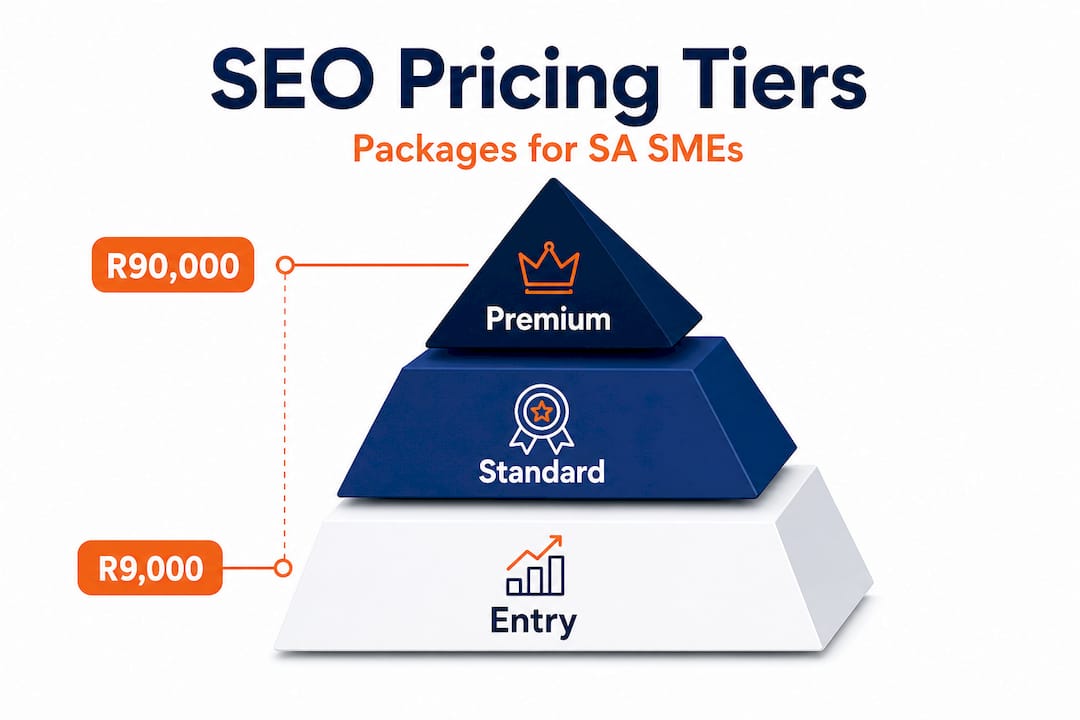
Here is how the tiers generally compare:
| Tier | Monthly cost range | Typical inclusions |
|---|---|---|
| Entry level | R9,000 to R18,000 | Basic technical audit, limited on-page work, local citations, monthly report |
| Growth | R18,000 to R45,000 | Full on-page, content creation (2 to 4 pieces), moderate link building, local SEO, weekly check-ins |
| Premium | R45,000 and above | Extensive content, high-authority backlinks, advanced technical SEO, custom reporting, dedicated manager |
The cost is not just about what you pay. It is about what you get in return. A R10,000 package that produces no measurable results costs you infinitely more than a R25,000 package that generates R80,000 in new business within six months.
Here are five steps to evaluate whether a price represents genuine value:
- Request a full deliverables breakdown. A credible provider lists exactly what happens each month, not vague promises about “improved visibility.”
- Ask for case studies from similar South African industries. Results in retail differ from results in legal services or hospitality.
- Check the reporting frequency and format. Monthly branded reports are standard; weekly updates and live dashboards signal a more engaged provider.
- Evaluate their link building process. Ask where they acquire backlinks and what their average domain rating target is.
- Understand the contract terms. Month-to-month flexibility is safer than long-term lock-ins until you have proven results from the provider.
To benchmark against what reputable SA SEO companies typically offer, use their published package structures as a reference point when comparing white label proposals.
Pro Tip: If a provider’s price seems unusually low, it often means automated link building, spun content, or overseas teams with no understanding of the South African market. Cheap SEO can trigger Google penalties that take months to recover from.
Risks, red flags, and smart ways to protect your reputation
White label SEO creates a trust gap. Your clients trust you. You trust the provider. But if the provider cuts corners, your reputation takes the hit, not theirs. This is the most underappreciated risk in the entire model.
Risks in white-label SEO commonly include “black-box” delivery, vague or incomplete reporting, and a total lack of clarity about what the provider is actually doing. When your client asks why their rankings dropped and you cannot answer because the provider has not told you, that conversation is painful and damaging.
“Your brand is on the line every time your white label provider delivers substandard work. The client blames you, not the invisible third party. Always remember: you own the risk.”
Watch for these red flags before and during any provider relationship:
- Vague service descriptions. Phrases like “full SEO management” with no specific deliverable list should stop you cold.
- Dressed-up reports without activity logs. A ranking graph is not proof of work. You need to see what was actually done.
- Guaranteed rankings. No one can guarantee Google rankings. Providers who do are either lying or using black-hat tactics.
- No South African market knowledge. Providers who cannot explain the difference between local citation building in Cape Town versus Johannesburg are not equipped to serve your clients.
- Poor communication. If getting a response takes days during the sales process, it will be worse once you have signed.
- Automatic contract renewals buried in terms. Read the fine print around cancellation and ownership of deliverables.
To protect yourself, build these safeguards into your provider agreement:
First, own all the assets. Make sure website access, Google Analytics, Google Search Console, and any content created belongs to you or your client, not the provider. Second, insist on monthly activity reports that list completed tasks by category. Third, run independent rank tracking using your own tools so you are never relying solely on the provider’s data. If you are unsure how to evaluate an SEO partner before committing, SEO expert hiring best practices offer a practical framework that applies equally well to vetting white label providers.

The providers worth working with will welcome your scrutiny. The ones who resist transparency are the ones to walk away from.
What’s next: future-proof SEO with AI-readiness and advanced optimisation
SEO in 2026 is not the same as SEO in 2021. Google’s AI Overviews, zero-click searches, and entity-based ranking signals have fundamentally changed what “ranking well” means. Your white label provider needs to be ready for this shift, or your investment will stagnate.
White-label SEO providers are increasingly adding AI-focused service extensions like AEO (Answer Engine Optimisation) and GEO (Generative Engine Optimisation) to address changing search results, including AI overviews, entity-based optimisation, and citation-oriented content strategies. If your provider has not mentioned these terms, ask about them directly.
What does an AI-ready provider actually look like? Here are the features to look for:
- Structured data and schema markup implementation, so search engines can understand your content and surface it in rich results and AI summaries
- Entity optimisation, building brand signals that connect your business to relevant topics across the web
- Content formatted for AI summarisation, meaning clear headings, concise answers to specific questions, and factual precision
- Digital PR and brand mentions, generating authoritative citations that AI tools pull from when generating responses
- Regular content refreshes, keeping pages current because AI-driven search rewards freshness and factual accuracy
- E-E-A-T alignment (Experience, Expertise, Authoritativeness, Trustworthiness), ensuring content demonstrates real-world authority
The numbers support urgency. AI-generated overviews now appear in a significant percentage of Google searches, meaning traditional blue-link rankings are no longer sufficient. Your provider should be optimising for visibility within those AI answer boxes, not just page-one positions.
For South African SMEs, this matters because the gap between businesses with AI-optimised content and those without is widening fast. Ask your potential white label provider whether they offer or plan to offer AEO and GEO services. If they look confused, that tells you everything. Explore what AI-ready SEO software your provider should be using so you can have an informed conversation about their technology stack.
Future-proofing your SEO investment is not a luxury. It is the difference between compound growth and gradual irrelevance.
A fresh perspective: why most SA SMEs underestimate the value and the risks of white label SEO
Here is something most articles on this topic will not tell you: the biggest mistake South African SMEs make is treating white label SEO as a commodity purchase rather than a strategic partnership. They shop on price, compare packages like they are choosing a mobile data plan, and then wonder why results are mediocre six months later.
The reality is that white label SEO done properly is one of the highest-leverage investments an SME can make. Organic search traffic compounds over time. Unlike paid advertising, where visibility stops the moment you stop paying, good SEO builds an asset. A well-optimised website with strong backlinks and quality content continues to generate leads long after the work was done.
But here is the uncomfortable flip side. Because the model involves a third party executing work under your name, the risk is asymmetric. If the provider uses manipulative link schemes or generates thin, AI-spun content, Google penalises your client’s website. You then have to explain to a client why their traffic dropped 40 percent, when you were the one who guaranteed results. That conversation ends business relationships and, sometimes, generates legal disputes.
The businesses that get the most value from white label SEO are the ones that stay involved. They ask questions. They review deliverables. They push back when reports feel vague. They treat the provider like a member of their extended team rather than a vendor who handles something they do not understand. Understanding why local SEO matters for South African businesses specifically gives you the context to have smarter conversations with any provider you engage.
Choose providers who over-communicate, who share proof of work without being asked, and who are already investing in next-generation SEO capabilities. Those partners exist. They are not the cheapest option, but they are almost always the most cost-effective one over a 12-month horizon.
Ready to grow? Affordable SEO solutions for your SA business
If this article has shown you anything, it is that white label SEO is a real opportunity for South African SMEs to access professional, scalable search engine optimisation without the cost of building an internal team. But the quality of your results depends entirely on the quality of your partner.
At Local SEO Agency, we offer transparent, results-driven SEO built specifically for South African businesses. Whether you are an agency looking to add SEO to your service offering or an SME ready to invest in organic growth, we have tailored solutions for your goals. Explore our best SEO optimisation service to see what measurable performance looks like, or browse our affordable SEO service options to find a package that fits your budget without compromising on quality. Ready to compare in detail? Our SEO packages for SA SMEs lay out exactly what you get at each level, so you can make a confident, informed decision.
Frequently asked questions
What is the main advantage of white label SEO for South African SMEs?
It allows businesses to access expert SEO services without hiring their own team, saving both cost and time while keeping full brand control over client-facing work. As the model shows, the visible agency manages clients while specialists handle all execution behind the scenes.
How do I know if a white label SEO provider is trustworthy?
Trustworthy providers offer full transparency through detailed reporting, documented proof of completed tasks, and clear communication about what is happening each month. Be cautious of any provider whose reports show rankings but include no evidence of actual work completed.
Is white label SEO suitable for businesses outside major SA cities?
Yes, because most reputable South African providers offer local SEO and geo-targeting services that help SMEs compete in any region, from Polokwane to Port Elizabeth to smaller towns in between.
What is the difference between basic and premium white label SEO packages?
Premium packages deliver more content, higher-quality backlinks, advanced technical optimisation, and more frequent audits, while basic options focus only on core essentials. Packages range from entry-level at around $500 per month to $2,500 and above for premium tiers, with meaningful differences in deliverable quality at each level.