

TL;DR:
- Building a solid SEO foundation with proper tools and consistent optimizations is essential.
- Local keyword research and Google Business Profile optimization drive improved local visibility.
- Ongoing monthly audits and community engagement enhance long-term search rankings.
Step-by-step SEO strategy: Boost your SA business visibility
Your business delivers excellent service, yet potential customers nearby cannot find you online. This is a frustrating reality for thousands of South African SMEs. Competing for visibility in local search results requires more than just a website. It demands a structured, repeatable approach that you can implement, measure, and refine over time. This guide walks you through exactly that: a practical, evidence-based SEO framework built for South African business owners. From setting up your tools correctly to tracking real progress month by month, every step here is actionable and grounded in what actually works for businesses operating in South Africa’s unique market conditions.
Table of Contents
- Laying the groundwork: Prerequisites for SEO success
- Core steps: Building your local SEO strategy
- Auditing and measuring SEO progress
- Troubleshooting and refining your strategy
- A South African perspective: Smarter local SEO in 2026
- Level up your SEO: How we can help
- Frequently asked questions
Key Takeaways
| Point | Details |
|---|---|
| Set correct SEO foundations | Prepare tools and information before starting your step-by-step SEO process. |
| Follow proven local SEO steps | Use structured, location-specific tactics backed by evidence for South African SMEs. |
| Continuously audit for results | Regular measurement and adjustment of SEO deliver ongoing growth and visibility. |
| Troubleshoot and adapt | Identify issues quickly and refine your strategy for the best possible business impact. |
Laying the groundwork: Prerequisites for SEO success
SEO is not a once-off task you tick off a list and forget. Businesses that treat it that way almost always end up disappointed. Think of it more like maintaining a vehicle. You keep checking the oil, rotating the tyres, and topping up the fuel. Consistent attention is what keeps the engine running and keeps you ahead of local competitors.
Before you invest a single hour into keyword research or content writing, you need to make sure your foundation is solid. That means having the right access, tools, and mindset in place from day one.
Tools and access you need from the start
Here is a practical list of what every South African SME should have ready before beginning any SEO work:
- Access to your website’s CMS (WordPress, Wix, or whatever platform you use), including admin rights to change page titles, meta descriptions, and content
- Google Search Console set up and verified for your domain, so you can see exactly which queries bring people to your site
- Google Analytics 4 (GA4) installed and tracking user behaviour, traffic sources, and conversion events
- A confirmed and fully claimed Google Business Profile (GBP) for your physical or service area location
- A list of your current online business citations: places like Yellow Pages SA, Cylex, and other local directories where your business name, address, and phone number appear
- A mobile device to manually test your own website’s speed and usability, because what loads fine on your office desktop may crawl on a mobile connection
Pro Tip: Use Google’s free PageSpeed Insights tool to check your site’s load time before doing anything else. According to HubSpot’s on-page SEO guide, your site should load in under 3 seconds on mobile, and it should include local keywords in your title tags, meta descriptions, and H1 headings. This is baseline, not advanced SEO.
Common beginner mistakes to avoid
Many SME owners in South Africa skip the preparation phase and jump straight into producing content or chasing backlinks. This is a costly mistake. If your website is not mobile-friendly, Google will penalise your rankings before you ever publish a single new article. If your business name, address, and phone number are inconsistent across directories, local search algorithms get confused and your visibility suffers.
Another common pitfall is neglecting to claim your online profiles. Unclaimed GBP listings are a missed opportunity that competitors will exploit. Getting familiar with DIY SEO tips for local businesses can help you identify and fix these gaps quickly before investing in more advanced tactics.
Use the table below as a starting checklist before moving to the strategy-building phase:
| Prerequisite | Status check | Why it matters |
|---|---|---|
| CMS admin access | Yes / No | Needed to update on-page elements |
| Google Search Console | Set up / Not yet | Tracks queries and indexing issues |
| Google Analytics 4 | Active / Not installed | Measures traffic and conversions |
| Google Business Profile claimed | Yes / No | Critical for local map rankings |
| Mobile load time under 3 seconds | Pass / Fail | Affects Google ranking directly |
| Consistent NAP across directories | Yes / Needs fixing | Builds local search trust signals |
| Schema markup on key pages | Yes / No | Helps Google understand page context |
With these prerequisites in place, you are building on solid ground. Understanding local SEO strategy basics will give you further context for why each of these elements plays a role in your long-term visibility.
Core steps: Building your local SEO strategy
With your foundation ready, let’s dive into the actual steps for creating local SEO results. These steps are sequential for a reason. Skipping ahead often means doing extra rework later.
Step 1: Keyword research with local intent
Local keyword research is different from general SEO keyword research. You are not just targeting “plumber” or “accountant.” You are targeting “plumber in Pretoria East” or “tax accountant Cape Town CBD.” These location-specific phrases tell Google that the person searching wants a nearby service provider, not general information.
Start by listing your core services, then add the city, suburb, or region where you operate. Use free tools like Google Keyword Planner, Ubersuggest, or even Google’s autocomplete suggestions to find variations people actually type. Pay attention to search intent. Someone typing “best electrician Sandton” is ready to hire. Someone typing “how does electrical rewiring work” is still in research mode. Target both, but prioritise service-plus-location terms on your main service pages.

Step 2: On-page SEO essentials
This is where your keyword research translates into actual website changes. Every service page and landing page on your site should have a clear, localised title tag, a compelling meta description, and a single H1 heading that includes your primary keyword. These are the signals Google reads first.
Beyond that, your pages need to load fast on mobile devices, include schema markup (structured data that helps Google identify your business type, location, and services), and embed a Google Map where relevant. These elements work together to tell search engines and users exactly who you are and where you operate.
Step 3: Local content and link building
Content that speaks directly to local audiences performs far better in South African search results. Write blog posts about topics your local customers actually ask about. Feature case studies from clients in your area. Mention local landmarks or neighbourhoods when they are relevant. This type of content earns both engagement and local relevance signals.
For link building, focus on earning mentions from local news sites, business directories, industry associations, and community organisations. A backlink from a respected Johannesburg business blog carries far more local authority than a generic link from an overseas directory. Exploring local SEO strategies in depth will give you a roadmap for building this kind of authority steadily over time.
Step 4: Setting up and optimising your Google Business Profile
Your GBP is arguably your most powerful local SEO asset. A complete, well-maintained profile directly influences whether your business appears in the Google Maps pack, which dominates the top of local search results. Fill in every field: business name, address, phone number, website, operating hours, services, and a detailed description. Upload genuine photos. Collect reviews consistently and respond to every single one, good or bad.
Pro Tip: Use the “Posts” feature on your GBP to share weekly updates, promotions, or news. Google treats active profiles as more trustworthy and relevant, which can improve your position in the local pack. Businesses that consistently use this feature alongside solid on-page work see faster ranking improvements than those who ignore it.
Here is a practical comparison of on-page versus off-page SEO impact for local SA businesses:
| SEO factor | On-page impact | Off-page impact |
|---|---|---|
| Title tags and meta descriptions | High: direct ranking signal | None directly |
| Mobile speed | High: user experience and ranking | None directly |
| Schema markup | Medium: helps search understanding | None directly |
| Local backlinks | Low direct | High: builds authority |
| GBP optimisation | Medium: listing completeness | High: local pack ranking |
| Customer reviews | Low direct | High: trust and click-through rate |
Combining on-page optimisation with off-page trust signals is how you move from invisible to visible in local search. For a structured starting point, work through this SEO checklist for small businesses to make sure nothing falls through the gaps. The results of boosting sales with local SEO become far more predictable when you follow a step-by-step process like this.
Auditing and measuring SEO progress
After building your strategy, you need to know if your SEO work is actually moving the needle. Without measurement, you are flying blind. You might be ranking for keywords nobody searches, or attracting traffic that never converts. Regular auditing is how you separate what is working from what is wasting your time.
Why measurement is non-negotiable
Organic search is one of the highest-value traffic sources available to any business. Research consistently shows that 53% of site traffic comes from organic search across business websites globally. If you are not measuring that channel carefully, you are leaving significant growth potential unattended.
Tracking SEO progress also protects your investment. If rankings drop after a Google algorithm update or a technical issue appears on your site, monthly auditing lets you catch and fix the problem before it causes serious damage.
What to audit each month
Here is a numbered audit process you can follow every 30 days:
- Check Core Web Vitals in Google Search Console. Look at your Largest Contentful Paint, Cumulative Layout Shift, and Interaction to Next Paint scores. Any pages flagged as “poor” need immediate attention.
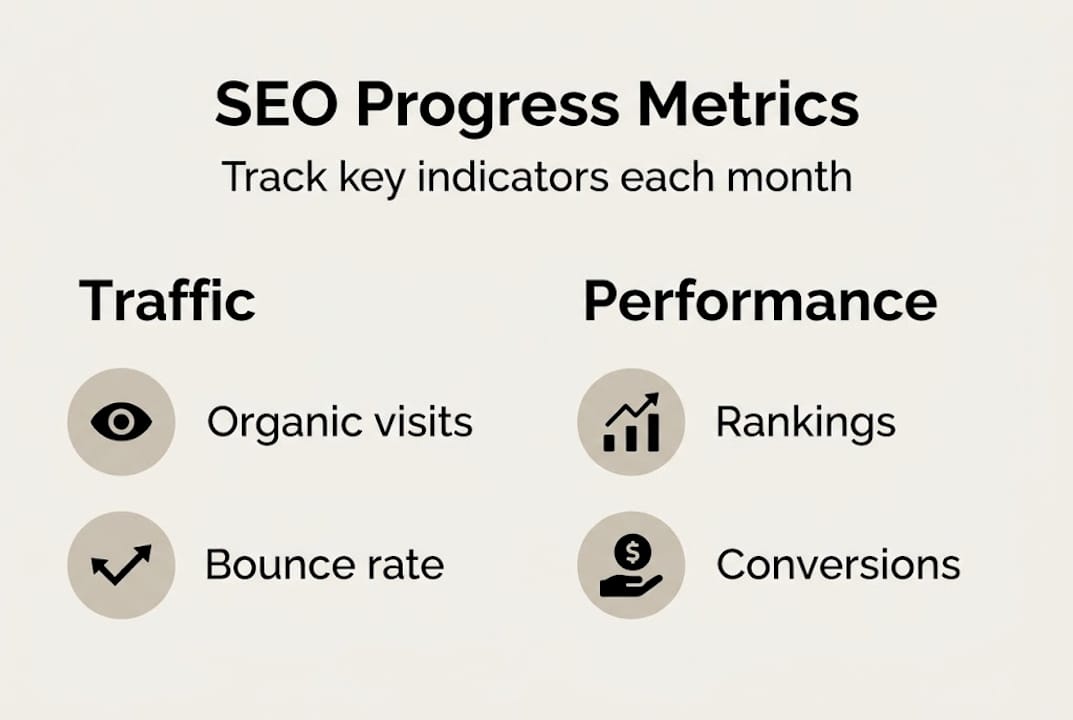
- Review organic traffic trends in GA4. Are sessions increasing month on month? Which landing pages attract the most visitors? Which pages have high bounce rates?
- Monitor keyword rankings using a rank tracking tool like SE Ranking or SERPWatcher. Flag any significant drops (5 or more positions) on priority pages.
- Audit your GBP insights. How many people searched for your business directly versus discovered it through category searches? How many clicked for directions or called?
- Review conversion data. Traffic without conversions is just vanity. Check which pages drive enquiries, calls, or form submissions and compare month on month.
- Crawl your site for technical issues using Screaming Frog or a similar tool. Look for broken links, missing title tags, duplicate content, and pages accidentally blocked from indexing.
Consult our guide on essential SEO audit steps to build this process into a consistent monthly routine.
Sample tracking table: What to measure and why
| Metric | Tool | Why it matters | Target |
|---|---|---|---|
| Organic sessions | GA4 | Shows SEO traffic volume trends | Month-on-month growth |
| Keyword rankings | SE Ranking / SERPWatcher | Tracks position changes for target terms | Top 10 for core keywords |
| Core Web Vitals | Google Search Console | Page experience signals | All pages in “good” range |
| GBP search impressions | GBP Insights | Measures local visibility | Monthly increase |
| Click-through rate (CTR) | Google Search Console | Shows how compelling your listings are | Above 3% for local terms |
| Conversions from organic | GA4 | Ties SEO to business outcomes | Steady monthly increase |
For South African SMEs working on improving local search visibility, tracking these metrics monthly creates a clear feedback loop. You stop guessing and start making informed decisions based on data your own website is generating.
Troubleshooting and refining your strategy
No SEO plan works perfectly out the gate. Learn how to fix and improve what you have built, because the businesses that win in local search are the ones that adapt fastest.
Common local SEO pitfalls in South Africa
Some of the most frequent issues we see South African SMEs run into include:
- Site errors left unresolved: Broken pages (404 errors) that were once ranking but were deleted without a proper redirect in place. These bleed authority and frustrate users.
- Duplicate content: Service pages that are near-identical except for the city name, created in bulk without genuine localisation. Google often ignores or devalues these pages.
- Missing or incorrect mobile optimisation: A site that looks fine on a widescreen monitor but breaks completely on a standard Android phone used by most South African consumers.
- Google Maps issues: An unverified GBP listing, or one with the pin placed in the wrong location, which actively hurts trust with nearby searchers.
- NAP inconsistencies: Your business is listed as “Acme Plumbing” on your website, “Acme Plumbing Pty Ltd” on a directory, and “Acme Plumbers” on another. These small differences confuse local algorithms.
How to identify and fix each problem
For site errors, run a monthly crawl with Screaming Frog or a similar tool. Set up 301 redirects for any deleted pages that previously had traffic or backlinks pointing to them. For duplicate content, rewrite each localised page with genuinely unique information: local testimonials, neighbourhood-specific details, or suburb-level case studies.
For mobile issues, test every key page using Google’s Mobile-Friendly Test. Address any flagged elements before working on anything else. For GBP errors, open the backend of your profile and verify the pin location manually. Cross-check all NAP details against your five most important directory listings and bring them into alignment.
“The SEO strategies that survive algorithm updates are the ones built on genuine value: accurate information, fast delivery, and real relevance to the user’s location and intent.” This is why consistent monitoring, as outlined in the 2026 SEO audit guide, remains the backbone of every sustainable SEO effort.
Pro Tip: Ask your best customers to leave a Google review mentioning the specific service they used and the area they are based in. These review signals reinforce your local relevance without you having to do anything technical. User-generated content, in the form of reviews, is one of the fastest ways to strengthen your local SEO between major strategy updates.
Once you have fixed the obvious problems, focus on what to build next. Read through our resources on developing an agency SEO strategy for inspiration on more advanced tactics. If your business uses multiple online assets like YouTube channels or subsidiary landing pages, understanding a Google Stack for business SEO can help you leverage all of them together for compounded visibility.
Refining for ongoing improvement
After three months of consistent implementation and monthly auditing, you will have a data set that tells a story. Use it. Look at which pages generate the most enquiries and create more content in that same format. Look at which keywords moved from position 12 to position 6 and identify what drove that improvement. Replicate those actions across your other priority pages. SEO success is iterative, and the businesses that refine continuously always outperform those that set and forget.
A South African perspective: Smarter local SEO in 2026
Most SEO guides are written for the UK or US market and then republished globally with a few tweaks. This is a real problem for South African SMEs, because the dynamics here are genuinely different. Consumer trust is built differently. Connectivity speeds vary dramatically between urban and rural areas. And the competitive landscape in cities like Durban, Cape Town, and Johannesburg has its own unique characteristics that a foreign framework simply will not account for.
One thing we have seen consistently working for South African SMEs is treating their Google Business Profile as a local trust signal first and a ranking tool second. Businesses that respond to reviews, post updates regularly, and keep their hours accurate build a sense of reliability that local customers respond to emotionally, not just algorithmically. That trust converts browsers into buyers far more reliably than any technical tweak.
We also see a clear pattern in what stalls local SEO efforts. It is almost always a loss of momentum. A business owner starts strong, optimises a few pages, sets up their GBP, and sees some early movement. Then life gets busy, the updates stop, and six months later they are back to square one wondering why their rankings dropped. Consistency beats intensity every time in SEO.
Community engagement is another underrated advantage for South African SMEs. Sponsoring a local school event, partnering with a nearby business, or getting mentioned in a community Facebook group creates the kind of organic, localised attention that search engines notice. These signals reinforce what your on-page SEO claims. The businesses we work with that combine digital consistency with genuine community involvement through our local SEO services tend to build durable rankings that hold up through algorithm updates far better than those chasing shortcuts.
Level up your SEO: How we can help
Implementing a full local SEO strategy while running a business is genuinely demanding. You need someone who understands both the technical side and the South African market context.
At LSA SEO Agency, we work with SMEs across South Africa to build, execute, and continuously refine local SEO strategies that deliver measurable results. Whether you need a full audit, ongoing local SEO services, or a targeted SEO optimization service to address specific gaps, we have the expertise and the tools to move the needle for your business. Our affordable SEO packages are designed specifically for South African business budgets, with no lock-in contracts and full transparency on what we do and why. If you are ready to stop being invisible in local search and start attracting the customers your business deserves, reach out to our team today for a no-obligation consultation.
Frequently asked questions
What is the best way to measure SEO progress for a small South African business?
Track your organic traffic, Core Web Vitals, search rankings, and Google Business Profile insights each month using Google Analytics and Search Console. Research confirms that 53% of business traffic comes from organic search, making it your most important channel to monitor.
Do I need to optimise my website for mobile for SEO in South Africa?
Yes, mobile optimisation is non-negotiable. Google prioritises mobile-ready sites with fast load times and responsive design, and the majority of South African users browse on mobile devices.
How often should I audit my SEO strategy?
Conduct a full technical and performance audit every month. Monthly reviews of Core Web Vitals and rankings allow you to catch drops early and maintain consistent momentum.
What’s the fastest way to improve my local rankings?
Optimise your key pages with local title tags and schema markup, claim and complete your Google Business Profile, and make sure your business name, address, and phone number are consistent across all directories.