

TL;DR:
- Understanding SEO jargon like canonical tags and Core Web Vitals helps South African SMEs make smarter marketing decisions.
- Technical and content SEO are both essential; technical fixes ensure website foundation, while content attracts local customers.
- Focusing on outcome-based metrics and plain-language reports ensures SEO efforts translate into real business growth.
Running a small business in South Africa is hard enough without your digital marketing provider burying you in technical terms you’ve never heard before. When someone mentions “canonical tags,” “crawl budget,” or “Core Web Vitals” in a meeting, it’s easy to nod along and hope for the best. But that guessing game costs you money. SEO reporting essentials show that SA business owners who understand what these terms actually mean make smarter decisions, choose better providers, and stop wasting budget on strategies that don’t move the needle. This guide breaks down the most important SEO terminology in plain language, so you can take control of your online growth and have genuinely useful conversations with whoever manages your search presence.
Table of Contents
- What is SEO? Why understanding the jargon matters
- Core SEO terms every SA business owner should know
- Technical vs content SEO: How each affects South African brands
- Avoiding jargon pitfalls: Black hat, white hat, and reporting traps
- Putting SEO jargon into action: Communicating with providers
- The uncomfortable truth: Why neat SEO jargon can sometimes hide real problems
- Unlock your business growth with expert SEO help
- Frequently asked questions
Key Takeaways
| Point | Details |
|---|---|
| Demystify SEO jargon | Understanding key SEO terminology empowers confident business decisions. |
| Focus on local SEO | Local optimization drives visibility and results for South African small businesses. |
| Beware black hat traps | Avoid risky SEO tactics and focus on guideline-compliant strategies for sustainable growth. |
| Prioritize real metrics | Measure SEO by conversions and revenue, not vanity metrics or rankings alone. |
| Communicate clearly | Using SEO jargon correctly enables better dialogue with marketing providers. |
What is SEO? Why understanding the jargon matters
SEO stands for Search Engine Optimization. It is the process of improving your website so that it appears higher in search engine results like Google when potential customers search for what you offer. A plumber in Johannesburg wants to appear when someone types “emergency plumber near me.” A bakery in Cape Town wants to show up when someone searches “custom cakes Cape Town.” That is SEO working as it should.
But here is the problem. SEO involves a wide range of technical and strategic concepts, and many providers communicate using industry shorthand that leaves small business owners completely lost. When you do not understand the terminology, you cannot evaluate whether the work being done is actually helping your business. You end up trusting blindly, and that rarely ends well.
For South African SMEs specifically, the stakes are even higher. Your customers are searching locally. They want to find businesses in their area, in their language, that understand their needs. This makes local SEO focus non-negotiable. National or global SEO strategies often miss the mark for a business that serves a specific suburb, city, or province.
Understanding SEO jargon also helps you spot a bad provider quickly. If someone promises you “guaranteed number one rankings” or talks only about traffic without mentioning conversions, those are warning signs. Knowing the right questions to ask puts you in control.
Here is what you should understand from the start:
- Local SEO targets searches within a specific geographic area and is essential for SA SMEs.
- Google Business Profile (GBP) is your free listing on Google Maps and local search results.
- Core Web Vitals are Google’s measurements of how fast and user-friendly your website is.
- Schema markup is code added to your site that helps Google understand your content better.
- Citations are online mentions of your business name, address, and phone number across directories.
A well-rounded SEO strategy for South Africa should address all of these elements, not just one or two. As noted in SEO reporting essentials for measurable SMB growth, SA business owners should prioritize local SEO including Google Business Profile and citations, and learn to communicate technical needs like Core Web Vitals and schema to their providers.
“The difference between a business owner who grows through SEO and one who wastes budget on it often comes down to one thing: vocabulary. When you know the terms, you know the right questions to ask.”
Pro Tip: Before signing any SEO contract, ask your provider to explain three terms from their proposal in plain language. If they cannot, that is a red flag.
A solid SEO audit is usually the starting point for any good strategy. It reveals where your site stands and what needs fixing before you invest further.
Core SEO terms every SA business owner should know
Let’s cut through the noise and define the terms that matter most for local business visibility in South Africa. You do not need to become a technical expert. You just need to understand what each term means and why it affects your bottom line.
Here is a quick reference table of the eight most important SEO terms for SA SMEs:
| SEO term | What it means | Business impact |
|---|---|---|
| Canonical tag | Tells Google which version of a page is the “main” one | Prevents duplicate content from hurting your rankings |
| 301 redirect | Sends visitors from an old URL to a new one permanently | Preserves your ranking value when pages move or change |
| Crawl budget | How many pages Google will scan on your site per visit | Ensures important pages get found and indexed |
| Core Web Vitals | Google’s speed and usability measurements | Affects your ranking and user experience directly |
| Schema markup | Structured code that helps Google read your content | Can earn you rich results like star ratings in search |
| Google Business Profile | Your free Google Maps and local search listing | Critical for appearing in local searches near you |
| Backlink | A link from another website pointing to yours | Builds authority and trust with search engines |
| Keyword intent | The reason behind a search query | Matching intent means better conversions, not just traffic |
Let’s unpack a few of these more carefully. Canonical tags prevent duplicate content issues by specifying your preferred URL. This matters because many websites accidentally create multiple versions of the same page through tracking codes or filters, and Google penalizes this kind of duplication.
Crawl budget is particularly relevant for larger SA business websites with many pages. If Google only crawls a limited number of your pages per day and you have hundreds of low-value pages eating into that budget, your important product or service pages may not get indexed at all. You can find local SEO optimization tips that include how to manage crawl budget effectively for local businesses.
Core Web Vitals are worth paying close attention to. Google has confirmed they are a ranking factor. They measure three things: loading speed, interactivity, and visual stability. A slow website that jumps around as it loads will rank lower, and it will also frustrate customers who land on it.

One often overlooked insight: more than 53% of mobile visits are abandoned if a page takes longer than three seconds to load. For a South African SME relying on mobile traffic, that is a conversion killer you cannot ignore.
Key terms to watch for in provider reports:
- Organic traffic: Visitors who found you through search, not paid ads.
- Impressions: How many times your site appeared in search results.
- Click-through rate (CTR): The percentage of people who clicked on your result.
- Bounce rate: How many visitors left without taking any action.
Understanding these SEO performance metrics gives you the ability to hold your provider accountable. Also explore the SEO basics guide for a broader grounding in foundational concepts.
Technical vs content SEO: How each affects South African brands
SEO is not one single thing. It splits into two major categories, and understanding the difference will help you figure out where to focus your budget and your provider’s attention.
Technical SEO covers everything behind the scenes of your website. This includes site speed, mobile usability, URL structure, indexing, and how search engines crawl and understand your pages. Think of it as the plumbing of your website. If the plumbing is broken, it does not matter how nice the house looks.
Content SEO covers what is actually on your pages. This means keywords, blog posts, product descriptions, location pages, and anything else that answers a customer’s question. Good content matches what your target audience in South Africa is actually searching for.
Here is a side-by-side comparison to make this practical:
| Factor | Technical SEO | Content SEO |
|---|---|---|
| Focus | Website infrastructure | Page content and relevance |
| Tools needed | Site audits, crawlers | Keyword research, writing |
| Fixes | Speed, structure, redirects | Keywords, blogs, landing pages |
| SA relevance | Mobile performance for SA users | Local language and intent |
| Timeline | Often a one-time fix | Ongoing, builds over time |
A practical step-by-step approach for SA SMEs:
- Start with a technical audit to identify critical errors on your site.
- Fix speed issues, broken links, and mobile usability problems first.
- Build out location-specific pages targeting your key service areas.
- Publish regular content that answers questions your customers actually ask.
- Use top SEO tools to track progress and catch new issues early.
One serious risk that many SA business owners do not hear about: JavaScript-heavy websites. If your site relies heavily on JavaScript to display content, search engines may struggle to render and index it properly. The fix is server-side rendering or prerendering, which ensures Google sees the content without needing to execute code first. Ask your web developer or SEO provider whether this applies to your site.
Pro Tip: If your provider only talks about content and never mentions technical health, ask them when last they ran a full site audit. Content built on a broken technical foundation rarely ranks well long-term.
Explore competitive SEO techniques to understand how top-performing SA businesses combine both approaches for maximum impact.
Avoiding jargon pitfalls: Black hat, white hat, and reporting traps
Not all SEO strategies are equal. Some are designed to trick search engines, and they can destroy your online presence overnight. Knowing the difference between ethical and risky approaches is essential for every SA business owner.
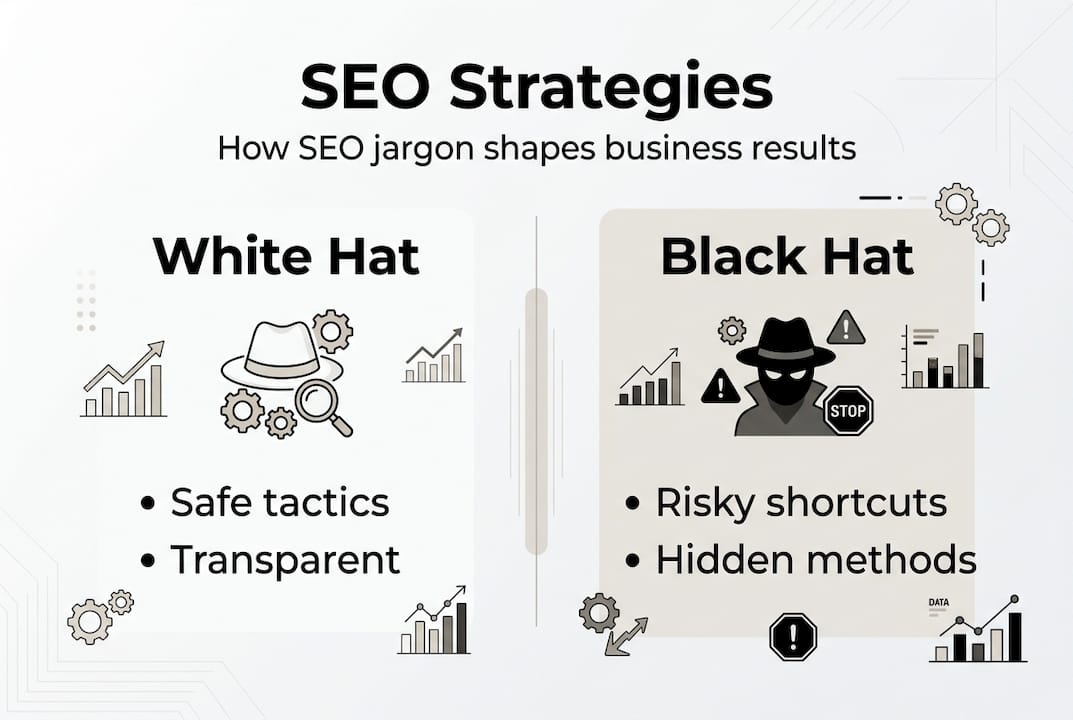
Black hat SEO refers to techniques that violate Google’s guidelines. These include keyword stuffing (cramming too many keywords into a page unnaturally), cloaking (showing different content to Google than to users), and buying low-quality backlinks. These tactics might show short-term gains, but black hat risks include severe penalties that can remove your site from Google’s index entirely.
White hat SEO means following Google’s guidelines and building your rankings through genuine value. This includes creating useful content, earning backlinks through quality and relevance, and ensuring your site is technically sound. It takes longer, but the results are stable and compounding.
“An SEO provider who uses jargon like ‘link velocity’ and ‘authority stacking’ without explaining what they mean or how they comply with Google’s guidelines deserves serious scrutiny.”
Beyond strategy risk, reporting traps are equally dangerous. Many providers flood their monthly reports with numbers that look impressive but mean nothing for your actual revenue. As highlighted in SEO reporting essentials, you should track conversions in ZAR and actual leads, not just rankings and page views.
Common jargon traps and what to watch for:
- “We increased your impressions by 300%”: Impressions without clicks mean nothing.
- “You’re ranking for 500 keywords”: If none drive revenue, this is meaningless.
- “Your domain authority improved”: This is a third-party metric, not a Google one.
- “We built 200 backlinks this month”: Volume without quality is a red flag.
- “Traffic is up 40%”: Ask whether conversions and enquiries also grew.
Understanding the importance of local SEO helps you distinguish between strategies that build real regional visibility and those that just look good on paper. When choosing an SEO company, make sure they speak in outcomes, not just activity.
Putting SEO jargon into action: Communicating with providers
Knowing the terms is only useful if you put them to work. The real power comes when you walk into a meeting or read a report and know exactly what to ask, what to question, and what to demand.
Here is how to use your new SEO vocabulary effectively:
- Ask about your Google Business Profile: Is it fully optimised? Are reviews being managed? Is the category correct? This is often the fastest win for local SA businesses.
- Request a Core Web Vitals report: Ask your provider where your site scores on loading speed and mobile usability. If they cannot show you this, that is a problem.
- Question your crawl budget: For any site with more than 100 pages, ask what is being done to ensure important pages are being crawled and indexed.
- Demand schema implementation: Ask whether your business has local business schema, product schema, or FAQ schema in place.
- Track conversions in rand: Ask your provider to set up conversion tracking so you can see actual leads and sales driven by SEO, not just traffic.
Pro Tip: At the start of each month, ask your provider one simple question: “Which three actions did you take last month that are most likely to increase my revenue?” The quality of their answer tells you everything.
The impact of getting this right is significant. Businesses that track revenue-tied metrics and communicate technical needs like Core Web Vitals and schema to their providers consistently outperform those that measure success by rankings alone. This is not theory. It shows up in actual leads and rand value generated.
For SEO essentials for SMEs that are just getting started, the most important first step is simply understanding what your provider is doing and why. That clarity comes from knowing the language. And when you understand local SEO game changers, you can direct your provider to the tactics that actually move local search results in your favour.
The uncomfortable truth: Why neat SEO jargon can sometimes hide real problems
Here is something most SEO guides will not tell you. The more jargon a provider uses, the more carefully you should listen. Technical fluency is important, but it can also become a smokescreen. When a provider spends more time explaining terminology than showing you results, something is often wrong.
We have seen this pattern in South Africa repeatedly. A business owner receives a report full of domain authority scores, anchor text ratios, and crawl depth analysis. The report looks thorough. But when you ask “did we get more customers this month?”, there is no clear answer.
Real SEO impact should always trace back to business outcomes. More phone calls. More form submissions. More walk-ins from people who found you on Google Maps. If your provider cannot connect their technical work to those outcomes, the jargon is decoration, not evidence.
The solution is to demand both: technical competence and plain-language accountability. Ask for a monthly summary in two paragraphs, no jargon, that explains what changed and what it meant for your business. A confident, capable provider will have no problem doing this.
Focus on real SEO impact by insisting on outcome-based reporting from day one. Long-term growth in South Africa’s competitive local search landscape requires honest metrics, not technical wizardry.
Unlock your business growth with expert SEO help
Now that you understand what the jargon actually means, you are in a much stronger position to act. Knowing the difference between technical and content SEO, understanding what black hat risks look like, and demanding revenue-tied reporting are the foundations of a productive SEO partnership.
At LSA SEO Agency, we work specifically with South African SMEs who want results they can see in their bank account, not just their analytics dashboard. Our local SEO services are built around your specific region, customers, and goals. We offer targeted SEO keywords research that identifies exactly what your customers are searching for, and we report in plain language. If you are ready to stop guessing and start growing, contact LSA SEO Agency today for a no-jargon consultation tailored to your business.
Frequently asked questions
What are the most important SEO terms for South African SMEs?
Focus on local SEO, canonical tags, crawl budget, schema, and Google Business Profile, as these directly affect regional visibility and lead generation. Canonical tags prevent duplicate content issues by specifying the preferred URL, while crawl budget limits the pages bots process on larger sites.
How does technical SEO differ from content SEO?
Technical SEO covers your website’s structure and performance, while content SEO focuses on keywords and information that engages your audience. Both are necessary, but technical SEO forms the essential foundation that content then builds upon.
What is ‘crawl budget’ and why is it important?
Crawl budget is the number of pages search bots will scan on your site during a given visit, and managing it ensures your most important pages get indexed. For larger SA business websites, crawl budget limits can prevent key service pages from appearing in search results at all.
Are ‘black hat’ SEO strategies risky for South African SMEs?
Yes, techniques like keyword stuffing and cloaking risk serious Google penalties that can remove your site from search results entirely. Black hat tactics offer no long-term value and can undo months of legitimate work in a single algorithm update.
How should I measure SEO success for my SA business?
Measure conversions and revenue in rand, not just traffic or keyword rankings, to capture actual business impact. Tracking revenue-tied metrics gives you a true picture of whether your SEO investment is generating real customers and sales.