
SEO Glossary: Technical SEO

A page can be crawled and still never appear in Google. Indexing is the step that decides whether your page earns a place in the search results at all.
What indexing is
Indexing is Google analysing a page it has crawled and deciding whether to store it in its index, the enormous database it searches every time someone types a query. During indexing Google reads the text, titles, images and structured data, works out what the page is about, and checks whether it is a duplicate of something it already has. Only pages in the index can rank.
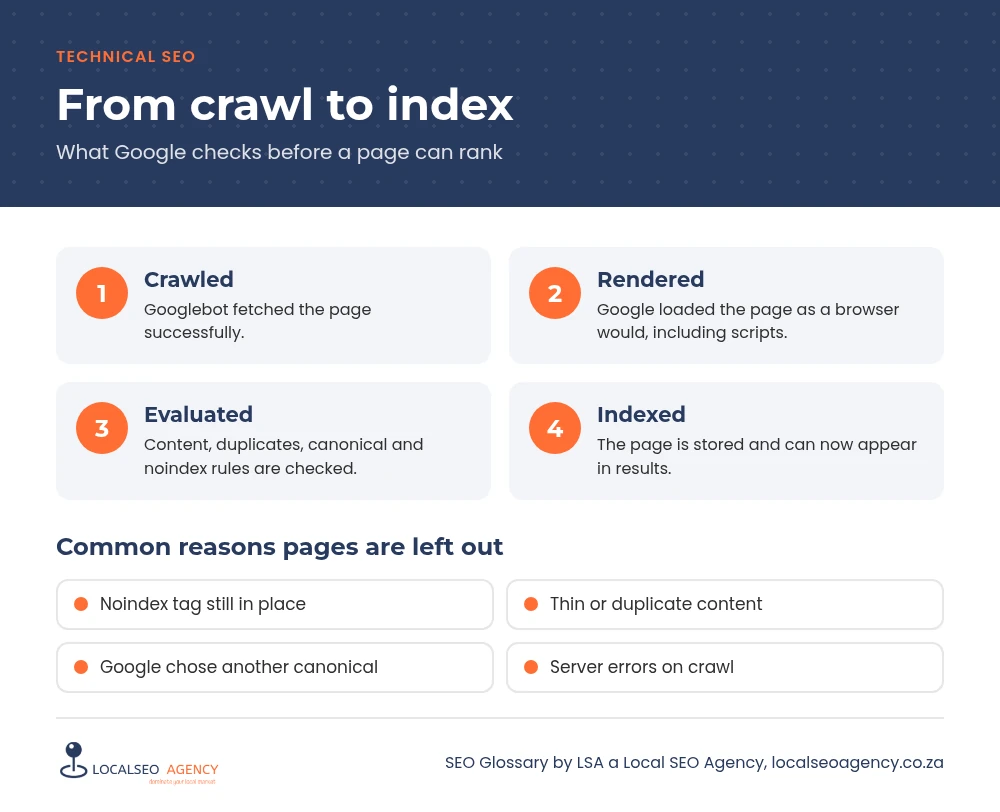
Indexing follows crawling. Google first has to discover and fetch the page, then it decides whether the page is worth keeping. A crawled page that is thin, duplicated or marked noindex is often left out.
Why it matters for your business
If your Bloemfontein service page or your new pricing page is not indexed, it does not matter how good it is: nobody searching Google will see it. For small South African sites the most common surprise is finding that only a fraction of the pages they thought were live are actually in the index, while old tag pages, image attachment pages or test pages are.
How Google decides what to index
Quality and usefulness
Google does not index everything it finds. Pages with very little unique content, or pages that look almost identical to others on the site, may be crawled and then skipped.
Duplicates and canonicals
Copies of a page at different addresses are grouped together, and only one representative is kept. The canonical tag guide explains how to influence that choice.
Instructions from you
A noindex tag tells Google not to index a page. Login walls and server errors also stop pages from being indexed.
Common indexing problems
- Important pages left on noindex after a website redesign.
- Thin or near identical location pages that Google treats as duplicates.
- Content hidden behind a search box, filter or form that Googlebot never submits.
- Server errors or slow responses when Googlebot visits.
- Low value URLs, such as tag archives and attachment pages, crowding the index.
How to check and improve indexing
Open the Pages report in Google Search Console. It splits your URLs into indexed and not indexed, and lists the reason for each excluded group, such as Crawled, currently not indexed or Duplicate without user selected canonical. Work through the reasons that affect pages you actually care about.
For a single URL, use the URL Inspection tool to see whether it is indexed and which canonical Google chose. If you have fixed a page, request indexing from there. Then strengthen the page itself: add genuinely useful content, link to it from related pages and make sure it is in your XML sitemap.
How LSA helps
LSA a Local SEO Agency reviews your index coverage page by page and separates the problems that cost you enquiries from the ones that do not matter. Through our technical SEO services we fix noindex mistakes, consolidate duplicates and clean low value URLs out of the index.
For the short definition, see Indexing in our SEO Glossary, alongside the other technical SEO terms.
Want Google to see your site the way your customers do? Call LSA a Local SEO Agency on 068 786 7331 or contact us for a technical check.