
SEO Glossary: SEO Content

Two people can type almost the same words into Google and want completely different things. Search intent is about understanding that difference and giving each person the right page.
What search intent means
Search intent is the goal behind a query. It answers a simple question: what does this person want to happen next? Some want to learn, some want to compare, some are ready to buy and some just want to reach a website they already know. Google studies how people behave on results pages, so it gets very good at guessing that goal, and it favours pages that fulfil it.
The four main types
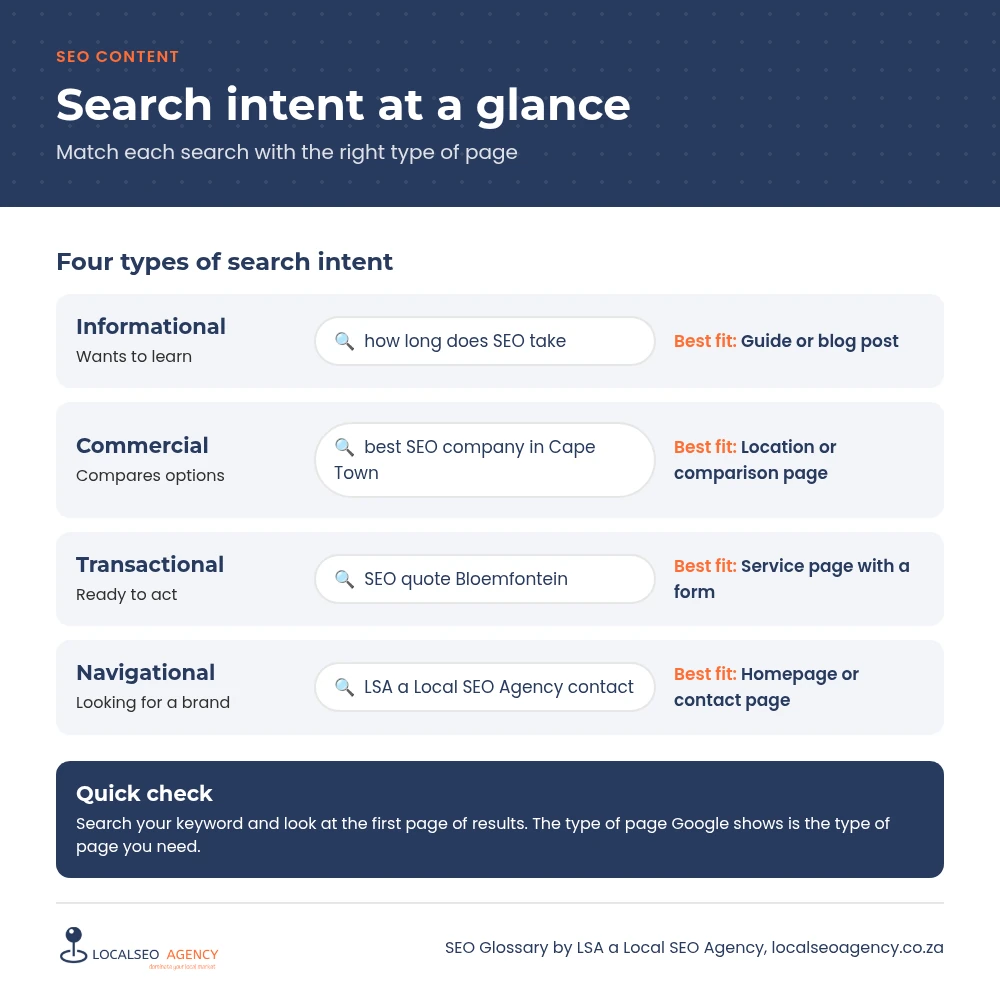
Informational
The searcher wants an answer or an explanation, for example how long does SEO take. The best fit is a clear guide or blog post.
Commercial
The searcher is weighing options, for example best SEO company in Cape Town. Comparison content, location pages and pages that show your process and proof tend to win here.
Transactional
The searcher is ready to act, for example SEO quote Bloemfontein. They want a service page with a clear offer, a phone number and a short form.
Navigational
The searcher is looking for a specific brand or page, such as your company name plus contact. Your homepage, contact page and Google Business Profile need to be easy to find.
Why it matters for South African businesses
Matching intent is often the difference between traffic and enquiries. A Durban plumber who writes a long article for emergency plumber Durban will struggle, because people searching that phrase want a phone number now, not an essay. A Pretoria accountant who only has a sales page will miss the many people searching questions about tax deadlines, who could become clients later. Local searches add another layer, because terms with a city or near me usually carry a strong intent to call or visit.
Common search intent mistakes
- Targeting a ready to buy keyword with a blog post instead of a service page.
- Trying to rank one page for several intents at once, such as a guide and a price list on the same URL.
- Writing several near identical posts for the same intent, which leads to keyword cannibalisation.
- Choosing keywords by search volume alone and ignoring what the results page already shows.
- Burying the next step, such as a phone number or quote form, on pages with strong buying intent.
How to check and improve intent match
Search your target keyword in a private browser window set to South Africa and study the first page. Are the results guides, service pages, directories or maps listings? That mix is Google telling you which intent dominates. If your page is a different type, change the page type rather than adding more keywords.
Next, open the Performance report in Google Search Console and look at the queries each page is shown for. If a service page mostly appears for question style searches, it may need a supporting guide. If a blog post is shown for buying searches, link it clearly to the matching service page. Finally, make the next step obvious: answers for informational pages, proof for commercial pages and a fast route to contact for transactional pages.
How LSA helps
LSA a Local SEO Agency builds every keyword plan around intent. Through our SEO content services we map each keyword group to one page type and one URL, so pages stop competing with each other. For local searches, our local SEO services and city pages, such as our SEO company in Cape Town page, are written for people who are ready to pick a provider.
For the one paragraph summary, see search intent in our SEO Glossary, next to related terms such as keyword research and keyword cannibalisation.
Want your pages matched to what your customers are really searching for? Call LSA a Local SEO Agency on 068 786 7331 or contact us today.