
SEO Guides: Link Building
Cloud stacking is the practice of uploading simple web pages to the public storage services run by large cloud providers, filling them with keywords and pointing links at a business website. Sellers claim the reputation of the provider rubs off on your site. This guide explains the idea conceptually, how it measures up against Google's spam policies and what a South African business should spend that budget on instead.
What cloud stacking is
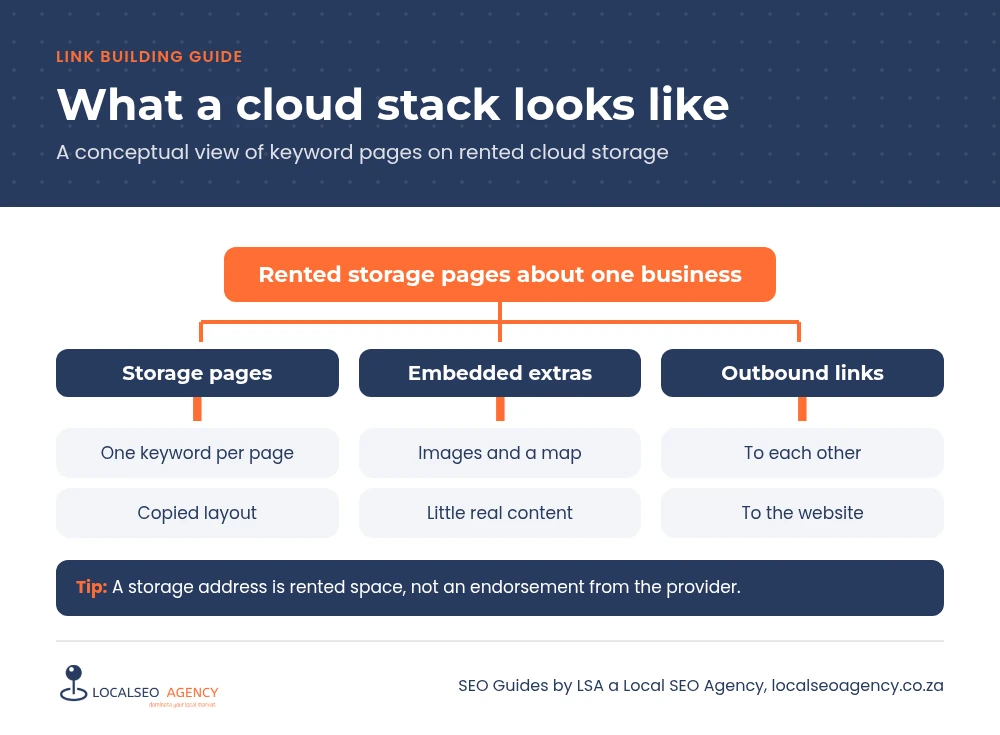
Big technology companies rent out online storage to developers and businesses. Files kept in that storage can be made public, which means anyone with the address can open them in a browser. A cloud stack uses that feature to publish a handful of pages, usually about one business and one keyword, on addresses that belong to the storage provider rather than to the business.
Each page typically carries a block of keyword heavy text, perhaps an image or an embedded map, and links to the business website, its Google Business Profile and the other pages in the stack. Packages are often sold together with Google stacks, and the pitch is similar: borrow the authority of a famous technology brand.
How the idea is supposed to work
The theory rests on two assumptions. The first is that Google trusts anything hosted on the infrastructure of a major provider. The second is that links from those addresses pass that trust to the target site. Both assumptions fall apart on inspection.
A storage address is not an endorsement. The provider hosts millions of files for millions of customers and has no editorial role in any of them. Search engines understand that the domain belongs to a storage service, so the relevant question is the same as for any page: who created it, who reads it and why does the link exist?
This guide stops at that conceptual level. It gives no setup instructions, because there is nothing here we would recommend doing.
What Google's spam policies say
You will not find cloud stacking named in Google's spam policies, yet the practice is plainly covered. The link spam section gives automated link creation and low quality links as examples, and pages whose only job is to hold a keyword and a link to your site match that closely.
The scaled content abuse policy, announced in March 2024, also matters. It targets large numbers of pages produced mainly to influence rankings rather than to help people. Sellers who promise dozens of cloud pages per client are describing exactly that pattern.
Usually nothing visible happens at all. SpamBrain, extended to link spam in December 2022, quietly strips value from unnatural links at scale, so the stack just stops mattering. If reviewers uncover a broader manipulative pattern, a manual action can follow; it appears in Search Console and can suppress pages or a whole site.
Why cloud stacks rarely deliver
The pages have no audience
Nobody searches for a storage file about a plumber in Pretoria. Without visitors, links or engagement, the pages have no signal of value for a search engine to recognise.
The links add nothing new
A link earns weight when an independent source chooses to give it. A page you made yourself, on rented storage, pointing at your own site, is a self referral that search engines discount.
The setup leaves a footprint
Stacks built from a template share layouts, wording and linking habits. Patterns like that are easier for automated systems to spot than sellers admit.
Storage providers remove abuse
Cloud providers have acceptable use rules and can take down content used for spam. A stack can disappear without warning, along with whatever you paid for it.
The risks for your business

The most probable result is that the stack achieves nothing and the money is simply lost. The less likely but more serious risk is that the stack forms part of a broader pattern, such as bought links and fake citations, that leads to a manual action. Recovering from one means removing what you can, documenting the clean up and filing a reconsideration request, which costs time a small business can rarely spare.
A less visible price is complacency. With a report full of addresses in hand, owners tend to pause the reviews, pages and partnerships that genuinely lift rankings, and rivals use the gap.
Why sellers keep offering cloud stacks
Cloud stacks are cheap to produce and easy to report on. A seller can list twenty page addresses in a monthly report and call it progress, even though nobody visits them. Many buyers lack the time to check whether rankings or enquiries actually changed, so the product survives on the appearance of activity. When a South African owner compares that report with an agency explaining slower relationship work, the list of addresses can look more impressive than it really is.
A fair test for any SEO deliverable is whether you could show it to a customer without embarrassment. A useful guide on your website passes. A storage page stuffed with your suburb and trade keywords does not.
Spotting a cloud stack offer
Watch for these signs in a proposal:
- Phrases such as cloud stack, cloud authority, storage stack or entity cloud.
- Claims that pages on big tech domains are trusted automatically.
- Promises of map pack positions within weeks.
- A low monthly price covering cloud pages, Google files and a pile of directory listings.
- Reports that list file addresses but no visitors, enquiries or rankings.
If a provider cannot explain who would ever open the pages, treat that as your answer.
Legitimate uses of cloud storage
Cloud storage is excellent for what it was built for. Hosting product images, delivering downloadable brochures, serving video or backing up records are all normal, sensible uses. Some businesses even serve their entire website through a content delivery network on a cloud platform. The distinction is simple: a file people need belongs there, and a page made only to hold a link does not.
Better ways to spend the budget
Each goal a cloud stack claims to serve has a genuine route.
Strengthen your own website
Relevance is built on your own domain. Give every service and every town you cover a page that explains prices, process and common concerns in plain language.
Put effort into your Business Profile
Maps results respond to a well maintained listing: correct categories, current hours, fresh photos and a steady flow of genuine customer reviews. No external file can substitute for that.
Get recognised by the community around you
Recognition from your own community is what counts: a membership listing, a supplier's case study featuring your project, a story in the local paper. Our link building pillar guide describes how to win it, and our glossary covers local citations in detail.
Clean up what you already have
If a previous provider built a stack for you, delete any files on accounts you control and check your profile for other leftovers. Our glossary entry on toxic links explains what to look for.
A quick self check for any SEO tactic
Before paying for any link product, ask three questions. Would this exist if search engines ignored links? Would a customer ever see it or use it? Could I describe it openly on my website without hesitation? If the answer to any of them is no, the tactic is unlikely to survive Google's systems, and the budget is better spent on work your customers will notice.
Questions about cloud stacking
Is cloud stacking the same as Google stacking?
They are close cousins. A Google stack uses Google's document and site services, while a cloud stack uses public storage from cloud providers. Both rely on the same flawed idea of borrowed authority.
Can a cloud stack harm my rankings?
On its own it is more likely to be ignored than to cause harm. The danger grows when it is one part of a wider pattern of manipulative links.
Should I disavow links from my old cloud stack?
If you control the files, removing them is simpler. Consider the disavow tool only for manipulative links you cannot remove, ideally after a proper review.
How LSA helps
Cloud stacks are not on our menu at LSA a Local SEO Agency. Clients across South Africa get assets that keep paying off instead: strong pages, complete profiles, consistent citations and links earned from real organisations. Browse our backlink building page or local SEO services to find out more.
Ready to build links that last? Call LSA a Local SEO Agency on 068 786 7331 or contact us to talk about a link building plan for your business.