
SEO Guides: Link Building
Guest posting in South Africa can still be one of the most valuable things a business does online, or a complete waste of money. The difference is whether you are writing for a real audience on a real publication, or paying to place thin articles on sites that exist mainly to sell links. This guide shows how to do the first and avoid the second.
What guest posting is, and what it is not
A guest post is an article you write that is published on someone else's website, usually with your name, a short bio and sometimes a link to your site. The idea is old and perfectly legitimate: experts have always written for trade magazines, newspapers and association newsletters. Online, the same principle applies. You share expertise with a new audience, the publication gets useful content, and readers who like what they read may visit your site.
Buying links, however it is packaged, is a different thing altogether. Over the past decade a whole trade has grown up selling placements priced by third party metrics, frequently on sites without genuine readers or editors, carrying articles on any subject at all. Two of the link spam examples Google gives apply directly: optimised anchor text placed in articles and guest posts distributed on other sites, and advertorials where money is accepted for articles whose links pass ranking credit. Our glossary entry on guest posting has the short definition.
Why genuine guest posting still works
Done properly, a guest article delivers several things at once. It puts your name in front of people who already trust the publication. It shows expertise in a way an advert cannot. It can bring referral visits and enquiries directly. It builds a relationship with an editor who may invite you back, quote you in future stories or recommend you to others. And when the publication chooses to credit you with a link, that link comes from a relevant, trusted site, which is exactly the kind Google values.
For South African businesses there is an added advantage. Many local trade publications, association blogs and regional news sites are always looking for knowledgeable contributors, because their editorial teams are small. A well written, locally relevant article is often welcome.
Where to guest post in South Africa
The right publication is one your customers read. That narrows the field quickly, which is a good thing.
Trade and industry publications
Most sectors have magazines, newsletters and websites aimed at practitioners or buyers: construction, agriculture, hospitality, finance, logistics, healthcare and more. Many accept contributed articles from qualified people.
Associations and professional bodies
Many trade bodies and chambers publish member newsletters or blogs. A piece that helps fellow members, or the customers they serve, is usually welcome.
Regional and community news sites
Local news sites sometimes publish opinion pieces and expert columns, especially on topics that affect their readers, such as rates, water, safety, property or small business.
Complementary businesses
A wedding photographer writing for a venue's blog, an accountant writing for a business software reseller's resource section, or a solar installer writing for an electrical wholesaler are all natural fits. The audiences overlap, but you are not competitors.
What to avoid
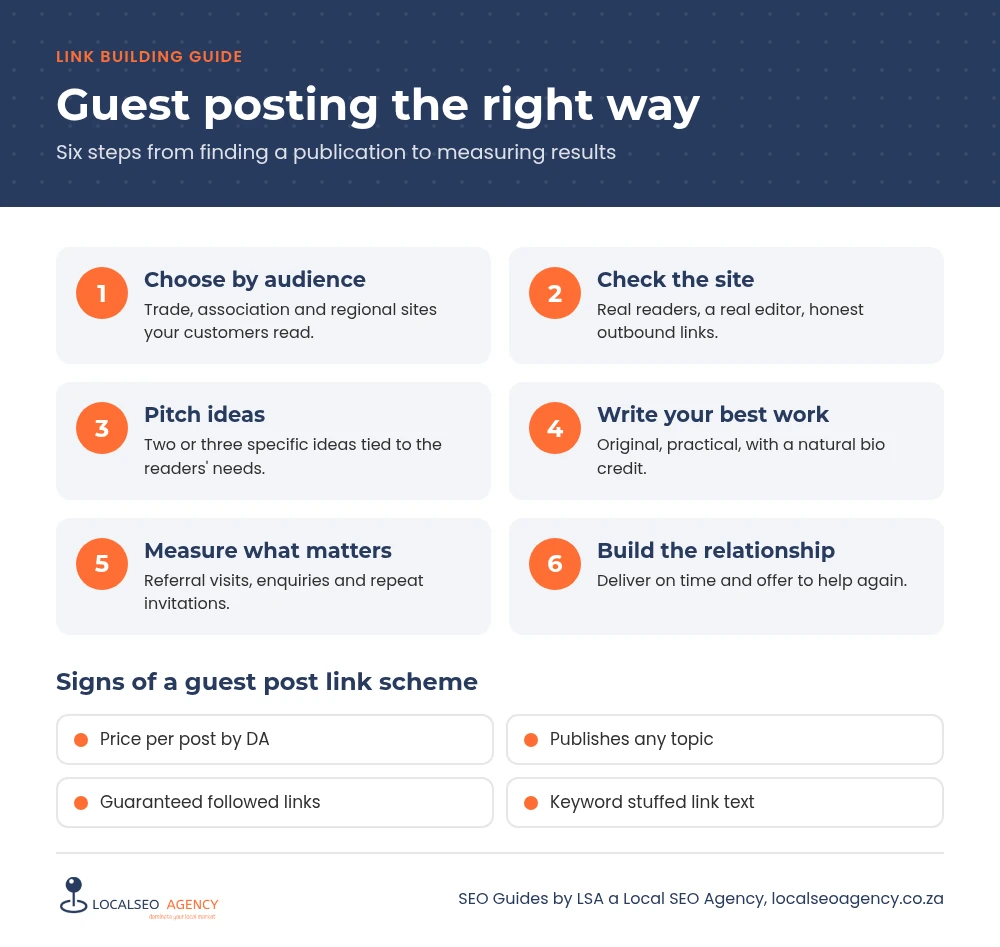
Steer clear of sites that publish on every subject, list a price per post, advertise their Domain Authority as the main selling point, or show page after page of articles that each contain several commercial links. These are signs of a site that exists to sell links, and links from such sites are likely to be ignored or worse.
How to judge a publication before you pitch
A few minutes of checking can save weeks of wasted effort. Before you approach any site, look for honest answers to these questions.
Does it have real readers?
Look for signs of an audience: comments, social shares, a newsletter, an active social media presence or events. A site that publishes constantly but shows no sign that anyone reads it is a poor bet.
Is there an editor?
Real publications have named editors, contributor guidelines and consistent standards. If anyone can publish anything, links from the site carry little weight.
Is it relevant to your customers?
Its subject matter should match your trade, a neighbouring trade, the interests of your buyers or your part of the country. A well targeted small title beats a large unfocused one.
What do its outbound links look like?
Open a few recent articles. If each one contains several commercial links to unrelated businesses, often with keyword rich link text, the site is probably selling links.
Would you be proud to be seen there?
If you would be embarrassed for a customer to find your article on the site, do not publish there.
How to pitch a South African editor
Editors receive many generic pitches. Yours will stand out if it is short, specific and clearly written by someone who has read the publication.
Do your homework
Read several recent articles and the publication's contributor guidelines, if it has any. Note the tone, the length of articles and the topics that seem popular.
Offer ideas, not a finished draft
Suggest two or three specific article ideas, each with a one line summary of why it would help the publication's readers. Ideas tied to timely local issues, such as new regulations, the start of the tax year or seasonal challenges, are particularly attractive.
Show why you are qualified
A sentence or two about your experience is enough. Mention relevant qualifications, years in the trade or notable projects.
Leave links out of the pitch
Do not lead with a request for a link. Ask how the publication normally credits contributors. Many will offer a bio with a link to your business; some will not, and that is their call.
Follow up once
If you hear nothing after about a week, one polite follow up is reasonable. After that, move on.
An example pitch
The example below uses fictional names to show the shape of a pitch that editors tend to answer. It is short, specific and focused on the reader.
Subject: Article idea for your members: preparing guest houses for the winter season
Hi Nomsa, I have read the association blog for a while and found last month's piece on staff training especially useful. I run a small consultancy that helps guest houses in the Western Cape with bookings and operations, and I would like to offer an article for your members. Two ideas: a practical checklist for keeping winter occupancy up, or a plain guide to the questions guests ask most before booking. Either would be around 900 words, original to your blog, and I am happy to follow your guidelines. Kind regards, Sam.
Notice what the pitch does not contain: no request for a link, no mention of Domain Authority, no attachment and no generic praise. It shows that the writer knows the publication and has something useful to offer.
Guest posting and local SEO
For a business that serves a specific town or region, guest posting can support local visibility in a way that national link building cannot. An article on a Free State agricultural news site, a KwaZulu-Natal tourism blog or a Gauteng business chamber's newsletter connects your business to your area in the eyes of readers and search engines alike. Mentioning your town naturally in the article and the bio, and keeping your business name exactly as it appears on your Google Business Profile, helps those signals line up.
Local publications are also more likely to become ongoing relationships. A regional editor who needs a reliable expert on property, finance or tourism will often come back to someone who delivered a good article once.
Writing an article that earns trust
Treat a guest article as seriously as anything on your own site. It represents your business to a new audience.
- Write for the publication's readers, not for search engines.
- Draw on cases you have handled, local detail and lessons learnt on the job.
- Avoid self promotion in the body. Let the quality of the advice do the selling.
- Let links follow the reader's needs. A bio that names your business is usually all the credit you need, and a link in the article itself belongs only where it adds something.
- Never use keyword stuffed link text, such as the exact phrase you hope to rank for.
- Send each publication something written for it alone, never recycled from your own blog or another site.
- Meet the deadline and the word count, and respond quickly to edits.
Paid placements and sponsored content
Some publications charge for contributed content, especially commercial content. That is allowed as advertising. Google's spam policies say paid links are acceptable when they are marked with rel="sponsored" or rel="nofollow". The link will not pass ranking credit, but a sponsored article on a well read publication can still bring visitors and awareness. What breaks the rules is paying for an article with a link that passes ranking credit, or asking a publication to leave the sponsored attribute off.
Be wary of any offer that charges a fee and guarantees a followed link. Our glossary explains how link attributes work.
Measuring guest posting results
Measure what matters for the business:
- Referral visits from each article, visible in your analytics.
- Enquiries or sales from those visitors.
- Invitations to write again, speak or comment.
- New relevant referring domains, where the publication chose to link.
- Rankings for the pages those links point to, over the following months.
Over a year, two or three articles on well read South African publications usually do more for a small business than dozens of placements on sites nobody reads.
Common guest posting mistakes
Nearly every problem here starts when a contribution is treated as a purchase.
- Buying packages of placements from link sellers or marketplaces.
- Choosing sites because of a third party score rather than their readers.
- Sending mass templated pitches to hundreds of blogs.
- Submitting filler content that any writer could have produced.
- Asking for exact match keyword link text.
- Publishing the same article on several sites.
- Ignoring the publication's guidelines or deadlines.
Guest posting versus paid placements
It helps to be clear about the two options. A genuine guest post is accepted on merit, edited by the publication and credited however the publication normally credits contributors. A paid placement is advertising: you pay, the content is published, and the link should be marked rel="sponsored". Both can be legitimate. The mistake is paying for a placement and treating it as if it were an earned editorial link.
Guest posting and outreach
Guest posting works best as part of broader outreach: building relationships with editors, journalists and partners who may also cover your news, quote your experts or list your resources. An editor who enjoyed working with you on one article is far more likely to say yes next time. Over time, those relationships become one of the most valuable assets a business can have online.
Guest articles are one tactic among many. The link building pillar guide shows where they sit alongside PR, partnerships and local listings.
Guest posting questions we hear often
Is guest posting against Google's rules?
No. Writing genuine articles for real publications is fine. What Google's spam policies target is guest posting done mainly for links, especially at scale, with keyword rich link text or where payment buys a link that passes ranking credit.
Should every guest post include a link to my website?
Not necessarily. A credit with your business name is valuable on its own, and many good publications link only in the author bio. Let the publication decide how to credit you.
How many guest posts does a small business need?
There is no magic number. A few articles a year on well read, relevant South African publications are worth far more than a steady stream of placements on sites without readers.
Can I republish my guest article on my own blog?
Generally no, at least not in full. The publication expects original content. You can write a short summary on your own site that links to the full article, which also sends your own readers to it.
A simple guest posting plan for the next quarter
For a small business with limited time, a realistic plan might look like this. In the first month, list ten publications your customers read and check whether they accept contributions. In the second, pitch your three best ideas to the three most relevant. In the third, write and deliver whichever articles are accepted, then share them on your own channels and record the results. Repeat each quarter. It is slow, but every article is an asset that keeps working.
How LSA helps
LSA a Local SEO Agency matches South African businesses with the publications their customers read, develops pitches editors say yes to and writes articles that do the business credit. No paid placements, no networks, and a clear record of every article and link. Find out more on our backlink building page.
Ready to build links that last? Call LSA a Local SEO Agency on 068 786 7331 or contact us to talk about a link building plan for your business.