
SEO Glossary: Backlink Building

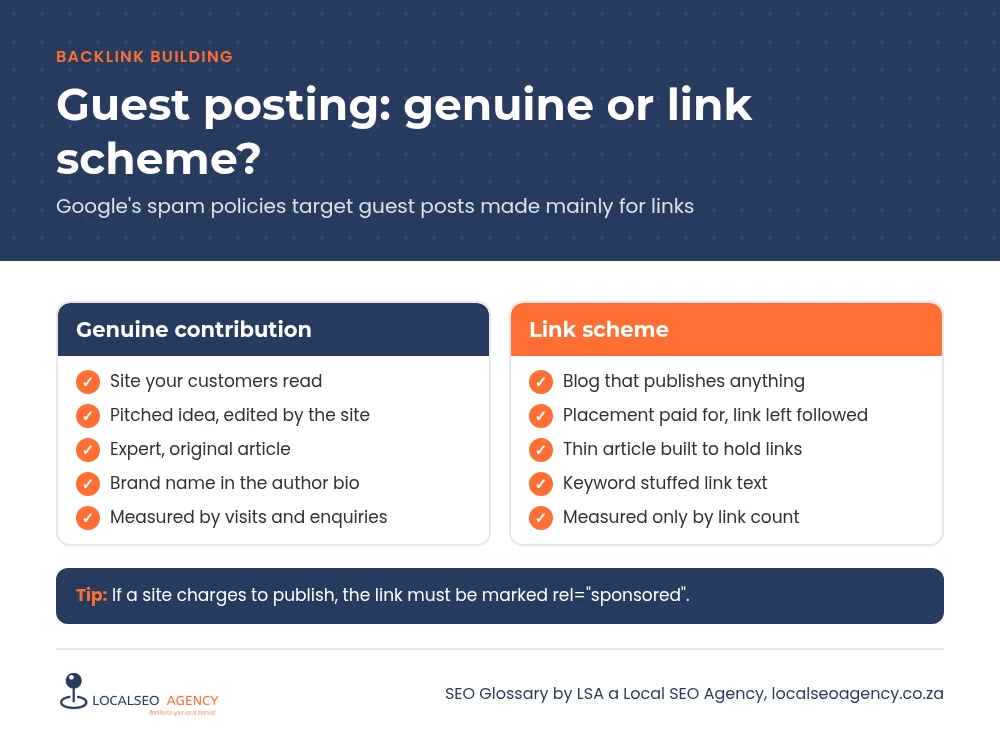
Guest posting means writing an article that is published on another website, usually with a short author bio. Done for the right reasons, it puts your expertise in front of a new audience. Done purely for links, it falls under Google's link spam policies.
Read the full guide to guest posting in South Africa.
The good version
A Johannesburg accountant writes a clear guide to provisional tax for a small business association's blog. The association's members find it useful, some contact the accountant and the article credits the author with a link to their site. The value comes from the audience and the expertise shown. Any link is a by-product of a genuine contribution.
The risky version
Google's spam policies list links with optimised anchor text in articles, guest posts or press releases distributed on other sites as an example of link spam, alongside advertorials where payment is received for articles with links that pass ranking credit. The pattern is easy to spot: thin articles written mainly to carry links, placed on general blogs that accept anything, often for a fee, with the link text stuffed with target keywords. Sites that sell guest posts openly tend to be ignored by Google's systems, so the links often pass nothing.
If a site charges to publish your article, the link should be marked rel="sponsored". That keeps you within the rules, but it also means the link will not count for ranking.
Common guest posting mistakes
- Paying for placement on blogs that publish any topic for anyone.
- Writing thin, generic articles whose main purpose is to hold a link.
- Stuffing author bios with the search term you hope to rank for.
- Pitching the same article to many sites, or reusing content you have published elsewhere.
- Judging the target only by a third party score instead of its audience.
How to guest post well
Choose sites by audience
Look for publications, associations and blogs your customers actually read, in your industry or your area.
Pitch an idea, not a link
Send a short, personal pitch with one or two specific article ideas that fit the site's readers. Show you know the site.
Write your best work
Give the article real substance: experience, examples and practical advice. It represents your business.
Keep links natural
An author bio link using your business name, plus a contextual link only where it genuinely helps the reader, is plenty. Natural anchor text is part of staying safe.
Measure the right things
Track referral visits, enquiries and new relationships, not only links. A single article on a well read association site can bring more work than a dozen links on blogs nobody visits.
Treat guest articles as one tool in a wider outreach plan rather than the whole plan.
Before you send a pitch, read the site's guidelines and a handful of recent articles. Editors receive many generic requests, and a pitch that shows you understand their readers stands out immediately.
How LSA helps
LSA a Local SEO Agency helps clients contribute genuinely useful articles to relevant South African publications and associations, never paid guest post networks. See our backlink building page for how this fits into our wider approach.
For the short definition, see Guest Posting in our SEO Glossary, alongside the other backlink building terms.
Not sure what your current links are doing for you? Call LSA a Local SEO Agency on 068 786 7331 or contact us and we will review them with you.