

TL;DR:
- PPC provides immediate online visibility and lead generation for South African SMBs.
- Properly structured PPC campaigns with geo-targeting and negative keywords ensure efficient ad spend.
- Combining PPC with SEO enhances overall digital marketing performance and ROI.
Most South African businesses assume that building online visibility takes months, and they are right about SEO, but wrong about everything else. Pay-per-click (PPC) advertising, where you pay only when someone clicks your ad, delivers immediate visibility and lead generation in ways that organic search simply cannot match at launch. Yet the majority of local SMBs still hand this advantage to their competitors by believing PPC is reserved for big brands with massive budgets. This article breaks down what PPC actually is, how it works behind the scenes, why it delivers real results for South African businesses, and how you can start applying it strategically, even on a modest monthly spend.
Table of Contents
- What makes PPC different from other marketing channels?
- How PPC works: The mechanics that power results
- Benefits of PPC for South African businesses
- Integrating PPC with other digital marketing strategies
- The smart SMB’s shortcut: What most miss about PPC in South Africa
- Ready to accelerate your growth with PPC and expert strategy?
- Frequently asked questions
Key Takeaways
| Point | Details |
|---|---|
| Immediate online visibility | PPC advertising gets your business in front of targeted customers within days, not months. |
| Control and measurable ROI | You can set your budget, monitor every rand, and see exactly which ads generate leads. |
| Geo-targeting for local leads | PPC allows you to reach only customers searching in your chosen city or neighbourhood. |
| Works with other strategies | PPC data improves your SEO and content, driving faster and smarter long-term growth. |
What makes PPC different from other marketing channels?
Now that you know PPC delivers visibility fast, let us see how it compares to other popular digital marketing strategies.
PPC stands for pay-per-click. It is a model of online advertising where your ad appears on platforms like Google Search, and you only pay when a real person clicks through to your website. Every time someone searches a relevant term, an auction runs automatically in milliseconds, deciding which ads appear and in what order. You are not buying a fixed placement. You are competing in a live system where your bid and the quality of your ad determine your visibility.
This is fundamentally different from SEO, social media marketing, or traditional offline ads. SEO builds authority over time through content, backlinks, and technical optimisation. It can take six to twelve months before you rank consistently. Social media grows your audience and builds brand familiarity, but it rarely drives the same purchase-intent traffic that Google Search does. Offline ads like pamphlets or radio reach wide audiences with no way to track who responded. PPC cuts through all of that with precision and speed.
Understanding PPC vs SEO differences helps you see why these two channels serve different purposes rather than competing directly. The real insight is that PPC complements SEO perfectly: PPC brings in leads from day one while your organic rankings are still building, and the keyword data from your PPC campaigns tells you exactly which search terms convert, informing your SEO content strategy.
| Channel | Speed to results | Cost model | Targeting precision | Measurable ROI |
|---|---|---|---|---|
| PPC | Days | Pay per click | Very high | Immediate |
| SEO | 6-12 months | Time and content investment | High | Long-term |
| Social media | Weeks to months | Pay per impression or click | Medium to high | Moderate |
| Offline ads | Variable | Fixed upfront | Low | Difficult |
The numbers support the case strongly. SMBs globally average $2 revenue for every $1 spent on PPC, with a return on ad spend (ROAS) of 3.5:1, and South African case studies show conversion uplifts of 17 to 50 percent alongside 45 percent lead growth.
Some common misconceptions still hold SA business owners back from trying how PPC advertising works:
- “PPC only works for big companies with large budgets.” Not true. Geo-targeting lets you spend only on your local area, making small budgets highly efficient.
- “I will waste money on irrelevant clicks.” Negative keywords allow you to block searches that do not match your offer, cutting wasted spend significantly.
- “PPC results stop the moment you pause your ads.” True, but you use that controlled period to gather real conversion data that improves all your other marketing.
- “SEO is better, so I do not need PPC.” Both serve different roles. Running them together consistently outperforms running either alone.
“Businesses that combine PPC with SEO see stronger overall performance than those relying on a single channel. The data each generates feeds directly into the other.”
How PPC works: The mechanics that power results
Understanding PPC’s advantages, the next step is seeing exactly how it works behind the scenes, and what tools make it effective for South Africans.
When someone in Cape Town types “plumber near me” into Google, an automated auction fires instantly. Google evaluates every advertiser competing for that keyword using a formula: your bid multiplied by your Quality Score. Quality Score is Google’s rating of your ad’s relevance, your click-through rate history, and the experience on your landing page. A higher Quality Score means you can rank above competitors even while bidding less. This is why ad quality matters as much as budget.

The PPC auction mechanics extend well beyond setting a bid. Three tools are especially powerful for South African SMBs:
Geo-targeting restricts your ads to specific cities, suburbs, or even a radius around your physical store. A Durban restaurant does not need clicks from people in Pretoria.
Negative keywords block your ads from showing for irrelevant searches. If you sell premium accounting software, adding “free” as a negative keyword prevents your budget from being spent on people who will never buy.
Ad scheduling lets you run ads only during hours when your target customers are active and your team can respond to leads, maximising every rand spent.
| Ad setup element | Example for SA SMB | Why it matters |
|---|---|---|
| Geo-target | Sandton, Johannesburg only | Eliminates out-of-area spend |
| Keyword match type | “electrician Joburg” (exact) | Attracts purchase-intent searches |
| Negative keyword | “DIY”, “free” | Reduces wasted clicks |
| Ad schedule | Weekdays 8am to 5pm | Aligns with business hours |
| Daily budget cap | R200/day | Controls total monthly spend |
Launching your first PPC campaign follows a clear sequence:
- Define your goal: leads, calls, form fills, or product sales.
- Research keywords your ideal customers are actually searching.
- Write compelling ad copy with a clear offer and call to action.
- Build or optimise the landing page visitors will arrive on.
- Set your targeting, budget, and bid strategy in Google Ads.
- Launch and monitor performance daily for the first two weeks.
- Adjust bids, pause low performers, and scale what works.
For measuring digital success properly, track cost per lead (CPL) and ROAS from week one so you know your actual numbers rather than guessing.
Pro Tip: A starting PPC budget of R2000 per month, focused tightly on one suburb and two or three high-intent keywords, can generate meaningful lead volume for many local service businesses. Start narrow, prove the model, then scale.
Benefits of PPC for South African businesses
With PPC mechanics understood, let us focus on why these features make a direct impact for South African business owners.
The single most powerful advantage PPC offers is what practitioners call the “switch-on” effect. The moment your campaign goes live, your business appears at the top of Google for the searches that matter most. There is no waiting period. A new bakery in Stellenbosch can be visible to hungry customers within 48 hours of deciding to advertise. That immediacy simply does not exist with any other digital channel.
The numbers behind the results are compelling. ROAS averages 3.5:1 for SMBs, meaning every R3500 in ad spend returns R12,250 in revenue on average. South African case studies show 17 to 50 percent more conversions and 45 percent more leads after running targeted PPC campaigns.
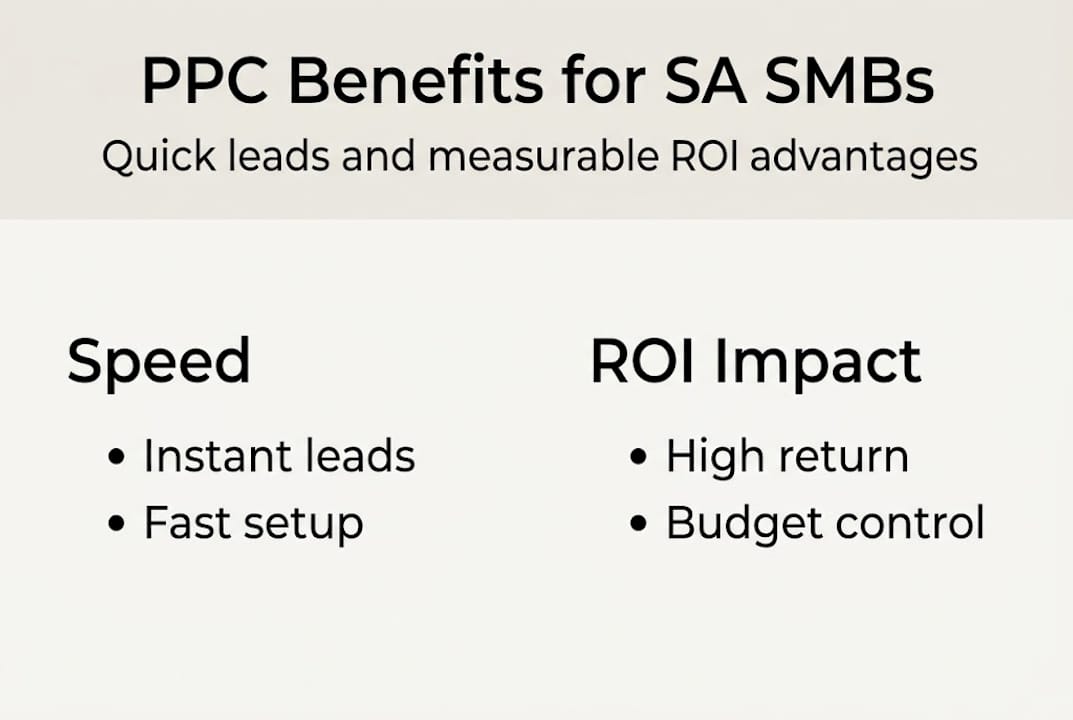
Budget control is another practical advantage that gets overlooked. You set a daily cap, and Google will never exceed it. You can pause a campaign on a public holiday, increase spend during your busiest season, or drop a campaign entirely if you are fully booked. No other advertising medium gives you that level of moment-to-moment control without penalty.
Local targeting capability is particularly valuable in South Africa where suburbs often represent distinct customer segments with different income levels, commuting patterns, and buying behaviours. Geo-targeting local searches in specific Joburg suburbs, for example, lets a business skip irrelevant impressions entirely and spend only where their actual buyers are searching.
Additional benefits that SA SMBs consistently report include:
- Real-time ROI tracking: Know your cost per lead and revenue per campaign without guesswork.
- Instant testing: Run two versions of an ad headline to see which one converts better before committing to a message across all channels.
- Audience insights: Learn which demographics, devices, and times of day generate your best customers.
- Flexibility: Adjust offers, landing pages, and bids based on what the data shows, not what you assume.
- Integration with identifying high-converting keywords: PPC data reveals exactly which terms drive revenue, sharpening your broader search strategy.
For businesses focused on improving online reach across competitive local markets, PPC provides the fastest feedback loop available in digital marketing.
Pro Tip: Split-testing two versions of your ad headline, where only one element changes between them, can reveal which message resonates and double your conversion rate without spending more. Test one variable at a time and wait for at least 100 clicks before drawing conclusions.
Integrating PPC with other digital marketing strategies
To extract the most value, you will want to link your PPC efforts to everything else you are doing online.
PPC and SEO are often positioned as alternatives, but treating them that way leaves serious value on the table. PPC fills the visibility gap while your SEO strategy is still building momentum. If your organic rankings are six months away from page one, your PPC campaign can be delivering qualified leads today. The two channels run in parallel without interference, and the combined effect is stronger than either alone.
The data PPC generates is one of its least appreciated gifts. Every keyword that produces a conversion is a direct signal that your SEO content strategy should prioritise that topic. Every ad headline that earns a high click-through rate is a proven message worth incorporating into your website copy, meta descriptions, and email subject lines. PPC functions as a real-world testing lab that pays for its own insights through the leads it generates.
According to SEO vs PPC research, the combination of immediate PPC leads and organic SEO authority consistently outperforms businesses that rely on a single channel. The data each generates feeds directly into the other.
Practical ways to apply PPC learnings across your digital campaigns include:
- Use top-performing PPC keywords as the focus topics for your next SEO blog posts or landing pages.
- Adapt high click-through ad copy into social media captions and organic post headlines.
- Test promotional offers with a small PPC spend before rolling them out across your entire website.
- Use PPC audience data (age, device, location) to sharpen your social media targeting.
- Identify negative keywords from PPC reports to understand what your audience is NOT looking for, which refines your content focus.
For a solid foundation in tracking what works, SEO reporting basics gives South African SMBs a framework for measuring both organic and paid performance in a unified way.
Testing a new service offering on a PPC landing page before building it into your main site is one of the highest-leverage tactics available. You can validate demand within two weeks, at a fraction of the cost of a full website rebuild, and only invest in pages that the data confirms will convert.
The smart SMB’s shortcut: What most miss about PPC in South Africa
Most South African small business owners who avoid PPC are not being unreasonable. They have watched money disappear on Facebook boosted posts with no clear return, or they have heard cautionary tales from someone whose Google Ads account burned through R10,000 without a single lead. These experiences are real, but they are almost always the result of poor setup rather than a flaw in PPC itself.
The uncomfortable truth is that PPC run without proper keyword targeting, negative keyword lists, and a relevant landing page will lose money. PPC run with those elements in place will almost always produce a positive return. The difference is not budget size. It is structure and continuous attention.
Hyper-local targeting is where small South African businesses hold a genuine advantage over national brands. A large retailer cannot afford to write separate ad copy for Melville versus Melrose Arch. You can. That specificity in language, offer, and relevance wins clicks and conversions at a disproportionate rate.
The set-and-forget mindset is the most expensive mistake in PPC. Campaigns need weekly reviews. Bids need adjustment as competition shifts. Ad copy needs refreshing when click-through rates drop. Businesses that treat PPC as a tap to turn on and ignore consistently underperform those that treat it as an ongoing conversation with the market.
How top SA SEO companies use PPC alongside organic strategies reveals a consistent pattern: they start with tight geographic targeting, test two or three ad variations, measure cost per lead weekly, and scale only what the data confirms is working.
Pro Tip: Commit a fixed test budget, something like R3000, for 30 days to a single tightly defined campaign. Measure the cost per lead you achieve. That number tells you more than any assumption, and it gives you a rational basis for deciding whether to scale or adjust.
Ready to accelerate your growth with PPC and expert strategy?
If you have been sitting on the fence about paid advertising, the evidence is clear: PPC delivers measurable leads faster than any other digital channel, works on modest budgets when set up correctly, and generates data that sharpens every other part of your marketing.
At Local SEO Agency, we work with South African SMBs to build PPC campaigns that are tightly targeted, properly structured, and built to generate a real return. Whether you are starting with our in-depth guide to PPC to understand the foundations, exploring local SEO strategies to complement your paid campaigns, or ready to discuss a customised plan, we are here to help you move from reading about results to actually generating them. Explore page indexing techniques as part of your broader digital foundation, and reach out when you are ready for a tailored strategy session.
Frequently asked questions
How quickly can I see results from PPC advertising in South Africa?
PPC delivers traffic and leads within days of launching, making it the fastest route to online visibility for South African SMBs. Unlike SEO, you do not need to wait months before seeing measurable activity.
What is the typical return on ad spend for South African SMBs using PPC?
Average ROAS sits at 3.5:1 globally, and South African case studies show 17 to 50 percent more conversions alongside 45 percent lead growth for businesses running well-structured campaigns.
Is PPC suitable for smaller budgets in South Africa?
Yes. Many SMBs start successfully with R2000 to R5000 per month by targeting specific local areas and a small set of high-intent keywords rather than broad national campaigns.
How does PPC help with local lead generation?
Geo-targeted PPC ads display your business only to people searching within your chosen area, such as a specific suburb or city, ensuring your budget is spent on the most relevant and conversion-ready local audience.