
TL;DR:
- SEO results in South Africa typically take at least six months of consistent effort to become meaningful.
- Initial improvements can appear within weeks, but sustainable growth depends on ongoing technical, content, and backlink strategies.
Running a business in South Africa is demanding enough without the added frustration of pouring money into SEO and seeing little movement for weeks on end. The gap between what most business owners expect from SEO and what actually happens is one of the most common sources of disappointment in digital marketing. The truth is, SEO does not behave like a paid ad that switches on the moment your budget clears. It operates more like a well-tended garden: the early work sets deep roots, and the real rewards come to those who stay the course.
Table of Contents
- How SEO works: What takes time behind the scenes
- SEO timelines: From quick wins to sustainable growth
- Factors affecting SEO timelines for South African businesses
- Applying long-term SEO for real business growth
- The uncomfortable truth most experts won’t tell you about SEO timeframes
- Ready to invest in SEO for lasting results?
- Frequently asked questions
Key Takeaways
| Point | Details |
|---|---|
| Expect gradual progress | SEO typically takes 3-6 months for early gains and 6-12 months for sustained ROI. |
| Site history matters | New domains see slower growth due to Google’s sandbox effect, while established sites improve faster. |
| SEO is cumulative | Technical fixes bring quick wins, but content and backlinks fuel lasting improvements. |
| Monitor and invest consistently | Regular tracking and strategic investment are key to long-term online visibility. |
How SEO works: What takes time behind the scenes
Having set the stage for why SEO feels slow, let’s look at the technical reasons behind these time lags. Before your website can rank on Google, it must go through three distinct stages: crawling, indexing, and ranking. Each stage takes time, and each introduces its own delays.
Crawling is when Google sends automated bots, called “spiders,” to visit your website and read its content. The frequency of these visits depends on how often your site is updated, how well it is structured technically, and how many other sites link to it. A site that publishes fresh content regularly and has clean code gets crawled more often. A static site with no updates might wait weeks between crawls.
Indexing happens after crawling. Google stores the information it finds in its massive database, called the index, so it can serve your pages as search results. But getting indexed does not mean getting ranked. It simply means Google now knows your page exists.
Ranking is the final stage, and it is the most complex. Google uses over 200 factors to decide which pages appear in which order for any given search. When changes are made to your site, rank updates do not happen instantly. As Google’s own guidance confirms, crawl, index, and rank transitions require time: crawling large or JavaScript-heavy sites takes longer, new sites face a sandbox delay, and rank changes are phased in over weeks or even months.
Here are the core technical reasons why SEO timelines stretch out:
- JavaScript rendering delays: Sites built on heavy JavaScript frameworks take longer for Google to fully process because the bots must first render the code before reading the content.
- Crawl budget limitations: Larger sites have a finite “crawl budget,” meaning Google only visits a set number of pages per crawl cycle. Low-priority pages wait longer.
- The sandbox effect: Brand new domains often experience an invisible holding period where Google limits their visibility while it assesses trustworthiness.
- Algorithm update rollouts: Even when a change is made, Google’s ranking updates roll out over days and weeks, not minutes.
“Understanding that Google’s processes are sequential and deliberate is the first step to setting realistic expectations. SEO is not a switch. It is a slow dial.”
For South African SMB owners, understanding search rankings is especially important because local factors, mobile usage patterns, and regional search behaviour add further complexity to how quickly your site gains visibility. The SEO challenges for SMEs in South Africa are real, but they are absolutely manageable with the right strategy and realistic timelines.
SEO timelines: From quick wins to sustainable growth
Now that we understand the processes, let’s see how these translate to timelines and actual business results. The good news is that not everything takes a year. Some SEO actions produce noticeable improvements within weeks, while others build compounding returns over many months.
Here is a realistic breakdown of what to expect at each phase:
| Timeframe | What typically happens |
|---|---|
| Weeks 1 to 4 | Technical fixes go live: broken links repaired, site speed improved, mobile usability resolved |
| Months 1 to 3 | Google begins to re-crawl and re-index updated pages; minor ranking shifts appear |
| Months 3 to 6 | Initial measurable results appear for small businesses, including ranking improvements and traffic increases |
| Months 6 to 12 | Significant ROI becomes visible; content and backlinks compound; significant ROI in 6-12 months is the realistic expectation |
| 12 months and beyond | Organic traffic becomes a consistent, self-reinforcing channel with lower cost per lead than paid ads |
Why the compounding effect matters. Every quality piece of content you publish, every reputable backlink you earn, and every technical issue you resolve adds to a growing foundation. Unlike a paid ad that stops the moment you pause the budget, SEO gains stay. A blog post you publish today may still be driving traffic three years from now. This compounding effect is what makes SEO so powerful for South African SMBs who want sustainable visibility without permanent ad spend.
The SEO reporting essentials phase is where many businesses lose patience. They see a small uptick in clicks in month two and expect a hockey stick by month three. When it does not come, they question whether SEO is working. What they are actually seeing is the early root system forming underground. The growth above the surface comes later, and it comes fast when it does.
A critical benchmark for South African business owners: Google itself states that improvements take 4 months to a year to show after SEO implementation. This is not a pessimistic disclaimer. It is an honest guide from the search engine that controls the game. Planning your SEO investment with this in mind protects your budget and your expectations.
Key milestones to track during this growth period include:
- Organic impressions in Google Search Console (an early signal before clicks arrive)
- Keyword rankings for your target terms
- Click-through rates from search results to your website
- Organic traffic volume month over month
- Conversion rates from organic visitors, such as calls, form fills, and quote requests
Pairing the right SEO strategies for SMEs with consistent measurement keeps your investment focused and your expectations grounded. Without a clear framework for tracking progress, many business owners mistake a slow ramp-up for failure.
Factors affecting SEO timelines for South African businesses
Understanding timelines is useful, but the actual speed of your results depends on factors specific to your business. Let’s explore the reasons why results may be faster or slower based on your individual situation.
1. Domain age and history
An established domain with years of credible backlinks and consistent content will rank faster than a brand new website. New domains often face what SEO professionals call the “sandbox,” a period where Google withholds rankings while it builds trust in the domain. New domains face a sandbox delay of 3 to 6 months or more, even when the site is technically well optimised. This is not a penalty. It is Google’s caution with unknown entities.
A professional SEO audit early in the process can reveal whether your domain has legacy penalties, toxic backlinks, or technical debt from a previous developer. These issues extend timelines significantly if left unaddressed.
2. Market competition
The level of competition in your market is one of the biggest factors influencing timeline. Consider these scenarios:
| Scenario | Competition level | Typical time to visible results |
|---|---|---|
| Niche service in a small South African town | Low | 2 to 4 months |
| Regional service in a mid-sized city like Bloemfontein | Medium | 4 to 6 months |
| National brand in a competitive industry like insurance or legal services | High | 9 to 18 months |
| Local service in a major metro like Johannesburg or Cape Town | Medium to high | 6 to 12 months |
The more competitors are investing in SEO in your space, the harder you must work to outrank them. This does not make SEO futile. It simply means your strategy must be sharper and your patience longer.
3. Website technology
How your website is built matters a great deal. Sites built on clean, crawlable HTML load faster and get indexed more easily. Sites built entirely on JavaScript frameworks like React or Angular require Google to render the code before reading the content, which slows crawling significantly. If your developer built your site for looks rather than technical SEO, you may be starting with a structural handicap. A professional SEO optimisation service includes a full technical assessment to identify and resolve these barriers early.
4. South African local context
South Africa has unique search behaviour characteristics that affect SEO timelines. Mobile usage is exceptionally high, with a large portion of searches happening on lower-end smartphones over mobile data connections. This means your site’s mobile performance is not optional. It is critical. Pages that load slowly on a 4G connection in Durban will be demoted in mobile search results regardless of how good your content is.

Language is another factor. Searches happen in English, Zulu, Afrikaans, Sotho, and combinations of these. A business serving a multilingual community in Pretoria may benefit from content in multiple languages, which takes additional time to produce but can open up significant organic traffic channels that competitors ignore.
Pro Tip: Use Google Search Console to check which search queries are already sending traffic to your site. Even in the early months, you will find keyword gems worth optimising around that you never thought to target.
The numbered list of the most impactful factors you can control to speed up your SEO timeline:
- Fix critical technical errors immediately (crawl errors, broken links, slow page speed)
- Publish consistent, genuinely useful content targeting specific search queries your customers use
- Earn backlinks from reputable South African directories, industry publications, and local partners
- Optimise your Google Business Profile if you have a physical location or serve a specific area
- Ensure your site loads in under 3 seconds on mobile connections
Applying long-term SEO for real business growth
With the influencing factors in mind, it is time to apply what works for real, lasting visibility gains. Many South African businesses get this phase wrong, not because they lack commitment, but because they focus on the wrong actions at the wrong time.
The most important principle to understand here is that SEO is cumulative: early technical fixes deliver quick wins in weeks, but sustainable growth comes from the compounding effect of consistent content, high-quality backlinks, and improved user behaviour over months. This makes SEO fundamentally different from paid advertising, where results stop the moment spend pauses.
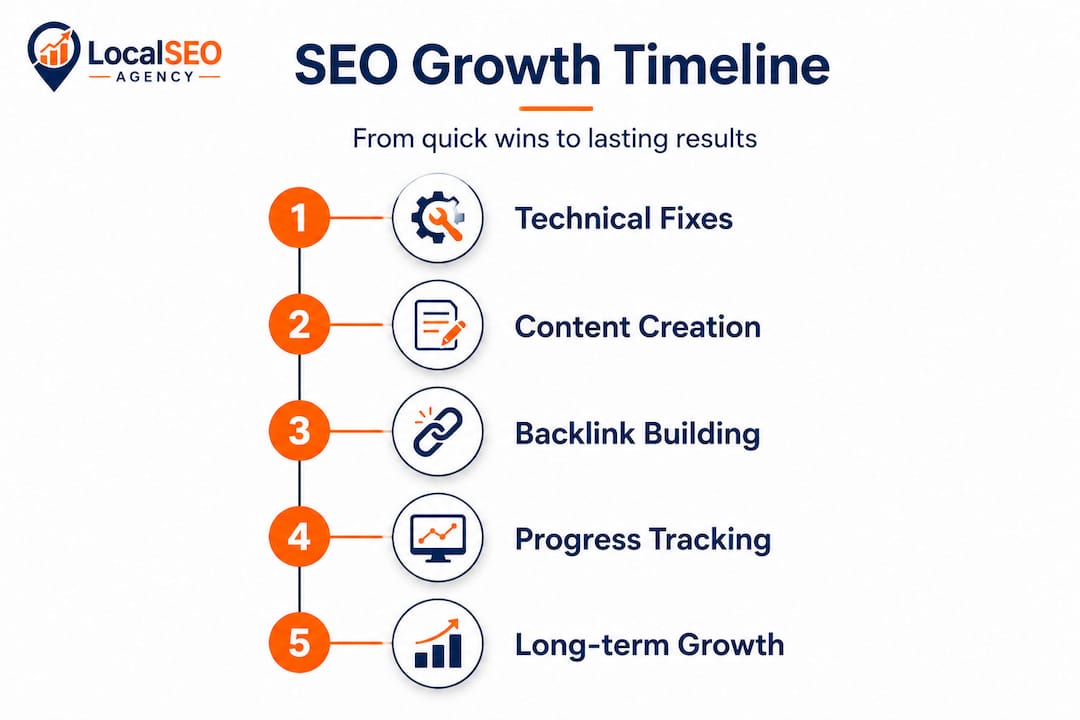
Here is how to structure your long-term SEO effort for maximum return:
Focus on content quality, not quantity. One well-researched, genuinely useful article that answers a specific question your target customer is asking will outperform ten thin blog posts every time. Google rewards depth, relevance, and expertise. Write for your customer first and the algorithm second.
Build backlinks the right way. Authentic links from relevant South African websites, industry directories, local business associations, and media mentions carry far more weight than bulk links purchased from overseas link farms. Shortcuts in backlinking are one of the fastest ways to earn a Google penalty that sets your timeline back by years.
Track progress at sensible intervals. Checking your rankings daily is a waste of energy and leads to anxiety over normal fluctuations. Instead, review your SEO metrics monthly. Compare quarter over quarter, not week over week. Use tools like Google Search Console, Google Analytics, and a rank tracking tool to build a clear picture of progress over time. Consistent improving Google rankings require patience and disciplined measurement.
Balance technical and content work. Many businesses fix their technical SEO in month one and then wait. Without fresh content and ongoing link building, the technical fixes will stall. Think of technical SEO as the foundation and content as the structure built on top of it. You need both.
Avoid common pitfalls:
- Chasing quick fixes like keyword stuffing, link buying, or doorway pages
- Changing your SEO strategy every few months out of impatience
- Ignoring mobile performance because “most of our customers are on desktop” (in South Africa, this assumption is usually wrong)
- Publishing content without a clear keyword strategy
- Not claiming or optimising your Google Business Profile for local searches
Pro Tip: Set a 90-day SEO plan with specific milestones: technical audit complete by week 4, first five content pieces published by week 8, first backlink outreach campaign running by week 10. Structured milestones keep your investment focused and give you something to measure against.
The uncomfortable truth most experts won’t tell you about SEO timeframes
Here is where we move past the standard advice and say what most SEO articles dance around. The real reason so many South African businesses are disappointed with SEO is not because their strategy was wrong. It is because they were sold results on a timeline that was never honest to begin with.
The SEO industry has a long history of over-promising. Agencies have told business owners they will rank on page one in 30 days. Freelancers have promised traffic doubling in 60 days. These promises feel good in the proposal stage, but they set businesses up for disappointment and distrust. When the results do not arrive on the promised schedule, the business owner blames SEO itself rather than the unrealistic expectation.
The uncomfortable truth is this: for most South African SMBs operating in moderately competitive markets, meaningful SEO results require six months of consistent, disciplined work at minimum. Full stop. Anyone telling you otherwise is either chasing your signature on a contract or selling you shortcuts that will hurt you later.
Another truth that gets glossed over is the difference between vanity metrics and real business results. Ranking for your business name is not a win. It is the baseline. True SEO progress means measuring SEO progress through organic traffic from customers who do not yet know your brand, conversions from search visitors, and improvement in rankings for commercially valuable keywords.
Fast fixes rarely deliver lasting impact because Google’s algorithm is specifically designed to detect and discount them. Keyword stuffing gets spotted within weeks. Purchased links get flagged through algorithm updates. Doorway pages get deindexed. Every shortcut creates technical debt that a legitimate SEO strategy will eventually have to clean up, and cleaning up that debt adds months to your timeline.
The businesses that win with SEO in South Africa are the ones who treat it like a long-term business asset rather than a short-term marketing campaign. They invest consistently, measure honestly, and resist the urge to pivot every time results feel slow. Strategy and patience are not passive qualities in SEO. They are active competitive advantages.
Ready to invest in SEO for lasting results?
Understanding why SEO takes time is the first step toward using it effectively as a growth tool for your business. But knowing the theory is one thing. Executing a consistent, technically sound, content-driven strategy month after month is another entirely.
At LSA SEO Agency, we work specifically with South African SMBs who are ready to build genuine, lasting online visibility. Whether you are starting fresh or trying to revive a stalled strategy, our team offers transparent timelines, honest reporting, and strategies built for the South African search landscape. Explore our best SEO optimisation service to see how we approach sustainable growth, or browse our SEO packages South Africa to find an option that fits your budget and ambitions. Ready to talk? Contact LSA SEO Agency and let’s map out a realistic path forward for your business.
Frequently asked questions
How long before my business sees SEO results?
Most small businesses see initial ranking improvements within 3 to 6 months, with significant traffic and ROI gains becoming clear in the 6 to 12-month window.
Why does my new website take longer for SEO to work?
New websites often experience the Google sandbox effect, where Google delays rankings for 3 to 6 months or more while it establishes domain trust, even if your on-page SEO is well optimised from day one.
Can technical fixes help SEO faster?
Yes. Technical SEO improvements like fixing crawl errors and improving page load speed often show quick wins within weeks, though these early gains must be followed by sustained content and link-building efforts for lasting results.
What slows SEO for South African businesses?
SEO progress is slowed most commonly by JS-heavy site builds, highly competitive local markets, inconsistent content publishing, and poor mobile performance on South Africa’s mobile-first internet landscape.