
SEO Glossary: SEO Content

A pillar page gives a broad, thorough overview of one core topic. A topic cluster is the set of narrower articles around it. Together they turn a scattered blog into an organised body of knowledge that both readers and Google can follow.
How pillars and clusters fit together
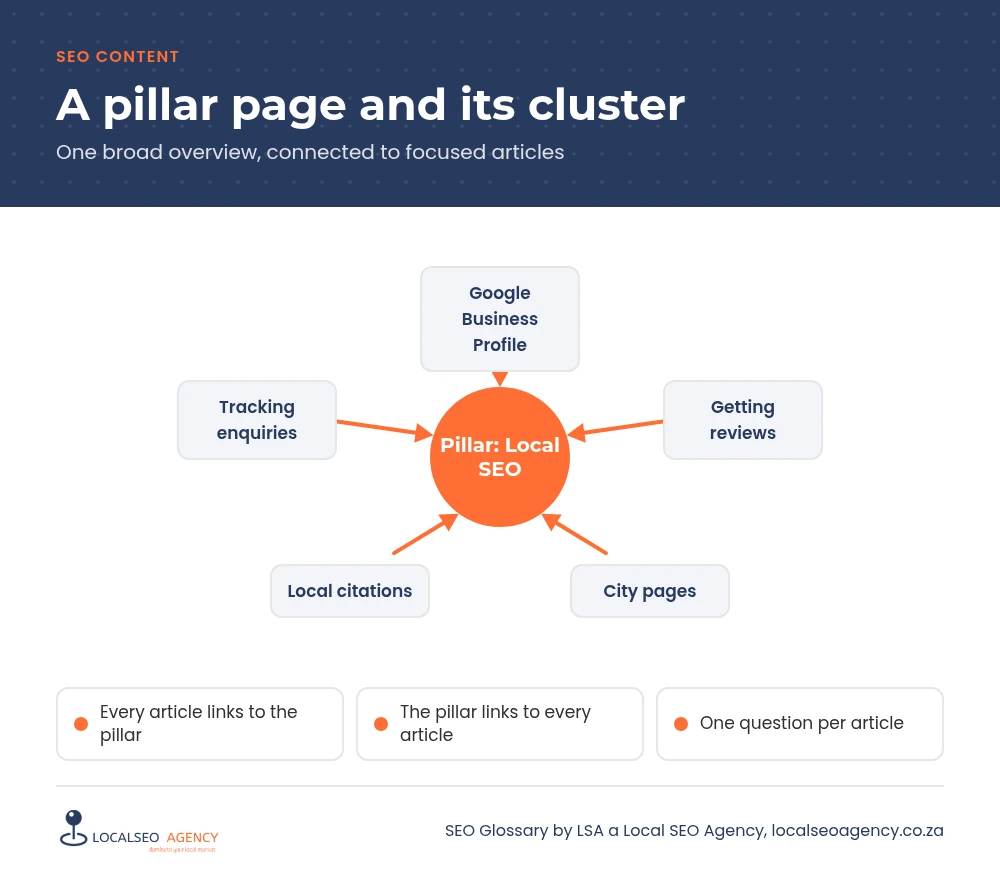
Take local SEO as an example. The pillar page covers the whole subject at a useful depth: what it is, how it works, the main factors and what a business should do first. Cluster articles each go deep on one part, such as setting up a Google Business Profile, getting more reviews or writing city pages. Each cluster article links to the pillar, the pillar links to each article, and related articles link to each other.
The pillar is often a service page or a guide closely tied to one. That way the strength built by the whole cluster flows towards a page that can bring in work.
Why the structure helps
Search engines try to understand which sites cover a subject thoroughly. A group of connected pages, each answering a different question, is a much clearer signal than a dozen unrelated posts. Visitors benefit too. Someone who lands on a narrow article can move to the overview or to the next step without going back to Google.
Clusters also prevent keyword cannibalisation. When every page has a defined place in the plan, you are far less likely to write two pages that chase the same search.
How to plan a cluster
Choose the pillar topic
Pick a core service or subject that matters to revenue and is broad enough to have many questions around it.
List the questions
Gather the questions customers ask about that topic and group the close variations. Each group becomes one cluster article.
Audit what exists
Many sites already have several posts that belong in the cluster. Improve and connect them before writing new ones, and merge posts that overlap.
Link deliberately
Add descriptive internal links between the pillar and every article, using wording that describes the destination.
Common pillar and cluster mistakes
- A pillar so thin it is just a list of links to the articles.
- Cluster articles that never link back to the pillar.
- Topics chosen because they are popular, not because they relate to what you sell.
- Two articles in the same cluster answering the same question.
- Building the cluster once and never adding to or updating it.
Measuring whether a cluster works
Judge the cluster as a group rather than post by post. In Search Console, filter the Performance report by the folder or by pages that share the topic, and watch whether the total number of searches the group appears for grows over time. Then check the pillar itself: is it earning more impressions and clicks as articles are added and linked? Finally, look at enquiries from visitors who entered on a cluster article. If the articles attract readers but nobody reaches the pillar or service page, the links between them need to be more prominent.
How LSA helps
LSA a Local SEO Agency maps your existing posts into clusters, identifies gaps and overlaps, and builds pillar pages that link to the services you want to grow. It forms part of our SEO content services. Our guide to content clusters and SEO goes into more detail.
For the short definition, see Pillar Pages and Topic Clusters in our SEO Glossary, alongside the other SEO content terms.
Need this written or rewritten properly? Call LSA a Local SEO Agency on 068 786 7331 or contact us today.