
SEO Glossary: SEO Content

A meta description is a short summary of a page, written in the page's code, that Google may show under your title in the search results. It does not directly change rankings, but it can decide whether someone clicks your result or the one below it.
What a meta description is
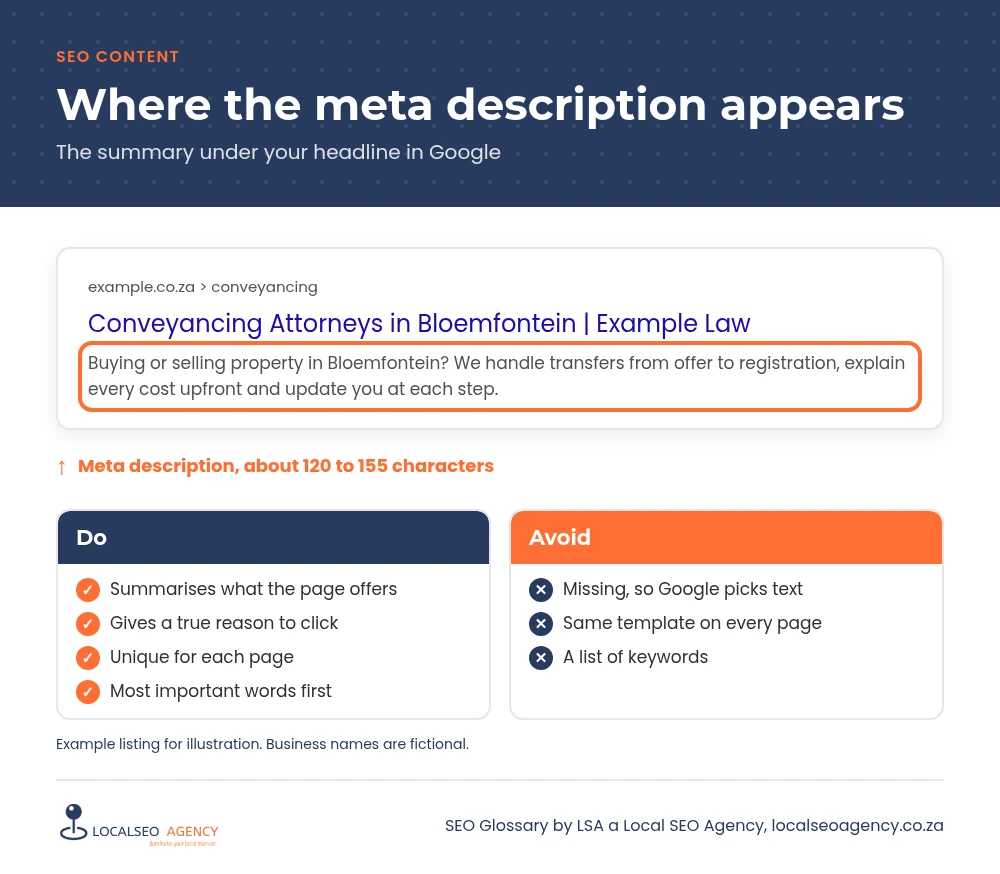
The meta description is an HTML tag in the head of the page. In WordPress it is usually set in the SEO plugin, below the SEO title. It is never seen on the page itself. Its only stage is the results page, where it appears as the grey text under your headline when Google chooses to use it.
Google often writes its own snippet instead, using text from the page that better matches the specific search. That is normal. A good description still matters, because it is used for many searches, especially those that closely match the page's main topic, and many SEO plugins reuse it as the summary when the page is shared on social media.
Why it matters
The description is your advert in the results. Two listings can rank next to each other, and the one with a clear, relevant summary will usually earn more clicks. More clicks from the same position means more visitors and more enquiries without needing to rank any higher.
How to write a good meta description
Say what the page offers
Summarise the content in one or two plain sentences. Match what the searcher is looking for, using the words they would use.
Give a reason to click
Mention something concrete: free quotes, same week visits, a step by step guide, the areas you cover. Only claim what is true.
Mind the length
Aim for roughly 120 to 155 characters. Google trims longer descriptions by pixel width, so put the most important part first.
Make each one unique
Every important page should have its own description. Repeating one sitewide gives Google no useful summary.
Common meta description mistakes
- No description at all, so Google pulls a random sentence from the page.
- One template description copied across dozens of pages.
- Strings of keywords that read like a list rather than a sentence.
- Descriptions that promise discounts or services you do not offer.
- The first lines of a cookie notice or menu appearing instead of real content.
Writing descriptions at scale
Start with the pages that matter most to revenue: the homepage, service pages, location pages and the guides that bring the most visitors. Write those by hand. For large numbers of older blog posts, a short, accurate summary is far better than a clever one, so do not let perfection hold up the job.
Write the description together with the title tag, reading them as a pair. The title earns attention and the description confirms the click is worth it. Avoid repeating the title word for word.
Then check how your listings actually appear for your main searches. If Google is consistently ignoring your description for a page, it is often a sign that the description does not match what people search for, or that the page itself needs a clearer opening paragraph.
How LSA helps
LSA a Local SEO Agency writes meta descriptions for your key pages in plain South African English, each one matched to the search it targets and the action you want. They are included in our on page SEO services.
For the short definition, see Meta Description in our SEO Glossary, alongside the other SEO content terms.
Have a question about your own pages? Call LSA a Local SEO Agency on 068 786 7331 or contact us for plain, practical advice.