
SEO Glossary: SEO Content
E-E-A-T stands for Experience, Expertise, Authoritativeness and Trustworthiness. It is the framework Google gives its human quality raters for judging whether content and the people behind it deserve to be believed.
Where E-E-A-T comes from
Google employs thousands of quality raters who review search results and score them against a published document, the Search Quality Rater Guidelines. Their scores do not change rankings directly. Instead, they help Google test whether its ranking systems are surfacing reliable content. E-E-A-T is the set of qualities those raters are asked to look for, so it describes what Google's systems are designed to reward.
The first E, for experience, was added at the end of 2022. It recognises that first hand experience, such as having actually done the job, can be as valuable as formal qualifications.
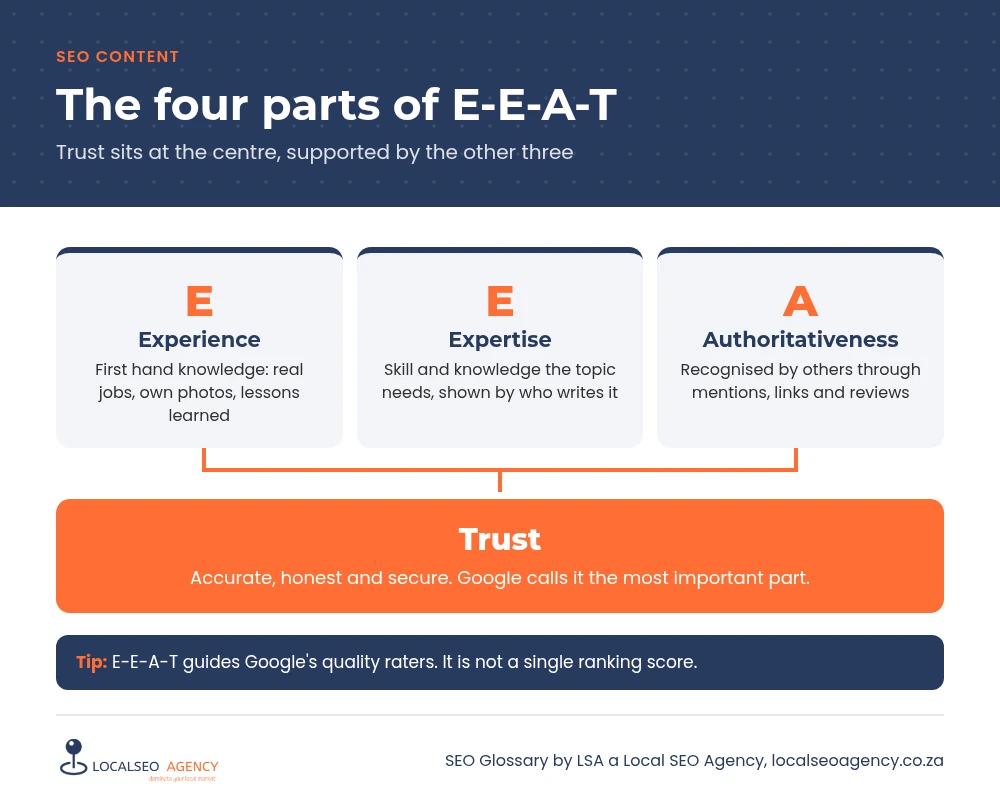
The four parts
Experience
Does the content show the writer has personally done or used the thing described? Real photos, specific details and lessons learned on actual jobs all demonstrate it.
Expertise
Does the writer have the knowledge or skill the topic requires? This matters most for financial, legal, medical and safety topics.
Authoritativeness
Is the business or person a recognised source on the subject? Mentions, links and reviews from others build this over time.
Trustworthiness
Google describes trust as the most important part. Accurate information, clear contact details, honest claims and a secure site all contribute. The other three support it.
Why it matters for local businesses
People searching for a service provider want to know they can rely on you. The same signals that persuade a cautious customer, such as a real address, a named team, genuine reviews and honest explanations, are the signals E-E-A-T describes. Pages that could have been written by anyone, about any business, give neither the customer nor Google much reason to choose you.
Common E-E-A-T gaps
- No about page, team names or physical business details anywhere on the site.
- Articles with no author or with a generic admin byline.
- Claims of being the best or number one with nothing to support them.
- Copy rewritten from other sites, with no first hand detail.
- Outdated facts, broken contact forms or a site without HTTPS.
How to show E-E-A-T
Add author names and short bios to guides, especially where the author has relevant experience. Use your own photos of jobs, premises and staff. Explain your process in detail. Keep an accurate about page, contact page and business information that matches your Google Business Profile. Collect and display genuine reviews, and respond to them.
Most importantly, write from what you know. A paragraph on a problem your team saw on a real job in Potchefstroom says more about experience than any general summary. That kind of detail is also what makes content helpful.
E-E-A-T is not a score you can check or a plugin you can install. It is the overall impression your site and your reputation give. Small, consistent improvements across many pages build it more reliably than one big change.
How LSA helps
LSA a Local SEO Agency helps you surface the experience and expertise your business already has, through author details, process pages, real examples and accurate business information. It runs through all of our SEO content services.
For the short definition, see E-E-A-T in our SEO Glossary, alongside the other SEO content terms.
Need this written or rewritten properly? Call LSA a Local SEO Agency on 068 786 7331 or contact us today.