

TL;DR:
- Most South African SMEs see 85% of local search traffic from optimized Google Business Profiles.
- Consistent effort in local SEO fundamentals leads to sustainable web traffic growth.
- Mobile optimization and locally relevant content are crucial for attracting and engaging South African users.
Getting your website noticed in South Africa’s crowded digital market is genuinely hard. You can have a great product, a professional-looking site, and still watch the visitor counter barely move. The frustration is real, and it’s shared by thousands of SME owners across the country. The good news is that 85% of local search traffic for South African SMBs comes from an optimized Google Business Profile, which means the basics matter enormously. This guide walks you through every practical step, from assessing your current site to creating content that resonates with local audiences, so you can build lasting, qualified web traffic without guesswork.
Table of Contents
- Assess your current website and set traffic goals
- Master Google Business Profile for local SEO impact
- Optimize on-page elements for South African users
- Create valuable, locally relevant content
- Track, test, and improve your SEO performance
- The real reason most SA SMEs fail to increase web traffic
- Accelerate your SEO growth with expert support
- Frequently asked questions
Key Takeaways
| Point | Details |
|---|---|
| Start with local SEO | Optimizing your Google Business Profile and local info gives the fastest traffic boost. |
| Prioritize mobile experience | Ensuring your site works perfectly on mobile is critical for South African users. |
| Focus on local content | Publish blog posts that answer real questions from your SA customers for steady growth. |
| Measure and adapt | Track your website’s results monthly and adjust your strategies for continuous improvement. |
Assess your current website and set traffic goals
Before you change a single thing on your site, you need to understand what you’re actually working with. Jumping straight into tactics without a baseline is like driving to an unfamiliar destination without checking your fuel gauge first. Start by connecting your site to Google Search Console and Google Analytics. These free tools show you which pages attract visitors, which search terms bring people in, and where users drop off.
In South Africa, mobile-friendliness is non-negotiable because over 90% of users access the web via mobile devices. This means your assessment must prioritize mobile performance above almost everything else. Check load times on a 4G connection, not just your office Wi-Fi. A page that loads in two seconds on fibre might take eight seconds on a mobile network, and that gap costs you visitors.
Here is a quick benchmark table to help you evaluate where your site stands:
| Factor | Healthy benchmark | What to do if failing |
|---|---|---|
| Mobile load speed | Under 3 seconds | Compress images, enable caching |
| SSL certificate | Active (HTTPS) | Contact your host to install |
| Mobile layout | Fully responsive | Redesign with mobile-first approach |
| Local keyword presence | In title and H1 | Rewrite key page headings |
| Google Search Console errors | Zero critical errors | Fix crawl and indexing issues |
Once you have your baseline, set SMART goals for your traffic growth. SMART stands for Specific, Measurable, Attainable, Relevant, and Time-bound. A weak goal sounds like “I want more traffic.” A strong goal sounds like “I want to increase organic visitors from 300 to 600 per month within 90 days by targeting Johannesburg-based service keywords.” That kind of clarity keeps your efforts focused.
Here is a checklist of features to review during your initial assessment:
- Mobile responsiveness across different screen sizes
- Page load speed using Google PageSpeed Insights
- SSL certificate status (look for the padlock in the browser)
- Presence of local keywords in page titles and headings
- Correct business name, address, and phone number on every page
- Broken links or missing pages (404 errors)
For a deeper look at mobile SEO best practices specific to South Africa, it is worth reviewing how local businesses structure their mobile experience. Pairing this with a solid SEO evaluation strategy gives you a complete picture of where to focus your energy.
Pro Tip: Open your website on an entry-level Android smartphone using mobile data. This simulates the experience of most South African users and immediately reveals problems that desktop testing misses.
Master Google Business Profile for local SEO impact
Once you know your starting point, it is time to secure your foundation: local visibility. Your Google Business Profile (GBP) is the single most powerful free tool available to South African SMEs. When someone searches for “plumber in Cape Town” or “accountant near me,” Google pulls results directly from GBP listings. 85% of local search traffic in South Africa is driven by optimized GBP listings. If yours is incomplete or inaccurate, you are handing customers to your competitors.
Here is how to claim and set up your GBP correctly:
- Go to business.google.com and sign in with your Google account
- Search for your business name to check if a listing already exists
- Claim the existing listing or create a new one
- Choose the most accurate primary business category
- Add your complete address, phone number, and website URL
- Upload at least 10 high-quality photos of your premises, team, and products
- Complete the verification process (usually a postcard or phone call from Google)
The difference between an optimized and an unoptimized profile is dramatic:
| GBP element | Unoptimized | Optimized |
|---|---|---|
| Business name | Inconsistent or missing | Exact legal name, consistent everywhere |
| Photos | None or low quality | 10+ professional images updated regularly |
| Reviews | No responses, few reviews | Active replies, steady review growth |
| Business hours | Missing or wrong | Accurate, including public holidays |
| Description | Empty | Keyword-rich, 750-character description |
| Categories | One generic category | Primary plus relevant secondary categories |
Common mistakes include listing a different phone number on your website versus your GBP, using a P.O. Box instead of a physical address, and ignoring the Q&A section where customers ask questions publicly. Each of these errors erodes trust and reduces your ranking in local search results.

For a broader view of local SEO strategies that complement your GBP, and to understand the full range of SEO techniques for SA businesses, it helps to see how GBP fits into a wider local search plan.
Pro Tip: After completing a job, send your customer a WhatsApp message with a direct link to your GBP review page. Most South Africans check WhatsApp daily, and a personal follow-up dramatically increases the chance they will leave a review.
Optimize on-page elements for South African users
With your local foundation in place, optimizing your site’s pages primes you for qualified traffic. On-page SEO refers to everything you control directly on your website: titles, headings, URLs, images, and content. Optimizing these elements for mobile and local keywords is essential because Google prioritizes mobile-friendly, locally relevant pages for South African searches.
Start with your page titles and H1 headings. Every key page should include your city or region name alongside your main service. For example, “Affordable accounting services in Durban” performs far better than “Accounting services” for local search. The same logic applies to your URL structure. A URL like yoursite.co.za/accounting-services-durban is cleaner and more relevant than yoursite.co.za/page?id=42.
Speed and security are equally critical. Use image compression tools to reduce file sizes without losing quality. Enable browser caching so returning visitors load your pages faster. Make sure your site runs on HTTPS, not HTTP. Google treats unsecured sites as a ranking risk, and South African users are increasingly aware of online security.
Here is a bullet list of essential on-page factors to review and fix:
- Page title includes primary keyword and location (under 60 characters)
- Meta description summarizes the page value (under 160 characters)
- H1 heading appears once and includes the local keyword
- Images have descriptive alt text with relevant keywords
- Internal links connect related pages logically
- Page loads in under 3 seconds on mobile
- No duplicate content across similar service pages
For practical guidance on mobile SEO optimization tailored to South Africa, and to explore advanced SEO techniques that go beyond the basics, these resources provide actionable next steps. Getting your SA keyword selection right is also a foundational step that many business owners overlook entirely.
Pro Tip: Test your website using an actual South African smartphone on a standard mobile data connection. Emulators on desktop computers do not replicate the real-world experience of your local customers.
Create valuable, locally relevant content
Optimized on-page elements set the stage. Next, your content must draw in and engage the right audience. Content is where many South African SMEs either win big or waste enormous effort. Generic blog posts about broad industry topics rarely attract local traffic. Locally relevant content that answers genuine South African user questions consistently outperforms generic posts for traffic growth.
The most effective content types for SA businesses include local guides (“Best areas to buy property in Pretoria in 2026”), FAQ-style posts answering questions your customers actually ask, and articles addressing local issues like load shedding impacts on small businesses or navigating SARS tax requirements. These topics connect with real South African experiences and create genuine search demand.
Here is a simple process to follow for every piece of content you create:
- Research: Use Google’s autocomplete and People Also Ask sections to find real questions South Africans are typing
- Write: Answer the question thoroughly in plain language, using local context and examples
- Optimize locally: Include your city, province, or region naturally in the text, headings, and image descriptions
- Publish and promote: Share on WhatsApp groups, Facebook pages, and local community forums
- Measure: Check Google Search Console after 30 days to see if the page is attracting impressions and clicks
“Content that resonates with local narrative increases site authority and traffic.”
Voice search is growing fast in South Africa, particularly among users who are more comfortable speaking than typing in English or Afrikaans. Write content that answers conversational questions directly. A heading like “What does a conveyancer do in South Africa?” followed by a clear, concise answer is exactly what voice search algorithms look for.
For strategies on increasing organic traffic through content, and detailed guidance on optimizing for voice search in the South African context, these resources can sharpen your content approach significantly.
Track, test, and improve your SEO performance
Content is your engine, but tracking and refinement keep you moving steadily forward. Many SME owners set up a website, publish a few blog posts, and then wonder why traffic is not growing. The answer is almost always that they are not measuring what is working and adjusting accordingly. Continuous improvement using analytics and experimentation is the key to compounding web traffic gains over time.
Google Analytics and Google Search Console together give you everything you need. Analytics shows you how many people visit, which pages they read, how long they stay, and whether they take action. Search Console shows you which search queries trigger your pages, your average ranking position, and any technical errors Google finds.
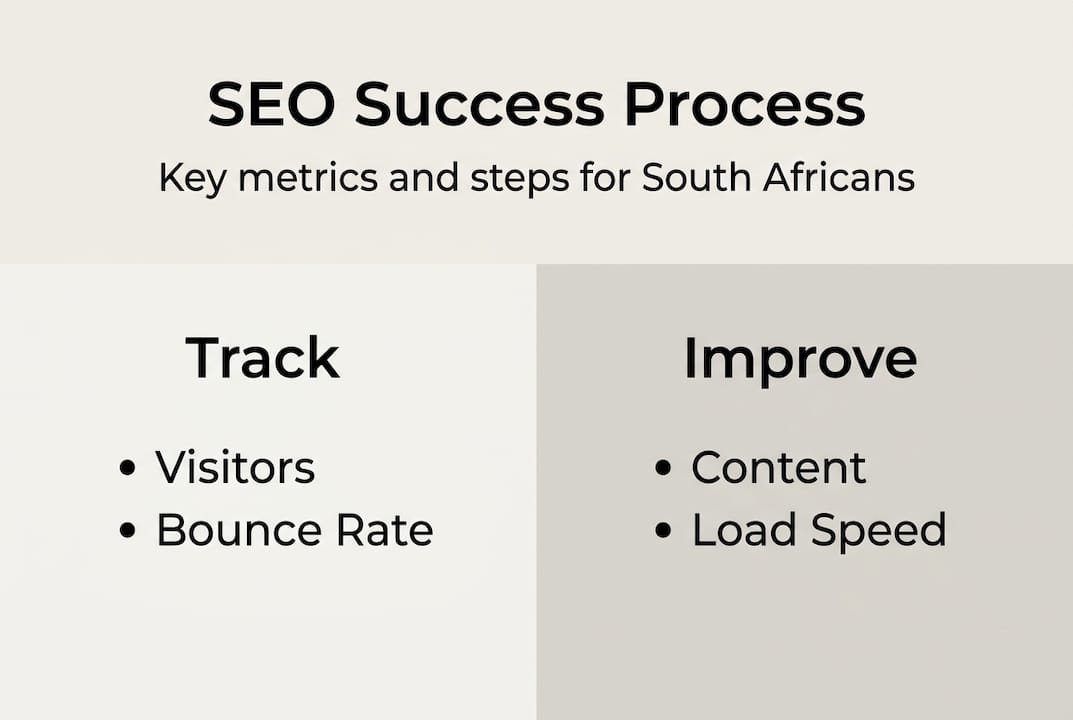
Here are the key metrics to monitor monthly:
| KPI | What it tells you | Target for growing SME |
|---|---|---|
| Organic sessions | Total visits from search | 10-20% month-on-month growth |
| Bounce rate | % who leave after one page | Below 60% |
| Average session duration | How long visitors stay | Over 2 minutes |
| Goal conversions | Enquiries, calls, form fills | Increasing trend monthly |
| Keyword ranking positions | Where you appear in search | Top 10 for key local terms |
Beyond monitoring, you need to actively test changes. Small adjustments can produce significant results:
- Rewrite page titles that have high impressions but low click-through rates
- Add FAQ sections to pages that rank on page two of Google
- Test different content formats (video, infographic, long-form guide) to see what your audience prefers
- Update older posts with fresh local statistics and current examples
- Improve internal linking between your top-performing pages and newer content
For ongoing organic growth tactics that build on your analytics insights, consistent testing and measurement separate businesses that grow steadily from those that plateau after an initial burst.
The real reason most SA SMEs fail to increase web traffic
Having covered all the tactical steps, it is worth pausing for a strategic reality check. Most South African SMEs do not fail at SEO because they lack information. They fail because they chase shortcuts instead of doing the unglamorous, consistent work that actually moves the needle.
The SEO industry is full of promises: instant rankings, guaranteed traffic, secret hacks. Business owners understandably want fast results, so they try one tactic, see no immediate spike, and abandon it for the next shiny approach. The result is a scattered, inconsistent online presence that Google cannot make sense of.
What top-performing South African businesses do differently is almost boring in its simplicity. They pick a handful of local keywords. They keep their GBP accurate. They publish content that genuinely answers the questions their customers ask. They check their analytics monthly and make small adjustments. That is it. No tricks.
Lasting web traffic is built on genuine answers to real local needs, not just keywords.
The businesses we see winning in local search are not the ones with the biggest budgets. They are the ones with the most consistent effort over the longest period. Consistency beats cleverness every time. If you want practical SEO tips that are grounded in what actually works for South African businesses, focus on the fundamentals and commit to them for at least six months before evaluating results.
Accelerate your SEO growth with expert support
Ready to see bigger results faster? Implementing all these steps on your own takes time, and the learning curve can slow your progress significantly. Working with a team that already understands the South African search landscape means you skip months of trial and error and move straight to strategies that are proven to work in your market.
At Local SEO Agency, we specialize in helping South African SMEs build sustainable web traffic through ethical, results-driven strategies. Whether you need a full audit, content creation, or ongoing optimization, our team delivers measurable outcomes tailored to your business. Explore our best SEO optimization service to see how we approach growth, or browse our local SEO services designed specifically for South African businesses ready to compete and win online.
Frequently asked questions
What is the fastest way for a South African SME to increase web traffic?
Optimizing your Google Business Profile and ensuring your website works well on mobile devices typically delivers the quickest local traffic improvements, since GBP optimization is the strongest first step for local visibility.
How long does it take to see SEO results in South Africa?
You can start seeing measurable traffic improvements within 3 to 6 months if you consistently implement local SEO best practices without interruption.
Why is mobile optimisation so important in South Africa?
Over 90% of South Africans access the internet via mobile devices, so Google gives ranking priority to sites that load fast and display correctly on smartphones.
Does local content really help drive more traffic?
Yes, content tailored to South African questions and interests consistently attracts more visitors than generic content because it matches what local users are actually searching for.
Recommended
- South African SEO Keywords That Will Drive Traffic to You – LSA SEO Agency
- Proven ways to increase organic traffic in South Africa
- Effective South African SEO Tips for Competitive Edge – LSA SEO Agency
- Your Guide to the Best Guest Posting Opportunities South Africa – LSA SEO Agency
- The Secret to Sustainable Website Traffic Growth | Rule27 Design
- Boost your rankings with expert SEO services – Nu Life Digital