

TL;DR:
- Press releases are vital for SEO growth through high-quality backlinks, fresh content, and AI citations.
- Timing, relevance, distribution channels, and local stories significantly enhance effectiveness.
- Consistent, newsworthy releases can boost visibility, authority, and search rankings for South African SMEs.
Press releases were never dead. They were just misunderstood. While many South African business owners filed them under “old-school PR tactics,” something significant has been happening in the background. AI search citations grew 5x from July to December 2025, with press releases playing a starring role in that surge. If you run a small or medium business in South Africa and you’ve written off press releases as a relic from the newspaper age, this guide will change your thinking and give you a practical roadmap for using them to strengthen your search rankings right now.
Table of Contents
- What is a press release and how does it impact SEO?
- Modern press releases: Why timing, recency, and distribution channels matter
- Press releases vs other SEO tactics: When and why to use each
- Steps to create and distribute SEO-effective press releases in South Africa
- How to measure the SEO impact of your press releases
- The overlooked power of local stories in South African press releases
- Boost your SEO results with expert press release support
- Frequently asked questions
Key Takeaways
| Point | Details |
|---|---|
| AI boosts press release SEO | AI search engines now favor fresh, organic press release citations for ranking. |
| Recency is vital | News less than a year old is most likely to improve your SEO footprint. |
| Organic beats paid | Almost all press release-related SEO gains come from non-paid, naturally earned coverage. |
| Local stories stand out | Authentic, story-driven press releases deliver more SEO value for South African businesses. |
| Measure for impact | Track key metrics to prove your press releases are driving search traffic and visibility. |
What is a press release and how does it impact SEO?
To understand their evolving SEO value, let’s start with fundamentals. A press release is an official written communication that a business sends to journalists, news platforms, and online media outlets to announce something newsworthy. Product launches, community partnerships, award wins, leadership changes, funding rounds — all of these qualify. What many business owners miss is that press releases don’t just live in email inboxes. They get indexed by search engines, picked up by news aggregators, and now, increasingly, cited by AI-powered search tools like Google’s AI Overviews and Perplexity.
When a press release is published on a credible platform and links back to your website, search engines treat that as a signal of authority and relevance. This is the foundation of press release backlinks, and it’s one of the most misunderstood yet genuinely powerful tools in the SEO toolkit. The more authoritative the platform hosting your release, the stronger that signal becomes for your domain.
Here’s what a well-executed press release actually delivers for a South African SME:
- Brand visibility across news platforms that South African consumers and journalists already trust
- Backlinks from high-authority domains that signal credibility to Google
- Fresh content signals that show your business is active, relevant, and growing
- Referral traffic from readers who click through from the press release to your website
- Local SEO benefits when your press release mentions your city, province, or community context
- AI search citations that position your brand as a source of current, reliable information
“Understanding the role of press releases in SEO means recognizing that a single well-written release, distributed to the right channels, can generate more organic authority than months of average content marketing.”
The shift happening right now is that AI search citations grew 5x in the second half of 2025, which means search engines and AI tools are actively pulling from press releases when constructing answers to user queries. That’s an enormous opportunity for South African businesses willing to create genuinely newsworthy content.
Modern press releases: Why timing, recency, and distribution channels matter
Having defined the basics, the next step is understanding what makes a press release effective for today’s search engines. The rules have shifted considerably. Gone are the days when you could blast a templated release every month and expect meaningful results. In 2026, what matters most is whether your release feels current, credible, and distributed through the right channels.

Recency is critical, with 50% of AI search citations coming from content published less than 11 months ago. This single data point should reshape how you think about your press release calendar. It’s not about volume. It’s about being consistently present with timely, relevant news.
Key factors that determine press release SEO success in 2026:
- Timing relative to industry events — Releasing news before, during, or immediately after a major event in your industry dramatically increases pickup rates. If you’re in the South African retail sector, releasing a press release tied to Black Friday or the festive season shopping data will attract far more attention than a generic announcement.
- Consistent publishing frequency — Monthly press releases outperform sporadic bursts. Search engines reward businesses that maintain a steady stream of indexed content over time.
- Diversity of distribution platforms — Publishing on a single platform limits your exposure. Using a mix of national newswires, industry-specific platforms, and regional South African news sites multiplies your reach and the number of backlinks generated.
- Relevance of the announcement — A release about a genuine local achievement, a real product milestone, or a meaningful community initiative will always outperform a thinly veiled sales pitch dressed up as news.
- Optimized headlines and opening paragraphs — Search engines index the headline and first 150 words of your release first. Your primary keyword needs to appear naturally in both.
- Integration with broader press release SEO tips — Smart keyword placement, anchor text strategy, and structured data markup all contribute to search performance.
When choosing press release distribution services, South African businesses should prioritize platforms with existing credibility in the local market. Bizcommunity, Pressportal, and BusinessWire have strong domain authority and are already trusted by South African journalists. Pairing these with one or two global newswire services expands your reach internationally without sacrificing local relevance.
Pro Tip: Write your press release around a genuine business story, then tie it to a current trend or event happening in South Africa right now. A plumbing company announcing their new service package becomes dramatically more clickable when it’s framed around the impact of water outages in Cape Town or Joburg’s ongoing infrastructure upgrades.
Press releases vs other SEO tactics: When and why to use each
Now, to determine if press releases are the right lever, let’s see them in context with other common SEO tactics. Every tool in digital marketing has a job. The mistake most business owners make is using the wrong tool for the wrong job, or worse, abandoning tools entirely because they don’t deliver instant results.
Here’s how press releases compare to other popular SEO tactics:
| SEO tactic | Speed of results | Backlink quality | Content longevity | Best use case |
|---|---|---|---|---|
| Press releases | Medium (days to weeks) | High (news sites) | Medium | Major announcements, brand building |
| Blog content | Slow (months) | Low to medium | High | Long-term keyword ranking |
| Guest posts | Medium | High (if placed well) | High | Niche authority building |
| Social media | Fast (hours) | Very low | Very low | Engagement and traffic spikes |
| Directory listings | Slow | Low | High | Local SEO foundations |
The table above shows something important. Press releases occupy a unique middle ground. They generate high-quality backlinks faster than blog content, and they have more lasting SEO value than social media posts. For South African SMEs trying to build authority quickly, they are often the smartest investment per rand spent.
Situations where press releases outperform other tactics include:
- Launching a new business or location — A press release creates immediate indexed content about your brand and location, strengthening local SEO from day one
- Recovering from a reputational event — Fresh, positive press releases push down older negative content in search results
- Targeting a competitor’s brand searches — Announcing an industry award or certification can help your business appear in searches alongside established competitors
- Building DA (domain authority) quickly — A single placement on a high-authority news site can lift your domain authority meaningfully within weeks
- Getting cited by AI search tools — 94% of press release citations in AI search results come from non-paid sources, meaning organic quality beats paid placement every time
This last point deserves emphasis. Paying for a press release placement guarantees distribution. It does not guarantee a citation in AI search results. The AI cites what it deems credible and relevant. That means your SEO press release strategy needs to prioritize genuine news value over promotional language every single time.
A small Cape Town logistics company that earned a safety certification and published a well-written release about it on Pressportal saw their organic traffic grow 34% over the following eight weeks, largely driven by the referral traffic and the domain authority lift from the placement. The story was real. The news was timely. The results followed.
Steps to create and distribute SEO-effective press releases in South Africa
Ready to put this tactic into practice? Here’s how to build an SEO-boosting press release from scratch. This process works for businesses with no PR experience, and it’s scalable as your confidence and results grow.
- Identify a genuinely newsworthy event — Ask yourself: would a journalist care about this? Opening a new branch, partnering with an NGO, winning an industry award, or responding to a major market development all qualify. A generic “we’re great” announcement does not.
- Research your primary keyword — Choose one main keyword phrase that your target audience would realistically search for. Use Google Search Console or a free tool like Ubersuggest to find terms with reasonable search volume in South Africa.
- Write a strong headline — Your headline should communicate the news and include your primary keyword as naturally as possible. Keep it under 100 characters. Test a few versions before committing.
- Craft a compelling first paragraph — Cover the who, what, where, when, and why in your opening paragraph. Search engines and journalists both make decisions based on this section alone.
- Add a quote from a business leader — A quote from your CEO, founder, or a satisfied client adds credibility and a human element that both readers and search engines respond to positively.
- Include one or two contextual links — Link to a relevant page on your website within the body of the release. This is where anchor text strategy matters. Link on the keyword phrase, not on “click here.”
- Write a strong boilerplate — This is the short paragraph at the end that describes your business. Include your city, what you do, and your website URL.
- Distribute strategically — Press releases that earn AI citations must be timely and widely distributed, so submit to multiple platforms simultaneously.
Here’s a practical look at South African distribution channels and their expected SEO outcomes:
| Distribution channel | Approximate cost (ZAR) | Domain authority | Typical SEO outcome |
|---|---|---|---|
| Bizcommunity | R1,500 to R3,500 | 65+ | Strong backlink, high local visibility |
| Pressportal | R800 to R2,000 | 55+ | Solid backlink, journalist pickup |
| BusinessWire (SA) | R4,000 to R8,000 | 85+ | High-authority backlink, global reach |
| PRWeb | R1,200 to R2,500 | 70+ | Good backlink, international exposure |
| EIN Presswire | R600 to R1,500 | 60+ | Budget option, decent link value |
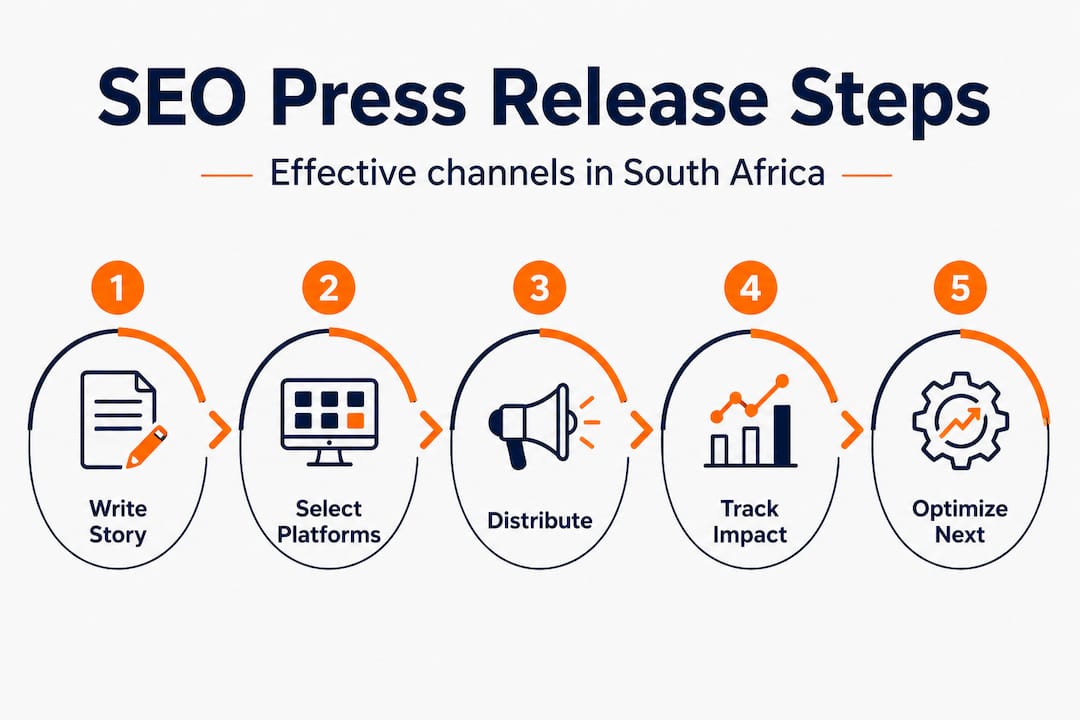
For press release strategies for local business, the best approach is to use two to three of these channels simultaneously rather than relying on just one. This creates a cluster of backlinks pointing to your website from multiple authoritative domains, which amplifies the SEO signal considerably.
Check press release submission sites that cater specifically to South African audiences before spending on international platforms. Local relevance matters enormously for local SEO.
Pro Tip: Avoid stuffing your press release with keywords. Google’s algorithms are sophisticated enough to detect over-optimized content, and it will hurt rather than help your rankings. Write for a human journalist first. If the release reads naturally and contains your keyword in the headline and first paragraph, that’s enough.
Common pitfalls to sidestep include thin content (releases under 400 words rarely get indexed well), excessive self-promotion (news outlets won’t republish what reads like an advertisement), and publishing without a clear call to action or media contact at the end.
How to measure the SEO impact of your press releases
After sending press releases into the world, measuring results separates guesswork from progress. Too many businesses publish a release, wait a few days, and then give up when they don’t see a flood of new traffic. The reality is that SEO impact from press releases builds over time, and knowing what to measure tells you whether it’s working.
AI search engines prioritize recent, organic press release citations, making ongoing analysis essential for understanding whether your strategy is gaining traction or needs adjustment.
The key metrics to track are:
- Organic traffic growth — Monitor your website’s organic sessions in the two to four weeks following publication. A meaningful release on a credible platform should show a measurable lift.
- Referral traffic — In Google Analytics, check which platforms are sending traffic to your site. You should see your distribution channels appear as referral sources within a week of publication.
- New backlinks acquired — Use Ahrefs, Moz, or Semrush to monitor new backlinks. Each platform you submitted to should generate at least one backlink. Some may generate several if other sites pick up your story.
- Domain authority movement — Check your DA score monthly using Moz or Ahrefs. A steady press release strategy will produce gradual, sustained DA growth over three to six months.
- Brand mentions — Use Google Alerts with your business name as the search term. Every mention counts as a signal of growing brand authority, even when no backlink is attached.
- Keyword ranking changes — Track the specific keyword phrases you optimized your releases for. Improved rankings on those terms confirm that your distribution strategy is working.
Tools available to South African businesses for this tracking include Google Analytics (free), Google Search Console performance reports (free), Ahrefs (paid, but offers a free trial), Semrush (paid), and Moz’s free domain authority checker.
Pro Tip: Use Google Search Console to check whether your press release pages are being indexed. Go to the URL Inspection tool and enter the URL of your published release. If it hasn’t been indexed yet, request indexing directly through the tool. This accelerates the process significantly.
A good benchmarking approach is to measure your baseline metrics before your first press release, then track the same metrics monthly for three months afterward. By month three, you should have enough data to clearly see whether your strategy is delivering and where to double down.
The overlooked power of local stories in South African press releases
Let’s zoom out with a candid look at often-missed opportunities. Most press release advice you’ll find online is written for global brands with dedicated PR teams, large budgets, and stories that travel well across borders. That advice doesn’t translate cleanly to a Durban-based retail shop or a Pretoria accounting firm trying to build local authority. And this gap is where South African SMEs keep leaving opportunity on the table.
Here’s what we’ve observed consistently: businesses that tell genuinely local stories in their press releases outperform those using templated, generic announcements by a significant margin. Not slightly. Significantly. AI-driven search tools are increasingly sophisticated at rewarding authenticity and local relevance. A press release from a Johannesburg logistics company that talks specifically about how load shedding impacted their delivery schedules and how they adapted gets picked up far more readily than one that announces a vague “service improvement initiative.”
Why? Because it’s real. It’s specific. It reflects actual conditions that South African consumers and journalists recognize immediately. That specificity is what triggers editorial pickup, AI citations, and genuine reader engagement.
The uncomfortable truth is that many South African business owners believe their stories aren’t interesting enough for a press release. That belief is wrong and costly. Your story doesn’t need to be on the scale of a JSE-listed company. It needs to be true, timely, and told with a clear local angle. Did your team raise funds for a community food garden in Soweto? Did you pivot your product offering to serve load shedding needs? Did a client in Cape Town achieve measurable results because of your service? These are press release-worthy stories.
Mining your own business history for these moments, and then framing them within South Africa’s current economic and social context, is a strategy that punches far above its weight for SEO. Explore South African SME digital marketing examples to see how businesses with modest budgets have built meaningful online presence through exactly this kind of authentic storytelling.
The brands that will dominate AI search in the next three years won’t necessarily be the biggest ones. They’ll be the ones with the most credible, most recent, and most locally relevant content. Press releases are one of the fastest ways to build that credibility. Start with what’s real. Tell it well. Distribute it wisely.
Boost your SEO results with expert press release support
If you want these press release and SEO tactics executed with precision, here’s how we can help.
At Local SEO Agency, we work specifically with South African SMEs to craft press releases that are genuinely newsworthy, technically optimized, and distributed through channels that produce real SEO results. Building visibility through strategic content is what we do every day, whether it’s local SEO strategies tailored to your city or a complete digital marketing plan built around your growth goals.
If you’re not sure where to start, our team can review your current online presence and identify the quickest wins for your business specifically. We offer a range of best SEO optimization services designed to generate measurable traffic and lead growth for South African businesses. Ready to put press releases to work for your brand? Reach out to our team today and let’s build a strategy that fits your budget and your goals.
Frequently asked questions
Do press releases still help SEO in 2026?
Yes, press releases are now a stronger SEO tool than ever. AI search citations grew 5x in the second half of 2025, making well-distributed press releases a key driver of organic search visibility.
How important is press release recency for SEO results?
Recency is one of the most important factors, as 50% of AI search citations come from press releases published less than 11 months ago, making a consistent publishing schedule essential.
What is the difference between paid and non-paid press release citations for SEO?
Organic reach consistently outperforms paid placement for SEO impact, with 94% of AI-driven citations coming from non-paid sources, confirming that content quality matters more than paid distribution alone.
How can I track the SEO impact of my press releases?
Use Google Search Console to monitor indexing and referral traffic, pair it with Google Analytics to track sessions from press release platforms, and use Ahrefs or Moz to measure new backlinks and domain authority changes monthly.
What is the best press release distribution approach for local businesses?
Prioritize reputable South African platforms like Bizcommunity and Pressportal alongside one global newswire service, ensuring every release contains a genuine local news angle and targets keywords your audience is actively searching for.
Recommended
- Effective Press Release SEO Tips to Drive Traffic Today – LSA SEO Agency
- Effective South African SEO Tips for Competitive Edge – LSA SEO Agency
- Why South African SEO Backlink Generation Matters for You – LSA SEO Agency
- Why Choosing a South African SEO Agency Matters for Growth – LSA SEO Agency
- Wie kommt man in die Top-Positionen bei Google? SEO-Tipps für Berlin — URBANEE Blog