
SEO Guides: Link Building
PBN links come from private blog networks: clusters of sites run by a single operator whose real job is to point links at paying customers. South African businesses are still offered them as a quick path to page one. Here we explain the concept, why Google classes these links as spam, what can go wrong and what to do instead. This is not a how to manual.
What a private blog network is
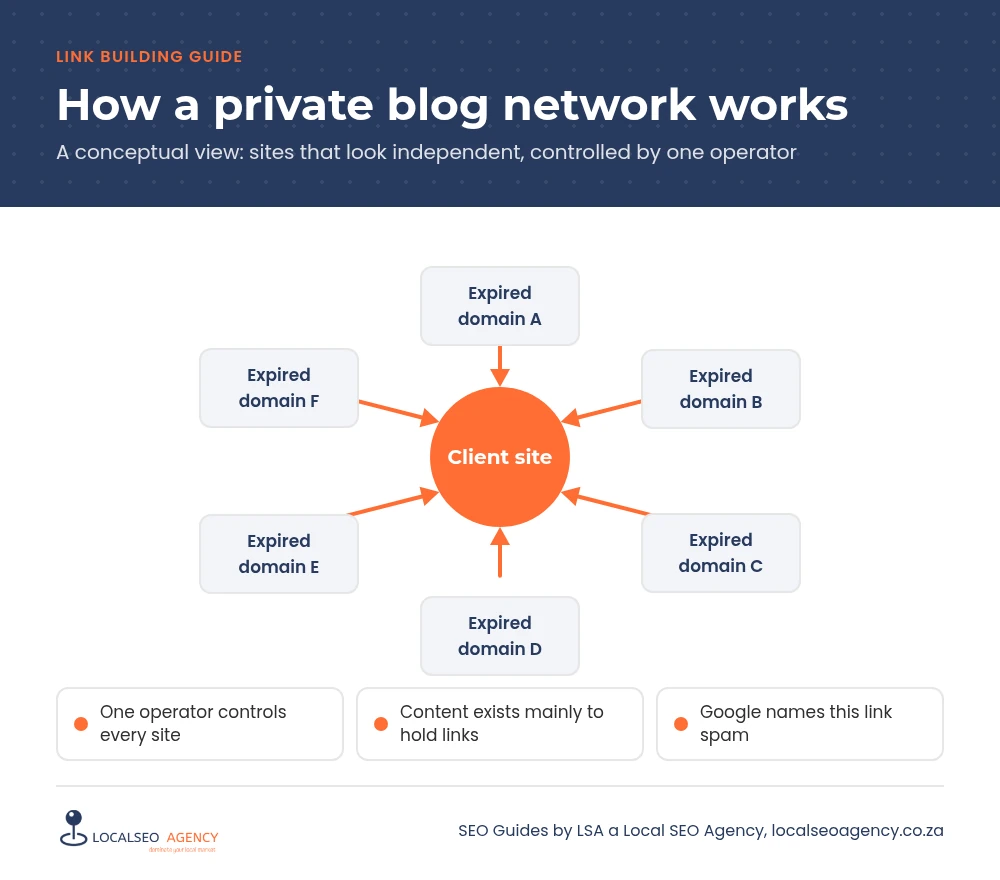
A private blog network, usually shortened to PBN, is a set of websites that look independent but are owned or controlled by the same person or company. Their main purpose is not to serve readers. It is to pass links to other websites, usually the operator's clients or the operator's own money making sites. Our glossary entry on private blog networks gives the short definition.
The word private matters. Unlike a public blog platform or a genuine publication, nobody outside the operator decides what gets published or linked. The links are placed, not earned, and they are typically sold, rented or bundled into SEO packages.
How PBNs work, conceptually
You only need the outline to recognise a network. The operator collects lapsed domains that still carry inbound links from an earlier owner, perhaps a defunct company, a disbanded club or a forgotten blog. Each one is given some content, frequently thin, reworded or machine written, and then used to point links at paying clients. Operators try to make the sites look unconnected by varying how they are presented and hosted.
The theory is that the old links pointing at each expired domain still carry some value, and that value can be redirected to clients through new links. In practice, that theory has been weakened considerably by changes in how Google evaluates links, as the next sections explain.
Why PBNs are sold so widely
PBN links are attractive to sellers because they can be produced on demand, priced per link and delivered quickly. They are attractive to buyers because they promise control: you choose the link, the page and the anchor text, and you do not need to persuade an editor of anything. In markets where rankings are valuable, such as legal, financial, medical and home services, that promise can be tempting.
Sellers lean on reassuring labels: aged domains, high DA or DR, contextual, niche relevant, safe. The labels do not change what is being sold.
What Google's spam policies say
Google's spam policies describe link spam as links intended to manipulate rankings. A PBN link breaks the policy on several counts at once.
- It is created mainly to influence rankings, not because an independent publisher chose to reference the target site.
- Money almost always changes hands, and purchasing links that carry ranking value is one of the first examples Google gives.
- It sits on low value content created mainly to host links, which Google also names in its examples.
In March 2024 Google introduced a dedicated expired domain abuse policy, aimed at lapsed domains reused mainly to game rankings with content of little or no value to users. Most networks are assembled in just this way, so they now fall foul of two separate rules.
Google's December 2022 link spam update introduced SpamBrain's ability to identify buyers and sellers of links alike, cancelling out what those links would have passed. That value does not return.
The risks of using PBN links
The risks fall into three groups: wasted money, ranking damage and business risk.
Wasted money
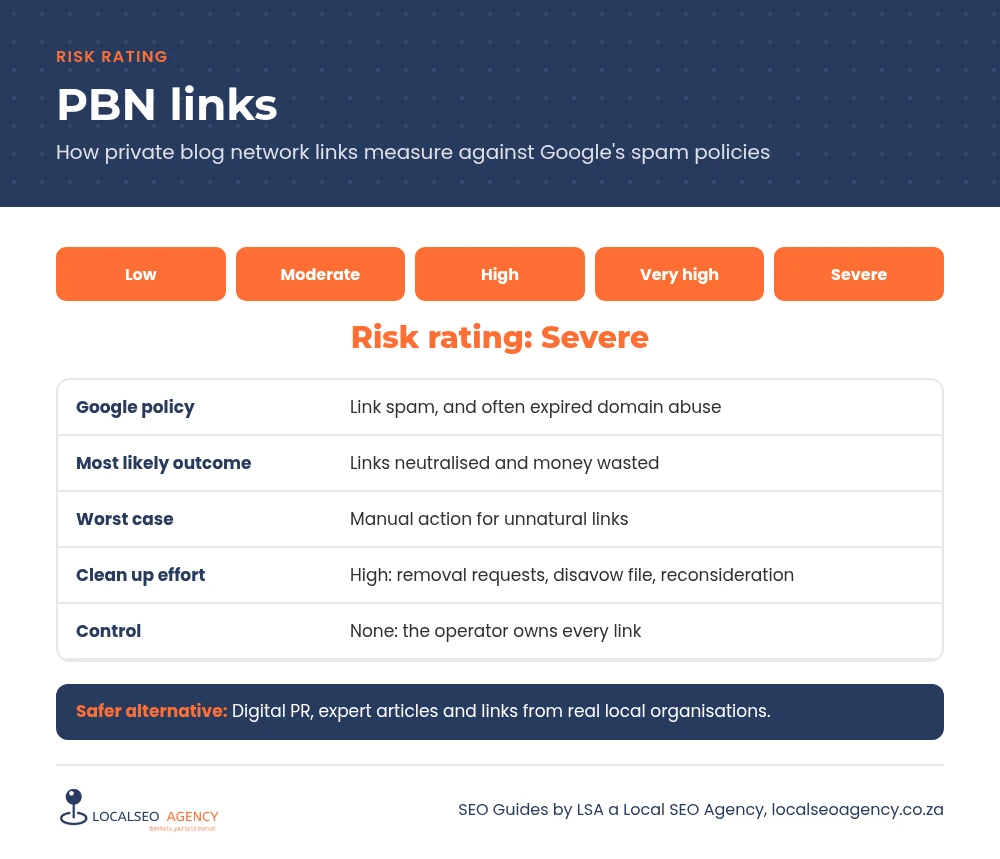
The most common outcome is not a dramatic penalty. It is that the links simply stop counting, or never counted at all. You keep paying for links that do nothing.
Ranking damage
When Google identifies unnatural links pointing at a site, it may take a manual action for unnatural links. That notice appears in Search Console under Security and manual actions, and it can affect some pages or the whole site until the problem is cleaned up and a reconsideration request is accepted. Even without a manual action, a site that relied on network links can lose rankings when those links are devalued, and the drop often arrives without warning.
Business risk
Your site's visibility becomes dependent on a network you do not control. If the operator stops paying for hosting or domains, sells the network or removes links when you stop paying, the links disappear. Some networks also link to gambling, adult or counterfeit sites, which is not company you want your brand to keep.
Clean up costs
Unwinding PBN links takes time: identifying them, requesting removal where possible, preparing a disavow file for the rest and, if there was a manual action, documenting everything for a reconsideration request.
How Google's approach to link schemes has changed
Link networks are not new, and neither is Google's opposition to them. In April 2012 Google launched the Penguin update, which targeted sites with manipulative link profiles. For several years afterwards, sites hit by Penguin often had to wait for the next refresh to recover. In September 2016 Penguin became part of Google's core algorithm and began working in real time, with Google explaining that it would increasingly devalue spammy links rather than demote whole sites.
The December 2022 link spam update took that further with SpamBrain, and the March 2024 spam policies added expired domain abuse as a named policy. The direction has been consistent for more than a decade: Google aims to make manipulative links worthless rather than merely risky. That is the real reason PBNs are a poor investment. Even when they escape a penalty, they increasingly do nothing.
PBNs in the South African market
South African businesses are offered PBN links in the same ways as businesses anywhere: through unsolicited emails, freelance marketplaces, cheap monthly SEO packages and sometimes through agencies that do not disclose their methods. Because the local web is relatively small, networks aimed at South African clients often use expired domains that once belonged to local organisations, such as closed businesses, school events, sports clubs or old campaigns, and fill them with generic articles about unrelated topics.
Two things make the risk sharper locally. First, the number of genuine South African publications in any niche is limited, so a profile dominated by unfamiliar sites stands out. Second, many local markets are small enough that a business owner can see exactly who ranks and why, and some competitors do report suspicious link patterns to Google.
What a healthy link profile looks like instead
It helps to know what normal looks like. A healthy profile for a South African small business usually includes a mix of: listings on the main platforms and directories; links from associations, suppliers and partners; a few mentions in local or trade media; links from community organisations or events; some nofollow links from social profiles and news sites; and a small number of links from genuinely useful content. The link text is mostly the business name, the website address or natural phrases. Growth is uneven and follows real activity. None of it requires a network.
Why PBNs are easier to detect than sellers claim
Sellers often say their network is undetectable. Conceptually, the problem is that a network is defined by patterns, and patterns are what search engine systems are built to find. Sites that share ownership, publish content mainly to hold outbound links, link to the same set of unrelated businesses, appeared on expired domains with a new unrelated purpose, or carry similar keyword rich anchors are all signals. Each one on its own may be innocent. Together, they form a footprint. Google also receives spam reports from users, and competitors can and do report suspicious link patterns.
How to recognise a PBN offer
You do not need technical tools to spot most PBN offers. Watch for:
- Prices that rise in steps with a tool's score for each domain.
- Promises of permanent, followed, contextual links on aged domains.
- A seller who keeps the domain names secret until the invoice is settled.
- Guaranteed ranking improvements within a few weeks.
- Sites with no real audience, no contact details and articles on every topic.
- A provider who reports only totals and never the actual URLs.
If you already work with a provider, ask for that list. A reputable provider can produce it immediately.
Recognising a PBN site
If you are reviewing links that already point at your site, a PBN site often shows several of these signs together:
- The domain's history does not match its current content, for example a former school or club domain now publishing generic business articles.
- Articles are short, generic or oddly worded, with little sign of a real author.
- Almost every post links out to a commercial site, often with exact match keywords.
- There is no real about page, contact information or social presence.
- The site covers an unusual mix of unrelated topics.
What to do if your site has PBN links
Start by opening the manual actions report in Search Console. Next, get a complete inventory of the links your current or past provider created and cancel any payments that keep network links running.
Where a manual action exists, the route is set: ask site owners to take the links down, keep a record of every request, list whatever remains in a disavow file and send a reconsideration request that explains what went wrong and what has changed.
If there is no manual action, removing your involvement is still sensible. Ask for removal where possible and stop renewing. Google's guidance is that most sites do not need to use the disavow tool, so think carefully before using it without a manual action, and focus your effort on building genuine links instead. Our glossary entry on toxic links explains how to separate harmless junk from real risks.
Safer alternatives to PBN links
Everything a PBN promises, a relevant, trusted link pointing at your important pages, can be earned honestly. It takes longer, but the links stay.
Digital PR
Pitch reporters something worth covering, such as fresh figures, a notable project or a qualified opinion. One article in a respected South African title outweighs any number of network links.
Expert contributions
Offer your expertise to editors whose audiences overlap with your market. Our guest posting guide shows how.
Relationships you already have
The organisations you already trade with, from suppliers to chambers and clients, often have partner or member pages that can mention you.
Linkable resources
Create the most useful guide, tool or local resource in your field, then tell the people who would benefit.
Reclaimed links
Fix broken links to your site with redirects, and follow up on mentions that lack a link.
Talking to your SEO provider about PBNs
If you suspect your provider uses network links, ask plainly. Request a list of every link built in the last year, with the site and page. Ask who owns each site and how the link was obtained. A provider using genuine methods can answer immediately and will usually be glad you asked. Vague answers, references to proprietary methods or reluctance to share the list are warning signs. Your website is your asset, and you are entitled to know what is pointing at it.
Questions business owners ask about PBNs
Are some PBNs safe?
No network built to pass links for ranking purposes complies with Google's spam policies, whatever its quality. Some may go unnoticed for a while, which is different from being safe.
My rankings went up after buying PBN links. Does that prove they work?
Short term movement is possible, but it does not tell you how long the links will last, or what happens when they are devalued. Many sites that rose on network links have fallen just as quickly.
My previous agency used a PBN without telling me. What now?
Ask for the full list, stop payments, check for a manual action and follow the clean up steps above. You are responsible for links pointing at your site, even if someone else built them.
Is a group of my own company websites a PBN?
Owning several genuine websites, such as separate brands with real audiences, is not a PBN. Creating extra sites mainly to link to your main site is a different matter.
Our link building pillar guide sets out the full strategy, and our glossary offers a quick ethical versus unethical comparison.
How LSA helps
LSA a Local SEO Agency keeps every client well away from link networks and purchased links. When a profile already contains them, we work out calmly which ones matter, plan any clean up that is genuinely needed and replace them with coverage and relationships that last. Ask us about a backlink audit or read about our backlink building approach.
Ready to build links that last? Call LSA a Local SEO Agency on 068 786 7331 or contact us to talk about a link building plan for your business.