
SEO Glossary: Technical SEO
Pages move. Services get renamed, old posts get merged and sites change domain. A 301 redirect makes sure nobody, human or Googlebot, gets lost along the way.
What a 301 redirect is
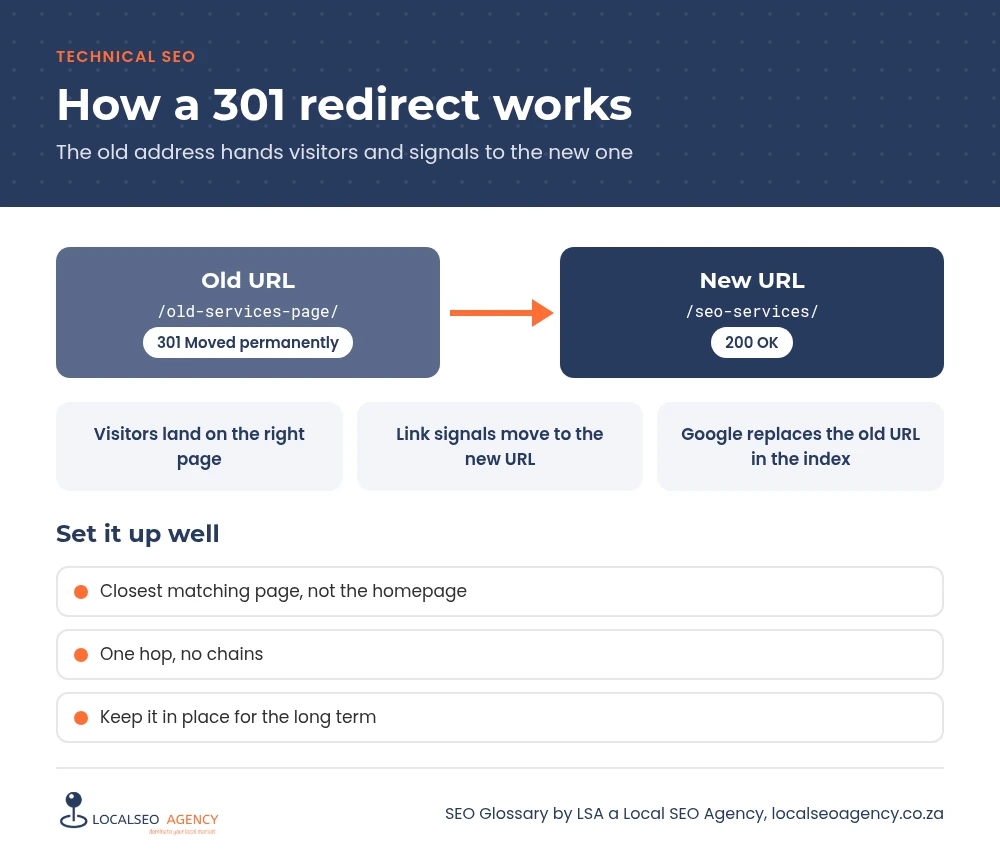
A 301 is an HTTP status code that means moved permanently. When a browser or search engine requests the old URL, the server answers with a 301 and the new address, and the visitor is sent there automatically. Google treats a 301 as a strong signal that the new URL should replace the old one in its index, and it passes the ranking signals of the old page, such as links pointing to it, to the new one.
When to use one
- You change a page's URL, for example from a long slug to a shorter one.
- You merge two or more pages on the same topic into one stronger page.
- You move the site from http to https, or to a new domain.
- You retire a service and a closely related page is the best replacement.
Why it matters for South African businesses
Every page that has ever earned a link, a bookmark or a ranking has value. A local directory listing, a supplier's website or an old Facebook post might still link to a URL from years ago. Without a redirect, those visitors hit an error page and the value of the link is lost. With a 301, the visitor lands on your current page and Google credits that page with the link.
How to set up redirects well
Redirect to the closest match
Send each old URL to the most relevant new page, not to the homepage. Google may treat mass redirects to the homepage as soft 404s.
Go straight to the final URL
Avoid redirect chains. Each old URL should point directly to its final destination in one hop.
Update your own links
Change menus, internal links and your sitemap to the new URL, so the redirect only catches outside visitors.
Common 301 mistakes
- Using a 302 for a permanent move.
- Redirecting everything to the homepage.
- Removing redirects after a few months, while old links still point there.
- Redirect loops, where two URLs point to each other.
How to check your redirects
Test old URLs in a browser and with a header checker to confirm they return 301 and land on a page returning 200. A site crawl lists every internal link that passes through a redirect. In Google Search Console, the Pages report shows Page with redirect, which is normal for old URLs but should not include pages you want indexed. On WordPress, Rank Math has a redirections module that keeps rules in one place.
How LSA helps
LSA a Local SEO Agency plans redirects carefully whenever pages are merged or renamed: we map every old URL to its best match, keep URLs with backlinks protected and test each rule after it goes live. It is part of the technical SEO services we run for clients.
For the short definition, see 301 Redirect in our SEO Glossary, alongside the other technical SEO terms.
Questions about your own website? Call LSA a Local SEO Agency on 068 786 7331 or contact us for straightforward advice.