

TL;DR:
- Most South African small businesses underestimate the power of consistent branding. Brand consistency can increase revenue by 23% and recognition by 80%. Building a strong, authentic local brand foundation and leveraging digital strategies like local SEO are key to growth.
Most South African small business owners believe branding is a luxury reserved for big corporations with massive budgets. That belief is quietly costing them customers every single day. Only 32% of South African MSMEs have a website, yet consistent branding can increase revenue by 23%. That gap between what most SMBs do and what effective local business branding actually delivers is enormous. This article breaks down exactly what local branding means for businesses in South Africa, why it matters more than most owners realise, and how to apply it step by step to grow your visibility, attract loyal customers, and compete confidently in your community.
Table of Contents
- Why branding matters for South African businesses
- Building a strong brand foundation: What every SMB needs
- From vision to visuals: Creating a distinctive local brand identity
- Digital-first execution: Local SEO, mobile, and community engagement
- Common pitfalls and advanced branding strategies for local success
- What most SMBs get wrong about local branding (and how to stand out)
- How we help South African SMBs brand for visibility and growth
- Frequently asked questions
Key Takeaways
| Point | Details |
|---|---|
| Consistent branding pays | Maintaining brand consistency can increase your revenue by nearly a quarter. |
| Mobile and local SEO essential | Optimizing for mobile and local search is crucial as most South African customers find businesses this way. |
| Community engagement builds loyalty | Sharing authentic stories and participating in the community strengthens brand connections and repeat business. |
| Avoid common pitfalls | Steer clear of inconsistent messaging and weak differentiation which erode brand trust and visibility. |
| Measure and adapt | Use clear metrics like brand recall and customer loyalty to refine your branding efforts over time. |
Why branding matters for South African businesses
South Africa has one of the fastest-growing internet user bases on the continent, yet the majority of small businesses remain invisible online. That contradiction creates a massive opportunity. If your competitors are not showing up consistently, you can own the local conversation simply by showing up better.
Branding is not just a logo or a colour palette. It is the total impression your business leaves on every person who encounters it, whether that is on a street sign in Soweto, a WhatsApp message, or a Google search result. When that impression is consistent and memorable, it builds trust. Trust converts into sales.
The numbers back this up clearly. Brand consistency boosts revenue by 23% and improves recognition by 80%. Think about what a 23% revenue lift would mean for your business right now. That is not the result of a massive advertising spend. It is the result of showing up the same way, every time, across every touchpoint.
Customer loyalty is equally powerful. 65% of customers report strong loyalty when they feel a genuine connection to a brand. In South Africa, where community ties run deep and word-of-mouth travels fast, that emotional connection is a competitive weapon.
“Your brand is what people say about you when you are not in the room.” This is especially true in tight-knit South African communities where reputation spreads fast.
Here is what strong local branding actually achieves for SMBs:
- Higher visibility in local search results and physical spaces
- Repeat customers who return because they trust and recognise you
- Pricing power because perceived quality allows you to charge more
- Partner and supplier trust because professional branding signals stability
- Word-of-mouth amplification in communities where personal referrals dominate
For more branding tips for South African SMBs, the data consistently points to one conclusion: consistency is the multiplier.
| Branding metric | Without consistency | With consistency |
|---|---|---|
| Revenue impact | Baseline | +23% increase |
| Brand recognition | Low recall | 80% improvement |
| Customer loyalty | Transactional | 65% report strong loyalty |
| Pricing power | Price-sensitive | Premium positioning possible |
These are not abstract marketing statistics. They are the difference between a business that struggles to attract new customers and one that builds a self-sustaining reputation in its local market.
Building a strong brand foundation: What every SMB needs
Understanding why branding matters is the first step. The next is building it properly from the ground up. Many SMBs skip the foundational work and jump straight to designing a logo or posting on social media. That approach produces inconsistency, which is the single biggest brand killer.
Here are the five core steps to building a brand foundation that actually holds:
- Define your purpose. Why does your business exist beyond making money? A plumber in Cape Town who exists to give families peace of mind has a more compelling story than one who just fixes pipes.
- Clarify your values. What principles guide every decision you make? Reliability, affordability, and community investment are values that resonate strongly in South African local markets.
- Craft your unique value proposition (UVP). What do you offer that no one else does, or does better? Be specific. “We respond to all calls within two hours” beats “great service” every time.
- Know your target audience. Who exactly are you speaking to? Age, location, language preference, income level, and pain points all shape how your brand should communicate.
- Position yourself clearly. Where do you sit in the market relative to competitors? Are you the affordable option, the premium specialist, or the trusted community name?
A phased approach works best: spend the first week locking down your foundation, then focus on maintaining consistency from that point forward. Rushing this phase is one of the most common and costly mistakes local businesses make.
Pro Tip: Audit your current brand in 30 minutes. Google your business name, check your social profiles, visit your website, and walk into your premises as if you are a first-time customer. Note every inconsistency in logo use, tone, colours, and messaging. That list is your branding action plan.
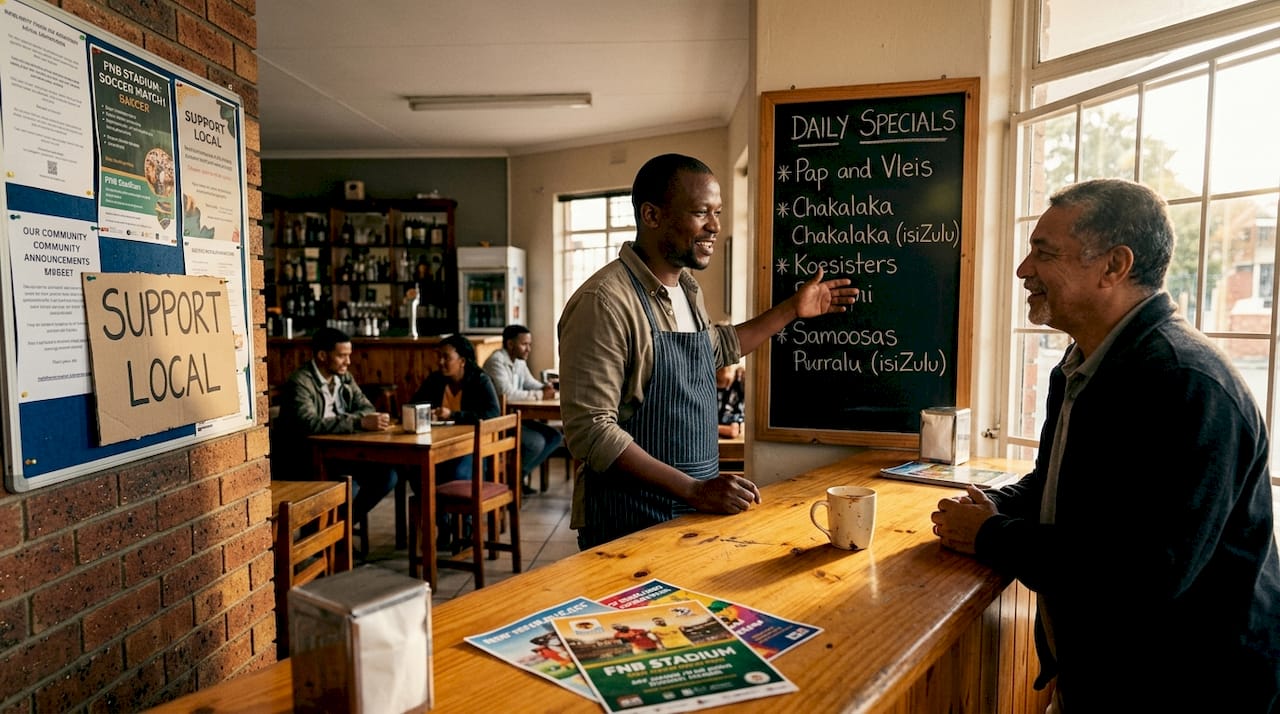
Local stories and community connection are often underestimated in this process. A business that references its neighbourhood, speaks to local challenges, and celebrates community milestones builds a brand that feels genuinely rooted. That authenticity is something no corporate chain can replicate.
| Attribute | Authentic local brand | Generic corporate brand |
|---|---|---|
| Tone | Warm, community-focused | Formal, distant |
| Trust signals | Local reviews, familiar faces | Awards, global presence |
| Customer connection | Emotional, personal | Transactional |
| Adaptability | Fast, context-aware | Slow, policy-driven |
When you understand building your brand as a foundation rather than a decoration, every business decision becomes clearer. Avoiding local SEO mistakes starts here too, because a confused brand produces confused search signals.
From vision to visuals: Creating a distinctive local brand identity
Once the foundation is solid, it is time to make the brand visible. Visual identity is the part most people think of first, but it only works when it is rooted in the strategic groundwork you have already done.
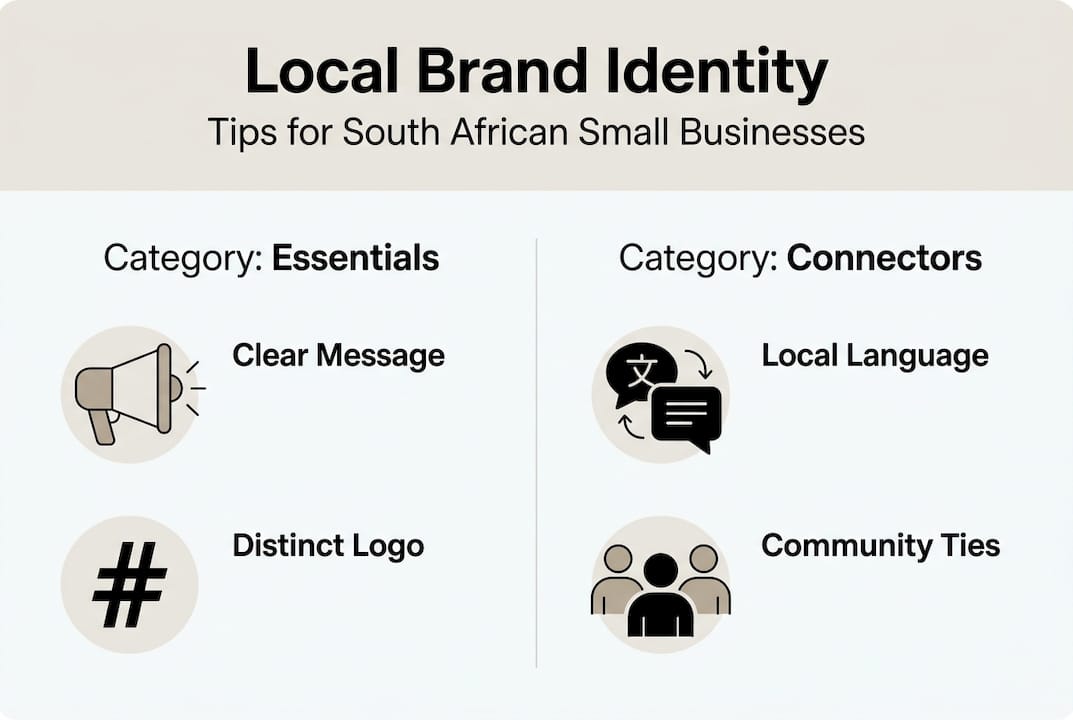
A strong visual identity for a South African SMB includes more than just a logo. It covers every element that a customer sees, hears, or reads when they interact with your business. Establishing visual identity through consistent logo use, colour schemes, and typography is the baseline. But the brand voice, meaning how you write and speak, is equally important and often neglected.
Here are the essential visual and identity assets every South African SMB should have in place:
- A clear, scalable logo that works in black and white as well as colour
- A defined colour palette of two to three primary colours used consistently everywhere
- Typography guidelines so your fonts are the same on your website, flyers, and signage
- A brand voice guide that defines your tone (friendly, professional, bold, warm)
- Consistent profile images and cover photos across all social platforms
- Physical signage and packaging that mirrors your digital presence
- A professional, mobile-optimised website that reflects your brand accurately
Pro Tip: South Africa has 11 official languages. You do not need to translate everything, but a multilingual brand voice that acknowledges local languages in greetings, signage, or social posts dramatically increases reach and relatability in your specific community.
Consider a township hair salon that uses bold Afrocentric colours, greets customers in isiZulu on their WhatsApp status, and posts before-and-after photos consistently on Instagram. That is a complete visual identity working together. Contrast that with a business that uses three different logos across its platforms, has no consistent colour, and switches tone randomly. Customers cannot hold onto a brand they cannot recognise.
Good website design best practices extend your visual identity into the digital space, ensuring that a customer who finds you on Google has the same experience as one who walks past your shopfront.
Digital-first execution: Local SEO, mobile, and community engagement
With a solid identity in place, the next challenge is making sure the right people actually find your brand. In South Africa, that means going digital, and going mobile first.
Setting up and optimising your Google Business Profile is the single highest-leverage action a local business can take online. Here is how to do it properly:
- Claim and verify your Google Business Profile listing
- Fill in every field: business name, category, address, phone, hours, and website
- Upload high-quality photos of your premises, products, and team
- Collect and respond to every customer review, positive and negative
- Post weekly updates, offers, or events to keep the profile active
- Add your service areas and ensure your NAP (name, address, phone) is identical everywhere online
Local SEO optimization built on top of a complete Google Business Profile gives your business a significant advantage in neighbourhood searches. For a deeper look at how this fits into a broader plan, a South African SEO strategy tailored to local intent is essential.
Mobile is not optional. Over 70% of South African internet traffic comes from mobile devices, and local searches are dominated by people looking for nearby businesses on their phones. If your website loads slowly or looks broken on a smartphone, you are losing customers before they even read a word about you.
“A poor mobile experience does not just lose a sale. It actively damages your brand in the customer’s mind.”
Community engagement is where local brands can genuinely outperform large competitors. Sponsoring a local school event, sharing a customer success story on social media, or partnering with a neighbouring business for a promotion all create brand impressions that feel real. 81% of customers would switch brands for a better experience, which means the bar for loyalty is experience, not just price.
| Channel | Traditional branding ROI | Digital branding ROI |
|---|---|---|
| Reach | Local, limited | Local + extended digital reach |
| Cost per impression | Higher (print, signage) | Lower (social, SEO) |
| Measurability | Difficult | Trackable in real time |
| Community engagement | In-person only | In-person plus online |
Exploring local SEO services purpose-built for South African businesses can accelerate this entire process significantly.
Common pitfalls and advanced branding strategies for local success
Even businesses with good intentions make branding mistakes that quietly undermine their growth. Knowing what to avoid is just as important as knowing what to do.
The most common branding mistakes South African SMBs make include:
- Weak differentiation: Saying you offer “quality service” without explaining what makes you different from the ten other businesses on the same street
- Inconsistency: Using different logos, colours, or tones across platforms, which confuses customers and erodes trust
- Neglecting customer experience: Forgetting that every interaction, from a WhatsApp reply to a delivery, is a branding moment
- Copying big brands: Adopting a corporate tone that feels foreign and disconnected from the local community
- Ignoring negative reviews: Leaving bad reviews unanswered signals that you do not care about your customers
- No measurement: Running branding activities without tracking whether they are working
Avoiding pitfalls like weak differentiation and neglecting experience requires active measurement. The key metrics to track are brand awareness (are more people recognising your name?), customer recall (can people describe what you do?), net promoter score or NPS (would customers recommend you?), and repeat purchase rate.
“If you cannot measure it, you cannot improve it. Brand health is not a feeling. It is a number.”
On the topic of BEE (Black Economic Empowerment) labelling, the decision requires careful thought. BEE labelling can open doors to premium retail and government procurement channels, but the fixed certification costs make it more viable for higher-margin or higher-volume products. For a small township business selling low-volume goods, the cost may outweigh the benefit in the short term.
For advanced branding, the goal is to build a brand that scales without losing its local soul. That means documenting your brand guidelines so that any new staff member or supplier can represent you consistently. It means investing in content that tells your story over time. And it means using South African SEO tips to ensure your brand story reaches people who are actively searching for what you offer.
What most SMBs get wrong about local branding (and how to stand out)
Here is the uncomfortable truth: most small businesses in South Africa spend money on the wrong things first. They commission expensive logo redesigns or pay for social media management before they have defined what their brand actually stands for. The result is polished packaging wrapped around a message nobody remembers.
The most powerful branding tool available to any local business is not a design agency. It is consistency. A business that shows up the same way, with the same warmth, the same promise, and the same quality, every single day, builds a reputation that no budget can buy.
Township businesses often understand this intuitively. The spaza shop owner who knows every regular customer by name, who always has stock of what the community needs, and who sponsors the local soccer team is doing branding. Genuine, effective, community-rooted branding that no corporate chain can replicate.
Conventional wisdom says you need a big budget to build a brand. We disagree. What you need is clarity, consistency, and the courage to tell your real story. Every customer interaction is a branding moment. Treat it that way.
Pro Tip: After every positive customer interaction, ask for a Google review or a WhatsApp testimonial. These are free, powerful brand assets. For a deeper look at how to apply this digitally, digital branding advice tailored to the South African market can sharpen your approach significantly.
How we help South African SMBs brand for visibility and growth
Building a recognisable local brand takes strategy, consistency, and the right digital infrastructure. If you have read this far, you already understand the value. The next step is putting it into action.
At LSA SEO Agency, we work with South African SMBs to build the digital foundation that makes local branding work. From local SEO services that put your business in front of nearby customers, to website design and content strategies that communicate your brand consistently, we handle the technical side so you can focus on running your business. Our best SEO optimization service is built specifically for businesses that want real, measurable results in their local market. Whether you are starting from scratch or looking to sharpen an existing brand, we would love to help. Contact us today to book a free consultation and find out exactly where your brand stands.
Frequently asked questions
What is the most critical branding asset for South African small businesses?
A strong, consistent brand identity including a memorable logo and unique value proposition is the foundation of effective local business branding. Creating visual identity with consistent brand elements is where every SMB should start.
How important is local SEO for brand visibility in South Africa?
Optimising for local SEO is essential, as over 70% of South African consumers use mobile devices to search for nearby businesses, making local search the primary discovery channel.
How can small businesses measure branding success?
Track brand awareness, customer recall, repeat purchase rate, and net promoter score to gauge effectiveness. Measuring via NPS and repeat rates gives you actionable data rather than guesswork.
Is BEE/empowerment labelling always effective for small local brands?
BEE labelling can boost access to premium markets but may not be cost-effective for low-volume goods due to fixed certification costs. BEE labelling viability depends heavily on your product margins and target channels.
What is the fastest way to improve local brand recognition?
Ensure consistency across all online profiles, signage, and messaging. 5 to 7 impressions are needed before a customer reliably recognises and remembers your brand, so repeated community exposure is key.
Recommended
- Maximize Your Visibility with a Local SEO Agency Today – LSA SEO Agency
- The Secret to Success: Local SEO Optimization Service – LSA SEO Agency
- Local SEO Insights Every South African CEO Should Know – LSA SEO Agency
- Local Listings Optimisation for Boosting SME Visibility
- 6 overených tipov na zvýšenie viditeľnosti vašej značky